Media and Dream highlighting
The latest walking recordings use longer steps and retain planted feet through sharp reversals. Character, pedestrians, locomotion, switching, sports and park GIF/HD pairs and their stills are refreshed together. Character poster frame 40 shows the forward step; the six-second clip also reverses and stops. The park poster uses frame 90, before standing and walking. Older sections below record their release's captures; the shared media filenames point to the latest set. Current source and frame audit.
The newer returning-foot correction refreshes character, pedestrian and locomotion sets again. The current character poster is frame 68; its close-up uses Reverse and stop. This retains the same distance-driven steps while keeping returning feet continuous through turns.
The terrain-footing pass refreshes character, pedestrians and locomotion again. The character close-up now uses Hill and Reverse and stop, showing player and instanced feet on the same slope. Its poster uses frame 40. The matching GIF, HD video and stills come from 180/720/180 consecutive rendered PNG frames at 30 frames per simulation second. These exports are motion evidence, not live frame-rate measurements.
These are captures of the running mock prototype. The game and asset geometry are rendered by Three.js from the checked-in Dream source.
Connected cycle junctions, 2026-10-19
cycle-junction.jpg is a native main-game still of the hospital/terrace fork.
The before/after evidence uses one frozen camera. city-plan.svg is regenerated
from the same cycle surface as the renderer and minimap. Driving, boost and
vehicle-switching GIF/HD pairs and corresponding stills are refreshed together:
660 actual 2400 × 1350 source frames, at 30 rendered frames per simulation second.
The world/town/voxel-world posters use driving frame 0; car-boost uses boost
frame 40; switching/on-foot use switching frame 35 and riding uses frame 110.
No frame interpolation or live frame-rate claim.
The adjacent hospital-junction.jpg still is refreshed after ordinary driving
and manual zoom, showing the same separated approaches with the current paint.
Asset sheets and walking-contact recordings retain their unchanged construction and motion. Other focused activity captures retain their recorded mechanics with historical background paint; use the current driving set and junction still for this surface. Native views, geometry counts and checks.
Pause controls and exit arrow
pause-controls.jpg, save-menu.jpg, backup-preview.jpg and cargo-save.jpg
are refreshed from the native redesigned dialog. The guide uses icon sections,
aligned keycaps and an independently scrollable panel. Native evidence includes
390 × 620 keyboard scrolling and a restored delivery with two loaves; the
temporary viewport override was reset. Checks and retained source.
The exit arrow's shaft now meets its arrowhead. A full native seated HUD view retains the shared Stand/Exit glyph. Existing motion exports do not open the pause dialog and keep their represented controls and simulation. Their prior exit glyph remains historical; the focused HUD evidence records the new icon. No geometry, animation, camera, accepted world, save format or mechanics change.
Character wardrobe, r71
The current people and player sheets, complete 109-assembly atlas, sports sheets,
main asset overview and measured-scale lineup show the connected voxel models.
The twelve-template family and standing/seated pair were checked from four sides.
people-wardrobe.png and player-characters.png use native full-canvas gallery
exports, including rows below the viewport. city-people.jpg uses the same family
export; team-assets.png and sports-assets.jpg use the actual live team sources.
Character, pedestrians, football, basketball, locomotion, swimming, switching, seating, commerce and conversation GIF/HD pairs are refreshed together with their stills. These ten sets contain 3,540 actual 2400 × 1350 rendered source frames at 30 frames per simulation second. The repository encoder keeps 1600 × 900 H.264 video and the existing per-clip GIF settings. No interpolation or live FPS claim. Still frame choices are 60, 90, 180, 180, 70, 60, 35/110, 90, 300 and 60 in that order; sports-park/basketball/court images share their sport's frame 180.
The keyboard Work-panel screenshot shows the current models and unchanged HUD layout. The source-generated city map retains the same streets, entrances and placement coordinates. Earlier domain recordings remain historical examples of their rules and older character construction. The new sheets and motion sets show current appearance; historical evidence retains its release-specific images and claims. Native checks, source identity and media manifest.
Distance-driven walking
The current character close-up adds an instanced walker alongside the CPU walker, runner and swimmer, moving over a fixed ground grid. Character, locomotion, pedestrians, swimming, football and basketball GIF/HD video pairs and their matching stills are refreshed together at 30 rendered frames per simulation second. The r71 wardrobe refresh below replaces these characters while keeping the distance-driven poses. Older activity recordings retain their recorded mechanics; they do not demonstrate the corrected cadence. The stride review records the release snapshot, native controls, stance checks and remaining terrain limits.
Pedestrian query cost
The movement optimization changes no asset, motion result, camera or HUD. Existing pedestrian GIF, HD video and still remain accurate together. The replay and pavement checks retain exact saved-state and geometry comparisons.
Ground-fitting allocation pass
The support builder keeps the exact ordered sample coordinates. No asset, camera, material, animation or physical placement changes, so the existing r69 captures remain accurate. The support check records the fixed profile hashes, local allocation benchmark and native verification.
Garden park, r69
park.mp4, park.gif and park.jpg share 360 consecutive 2400 × 1350 source
frames from ?capture, at 30 rendered frames per simulation second. The still is
frame 90. The video is 1600 × 900 and GIF 1280 × 720; no interpolation or live
frame-rate claim. garden-park.jpg and the four-angle evidence are native browser
screenshots. city-plan.svg is regenerated from the accepted paths and destination.
The new language guide includes the complete checked park-paths.dream example.
Existing assets and their atlas remain accurate because this reuses their exact
templates and physical scale. The r68 driving/crossing captures remain accurate:
the park does not alter those streets, paint groups or vehicle mechanics.
Placement and saved-state checks.
Street-only city, r68
The live circuit, its checkpoints, track effects and derived zebras are removed.
city-plan.svg was regenerated from the compiled streets and entrances.
driving.gif and driving.mp4 use 210 consecutive rendered 2400 × 1350 frames,
at 30 frames per simulation second. world.jpg, voxel-world.jpg and
town-center.jpg share the actual first frame. The GIF is 960 × 540 and the
HD video 1600 × 900. They are offline exports, not live performance measurements.
Native geometry exports in the street evidence show the merged market zebra and
the removal of internal crossings between close junctions. The earlier civic
review image is retained as the before comparison.
Existing asset, sports, vehicle, nature and commerce captures still describe their local mechanics and construction. Earlier city recordings below are historical layout references. No new asset template required an atlas refresh. Street checks and media hashes.
Food and bicycle symbols
symbols.png is a native browser capture of the shared bicycle outline and the
fork-and-knife food icon, alongside actual terrain-projected lane paint.
The symbol review retains four angles.
The commerce, switching, driving and business GIF, HD video and matching
stills are refreshed for this change; the source renders run at 30 frames per
simulation second. Contextual-control screenshots are refreshed where those
symbols appear. Older domain recordings below remain historical captures of
their recorded appearance and unchanged mechanics. The final world image now
uses SMAA at the existing drawing-buffer size; all four refreshed recordings
include it. The current market capture and Work-tab evidence also remove the
yellow selection underline.
Six-a-side matches, r67
Football and basketball now use 480 actual source frames each, at 30 rendered
frames per simulation second and 2400 × 1350 pixels. The matching H.264 videos,
1280 × 720 GIFs and football-practice / basketball-practice stills are refreshed
together. sports-park, basketball-court and basketball.jpg use frame 180 from
those same current recordings. These are offline exports, not frame-rate tests.
The capture viewport fixes DPR 1.5 so hidden review tabs keep the same source size.
team-assets.png and four evidence angles are native full-canvas gallery exports
of the four twelve-bone kits. sports-assets.jpg includes those kits,
the goals and both balls. assets-all.jpg is the complete current 109-template
Dream library export (1600 × 8680). The gallery's Save PNG includes rows below
the viewport. No generated concept art or interpolation is used.
Existing world, vehicle, commerce, repair, nature and material recordings retain their accurate local geometry and controls; their camera views do not contain the new athletes or goal sides. Older focused people/sport sheets remain construction references for their retained templates. The current sports appearance is shown by the captures above. The map, movement, transport and non-sports civic geometry are unchanged. Source, native controls, saves and media audit.
Keyboard HUD and depot ownership, r66
The current game uses a compact charcoal HUD with aligned action rows, keyboard
item selection and coin icons. context-actions.png and market-controls.png are native browser screenshots.
business-controls.png uses the actual rendered business source frame 500 from
the subsequent symbol refresh. The narrow review is a
real 390 × 620 game viewport, with selection, a locked job reason and the action
footer visible together. See the control checks.
business adds 600 actual rendered frames: buy the depot, deposit five coins,
receive the existing courier's six-coin supplier invoice and withdraw five.
commerce, driving and switching are refreshed with the same HUD, together
with their GIF, HD video and matching stills. The exporter draws the actual DOM
layout, captions and fixed SVG assets over each rendered world frame; item lists
retain their viewport clipping. Each new capture resets camera rotation; focused review clips then apply their
authored framing. These are offline exports, not live FPS results.
See the business checks.
Other main-game recordings below retain the HUD of their recorded release. They are historical demonstrations of unchanged movement, NPC, repair, food, seating and destruction mechanics, rather than references for today's controls. Asset galleries, construction views and the source-derived city map remain accurate. The subsequent symbol refinement changes icon paths, cycle-lane paint and final edge coverage; placements, terrain, contacts, navigation and actor budgets stay unchanged.
The r65 roof recheck adds four unmodified native gallery PNGs and a city view under
evidence/roof-surfaces/current-review.
The construction guide uses their front view, also saved as roof-surfaces.png.
These verify the existing roof
correction in the current world; the geometry, motion exports and matching
stills remain unchanged.
Motion you can actually follow
Driving, vehicle switching, jumping, swimming and destruction are exported at 30 frames per simulation second. Every frame is rendered; there is no frame interpolation. Most GIFs are 960 × 540 with a palette computed across the clip and Gifsicle compression. The market/conversation clips use 1280 × 720, 256 colors to keep UI text readable. The seating GIF uses Gifsicle loss level 20; other clips retain their existing compression settings. The matching 1600 × 900 H.264 videos keep more color and detail at a smaller download size.
| Capture | GIF | HD video | Duration |
|---|---|---|---|
| Driving | driving.gif | driving.mp4 | 7 seconds |
| Car → walking → bicycle → walking | switching.gif | switching.mp4 | 8 seconds |
| Voxel wall destruction | voxels.gif | voxels.mp4 | 4 seconds |
| Bench destruction | destruction.gif | destruction.mp4 | 4 seconds |
| Walking, running and jumping | locomotion.gif | locomotion.mp4 | 6 seconds |
| Swimming in the city canal | swimming.gif | swimming.mp4 | 6 seconds |
| Aircraft takeoff, climb, bank and descent | flight.gif | flight.mp4 | 10 seconds |
| Delivery pickup and vehicle carry | delivery.gif | delivery.mp4 | 12 seconds |
| Public-pavement maintenance journey | maintenance.gif | maintenance.mp4 | 20 seconds |
| Caretaker repair and return | repair.gif | repair.mp4 | 28 seconds |
| School bench recovery | schoolrepair.gif | schoolrepair.mp4 | 20 seconds |
| Counter opening hours | hours.gif | hours.mp4 | 16 seconds |
| Shared market seating | seating.gif | seating.mp4 | 16 seconds |
| Staffed bakery | kitchen.gif | kitchen.mp4 | 16 seconds |
| Customer meal journey | meals.gif | meals.mp4 | 16 seconds |
| Earned work and vendor recognition | progression.gif | progression.mp4 | 16 seconds |
| Packed lunches and recipe work | recipes.gif | recipes.mp4 | 12 seconds |
| Depot purchase and supplier income | business.gif | business.mp4 | 20 seconds |
| Food, trade and paid work | commerce.gif | commerce.mp4 | 12 seconds |
| Day and night | daynight.gif | daynight.mp4 | 12 seconds |
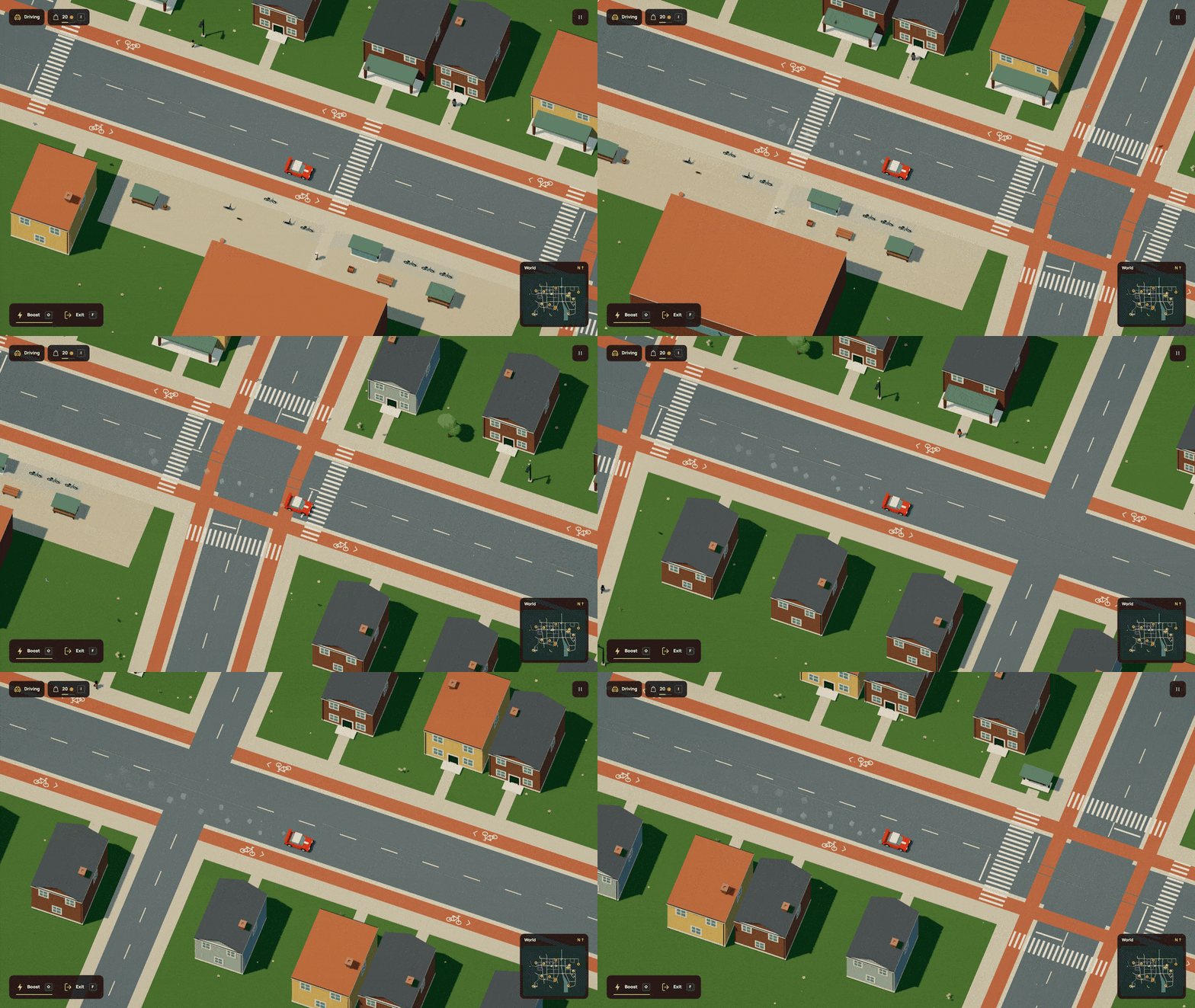
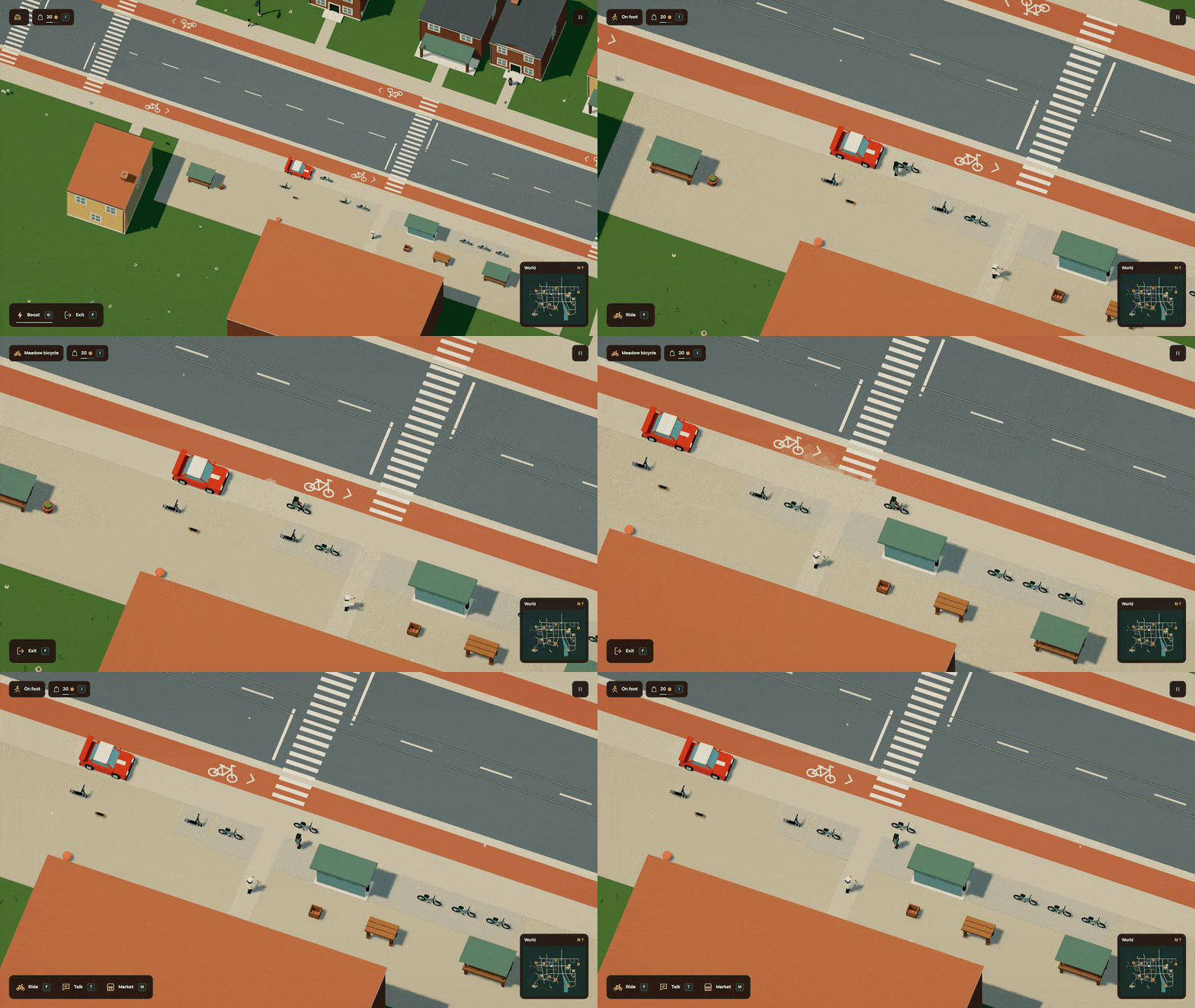
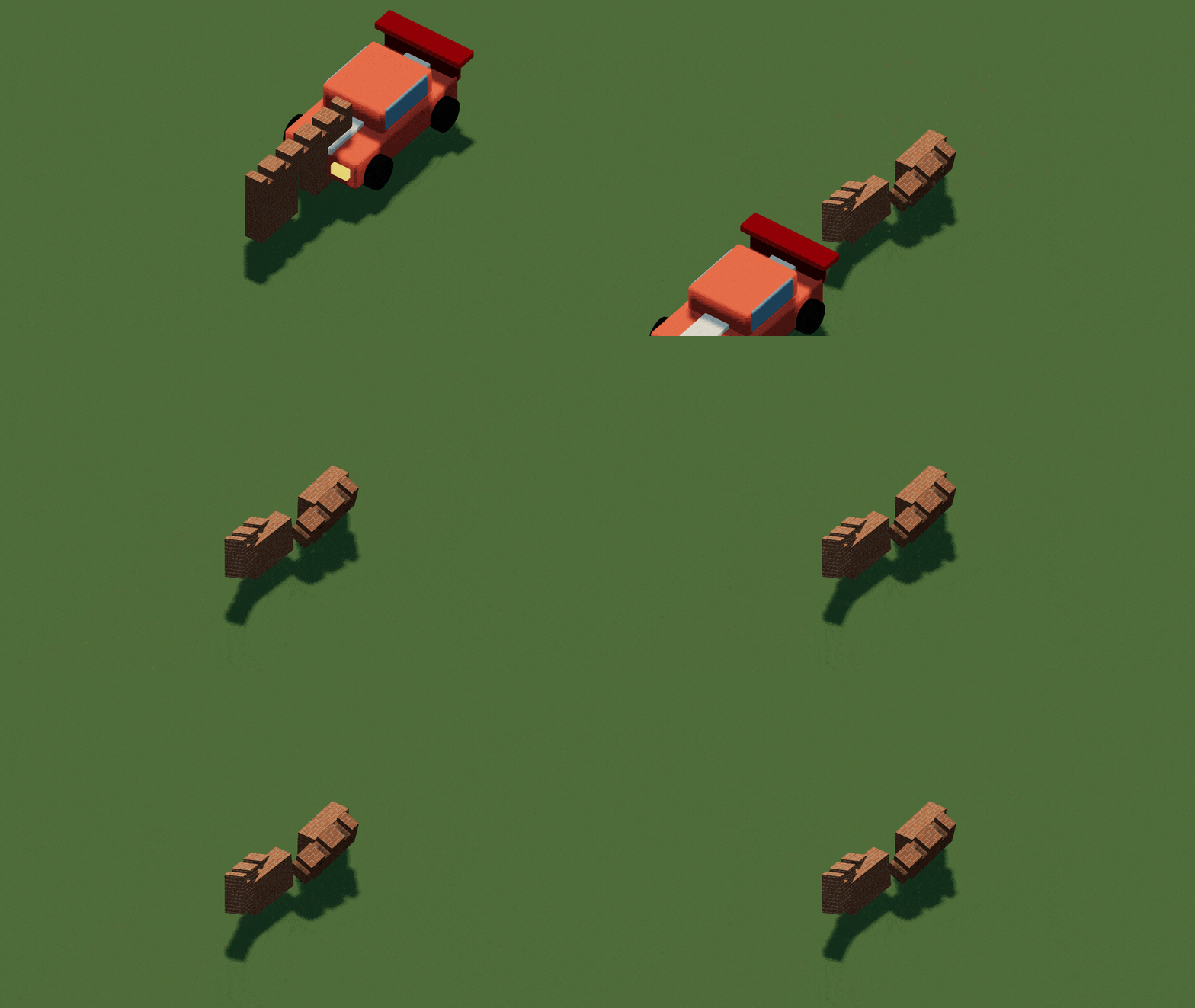
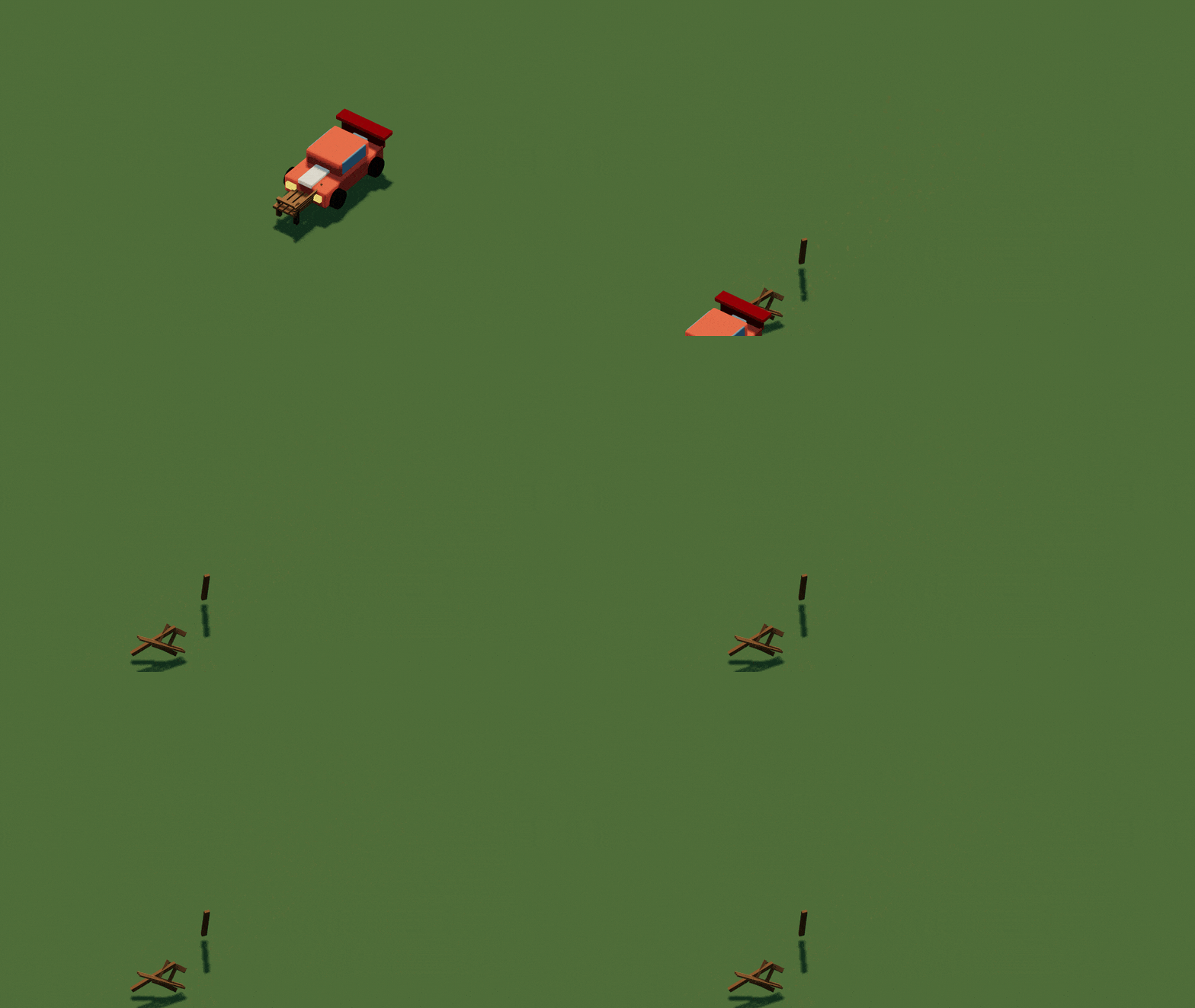
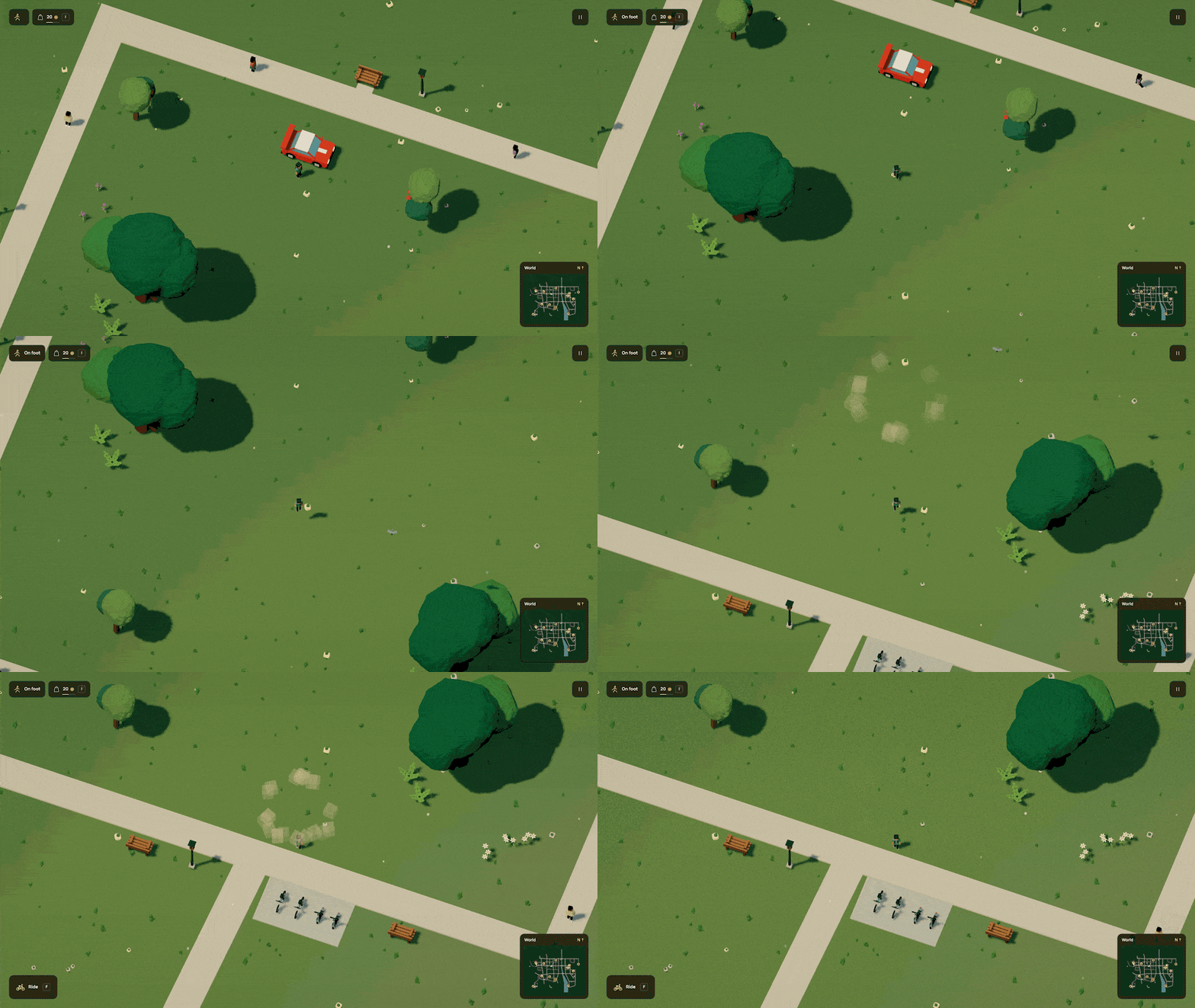
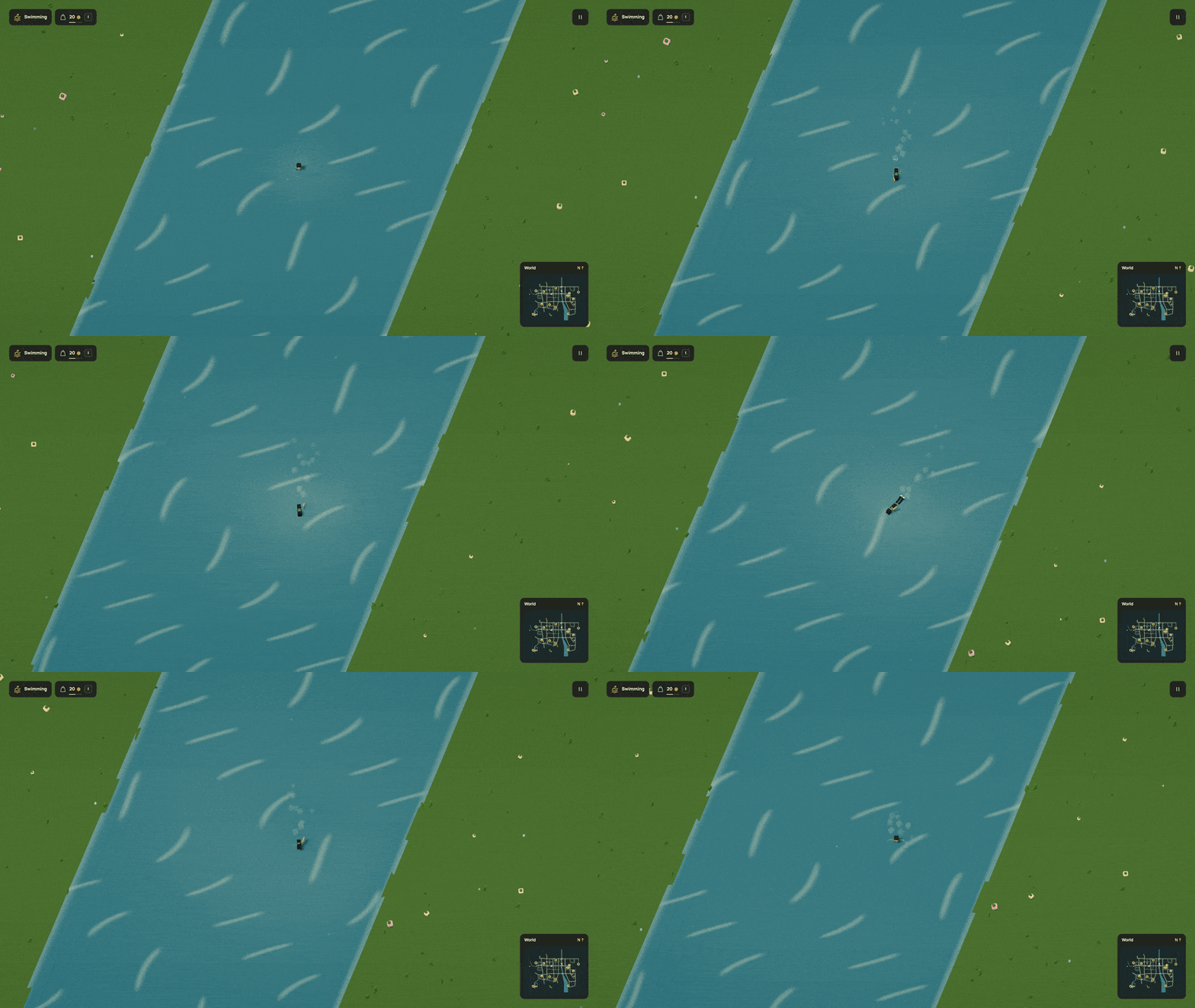
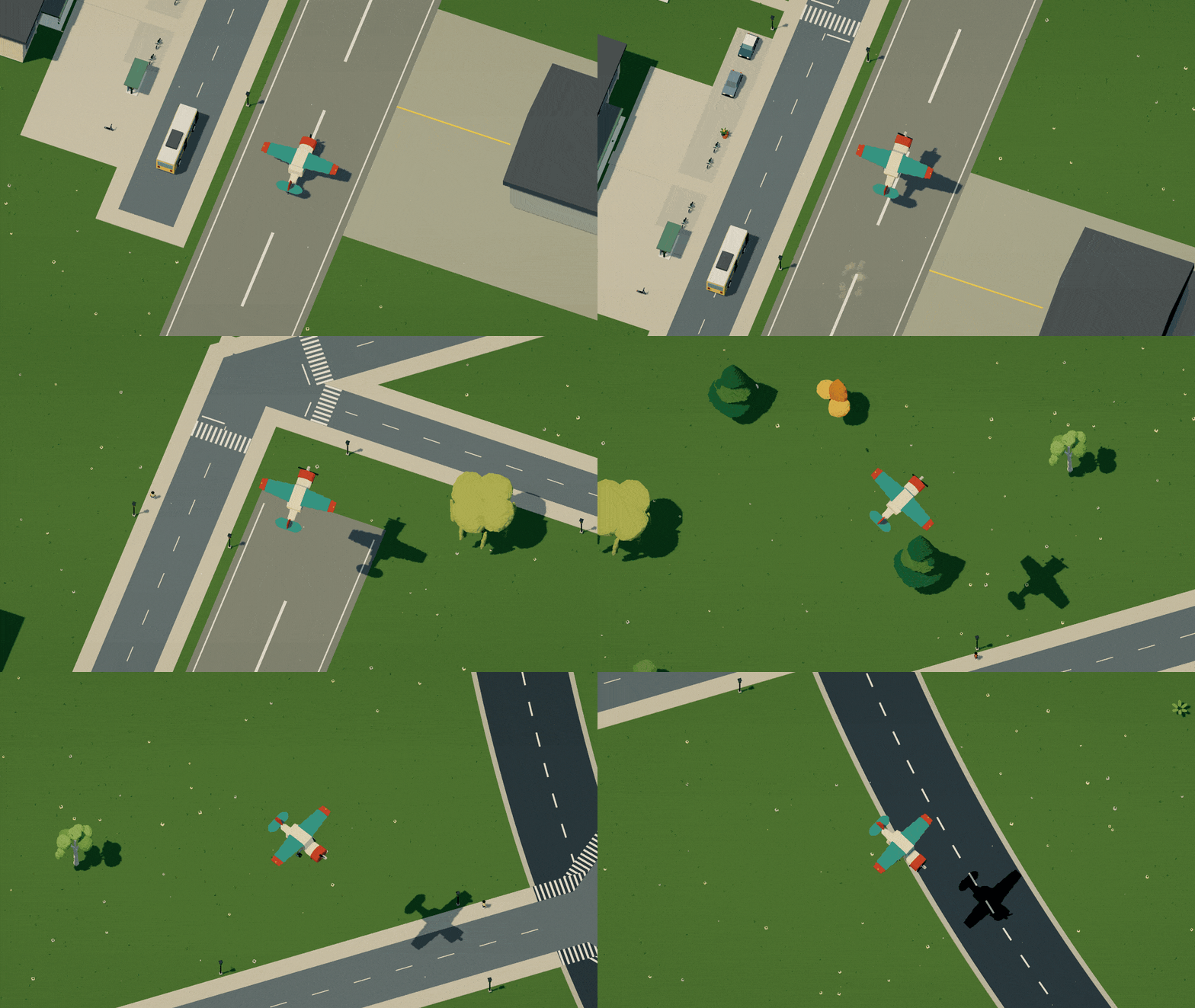
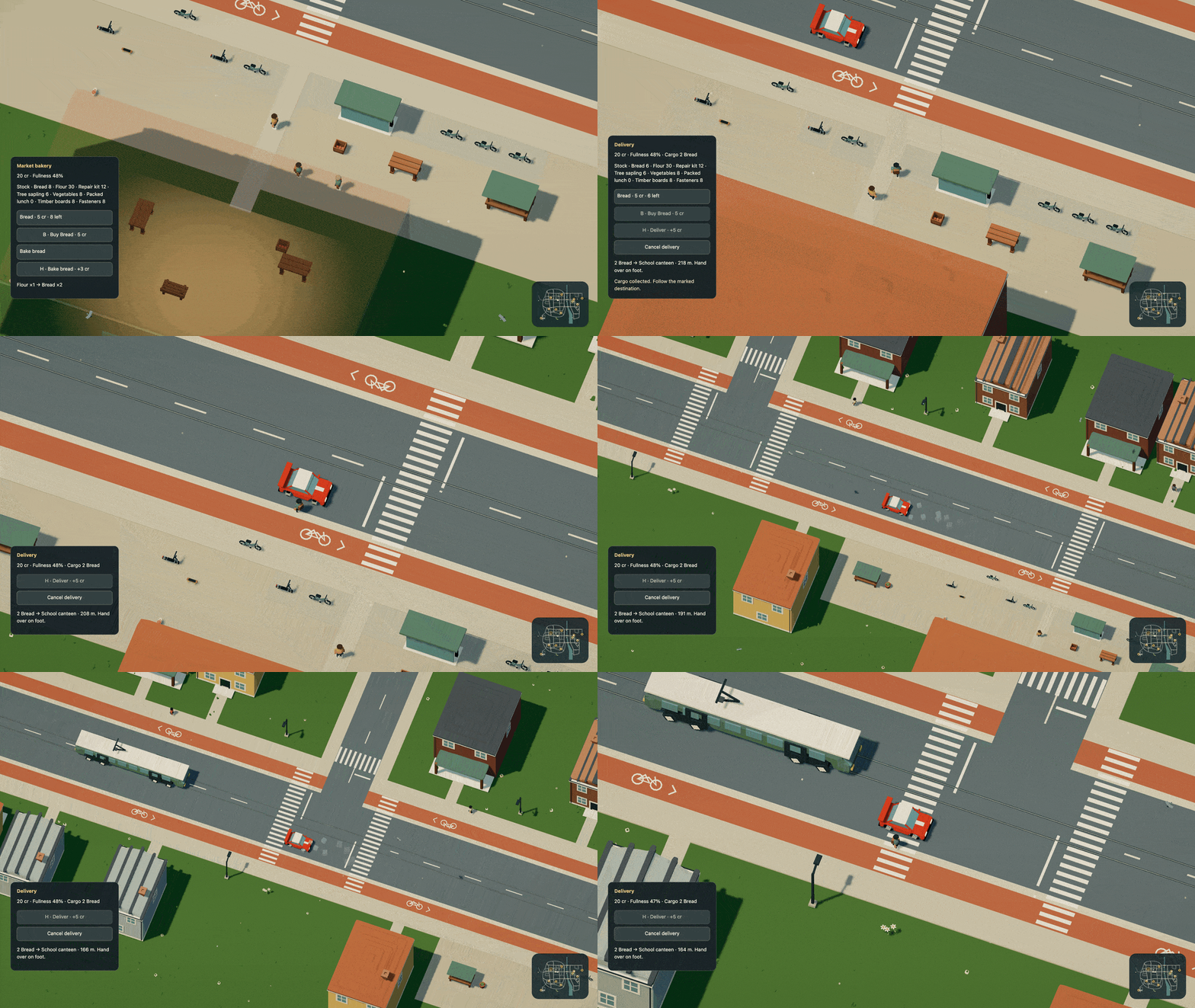
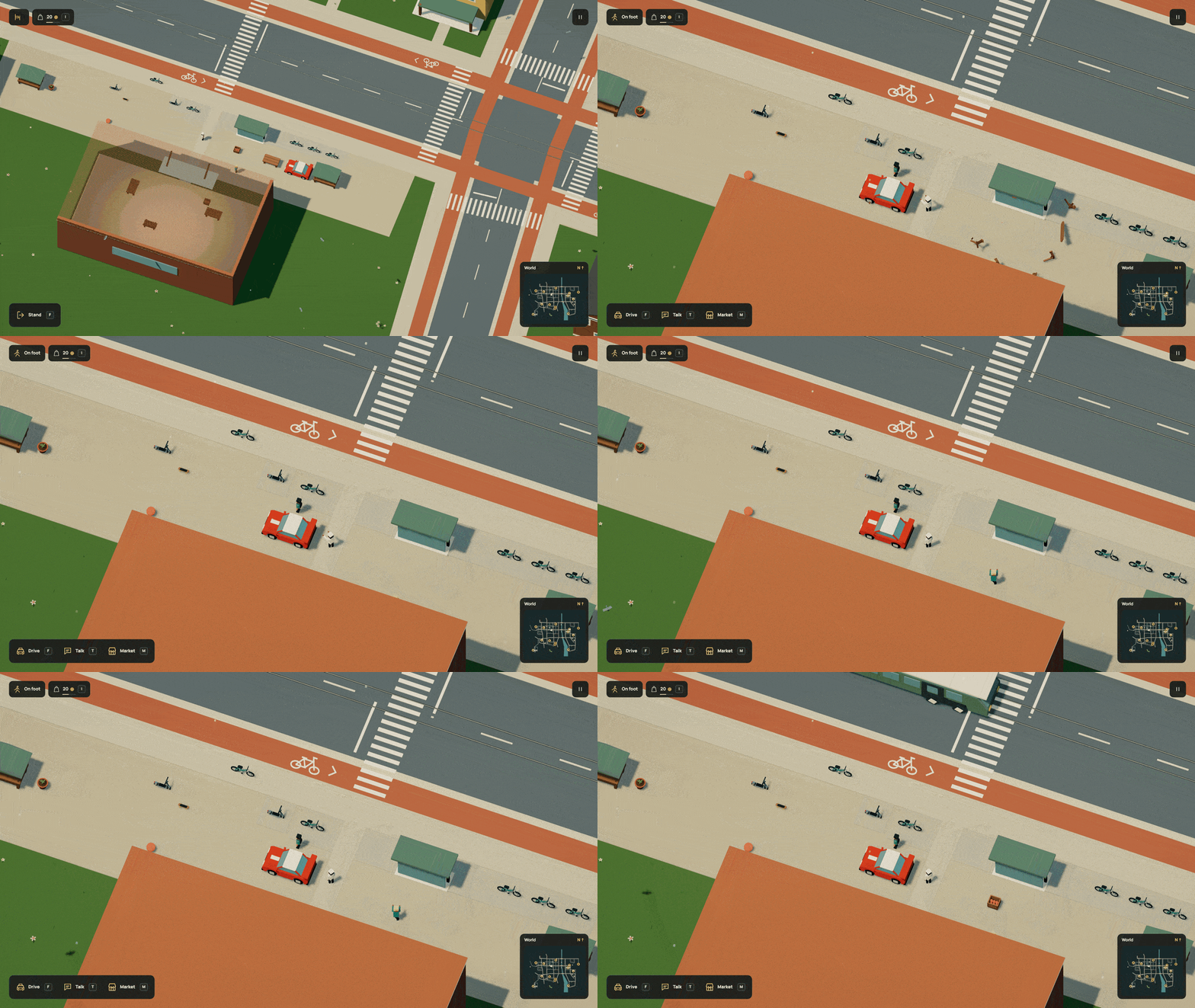
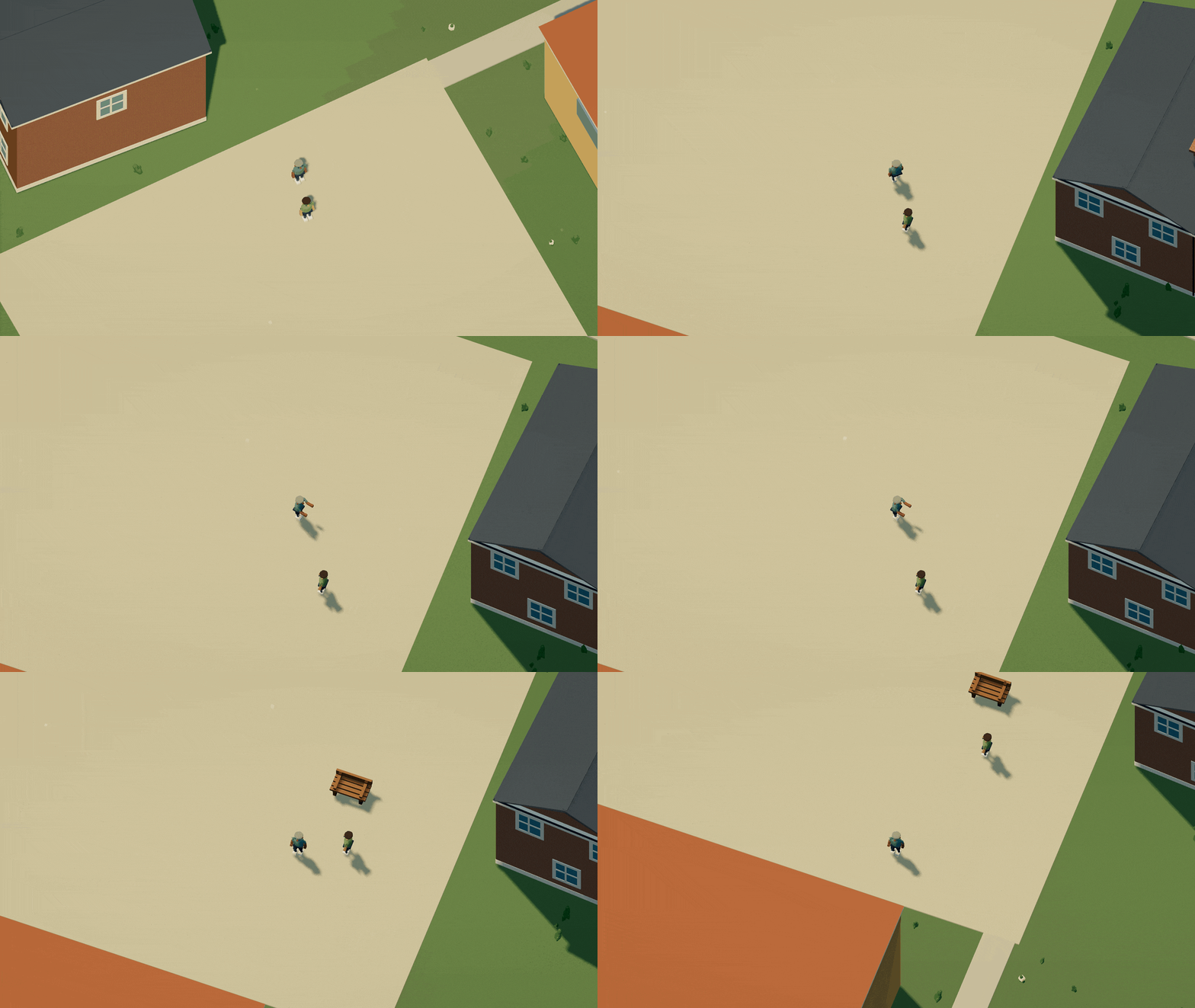
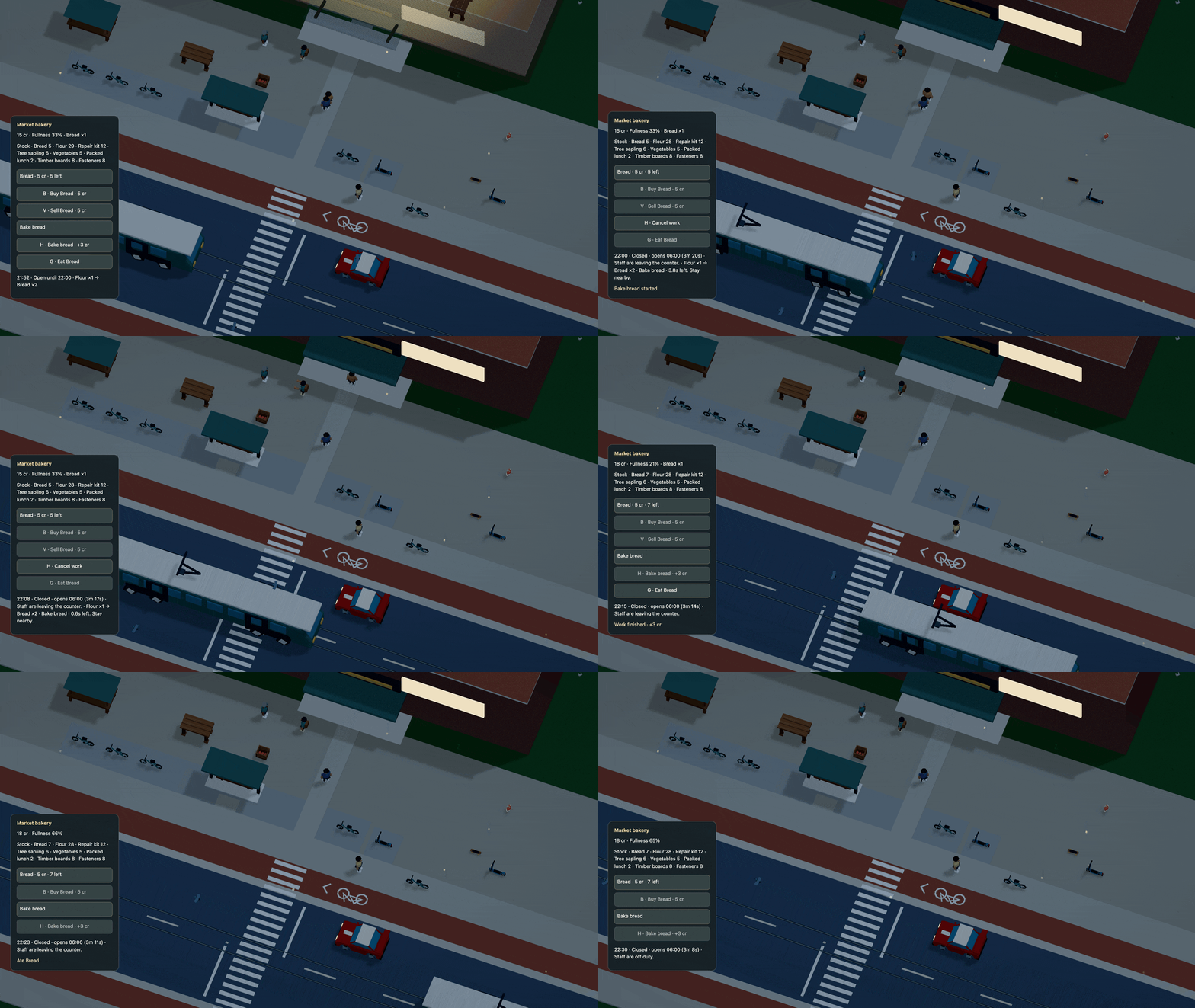
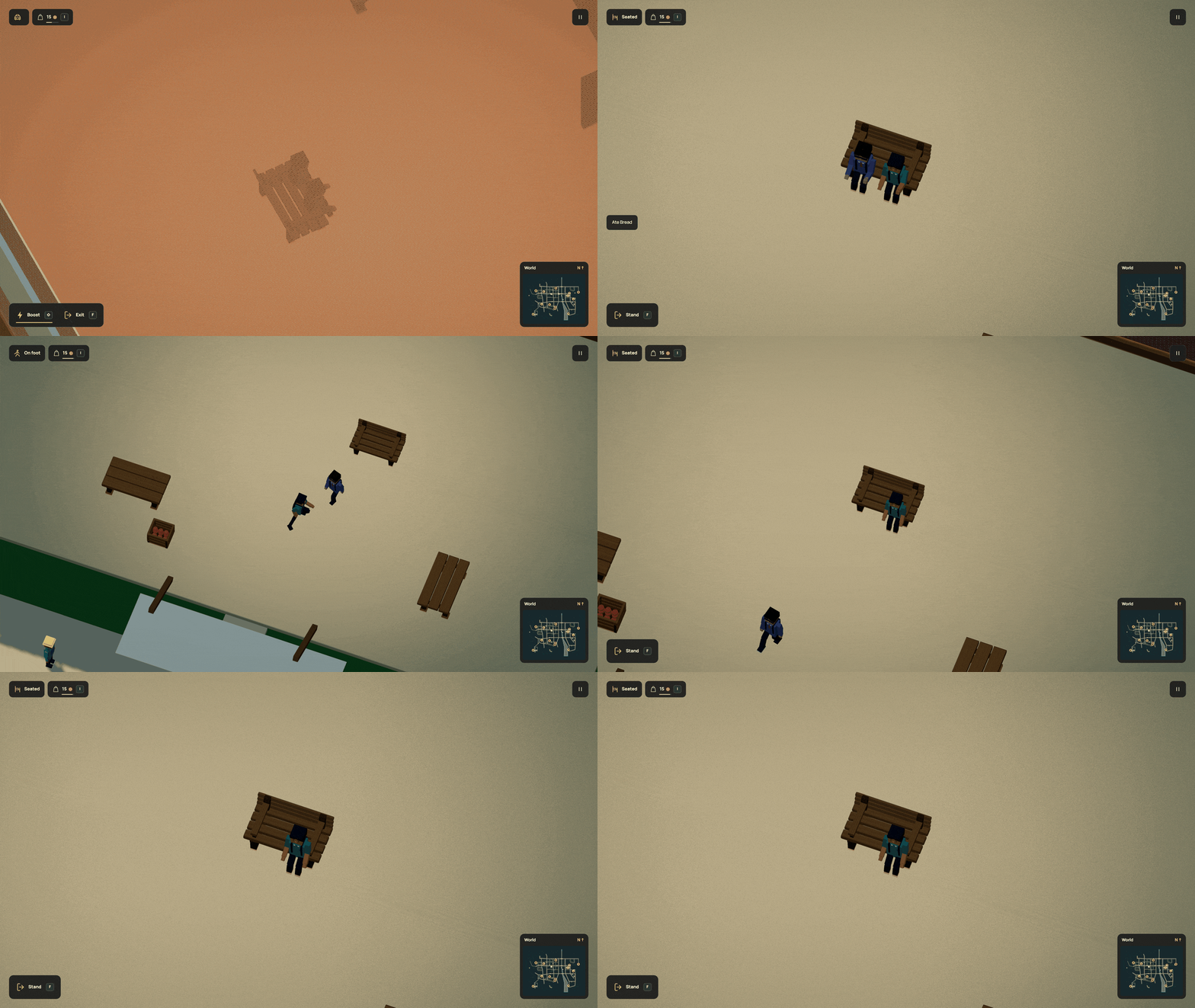
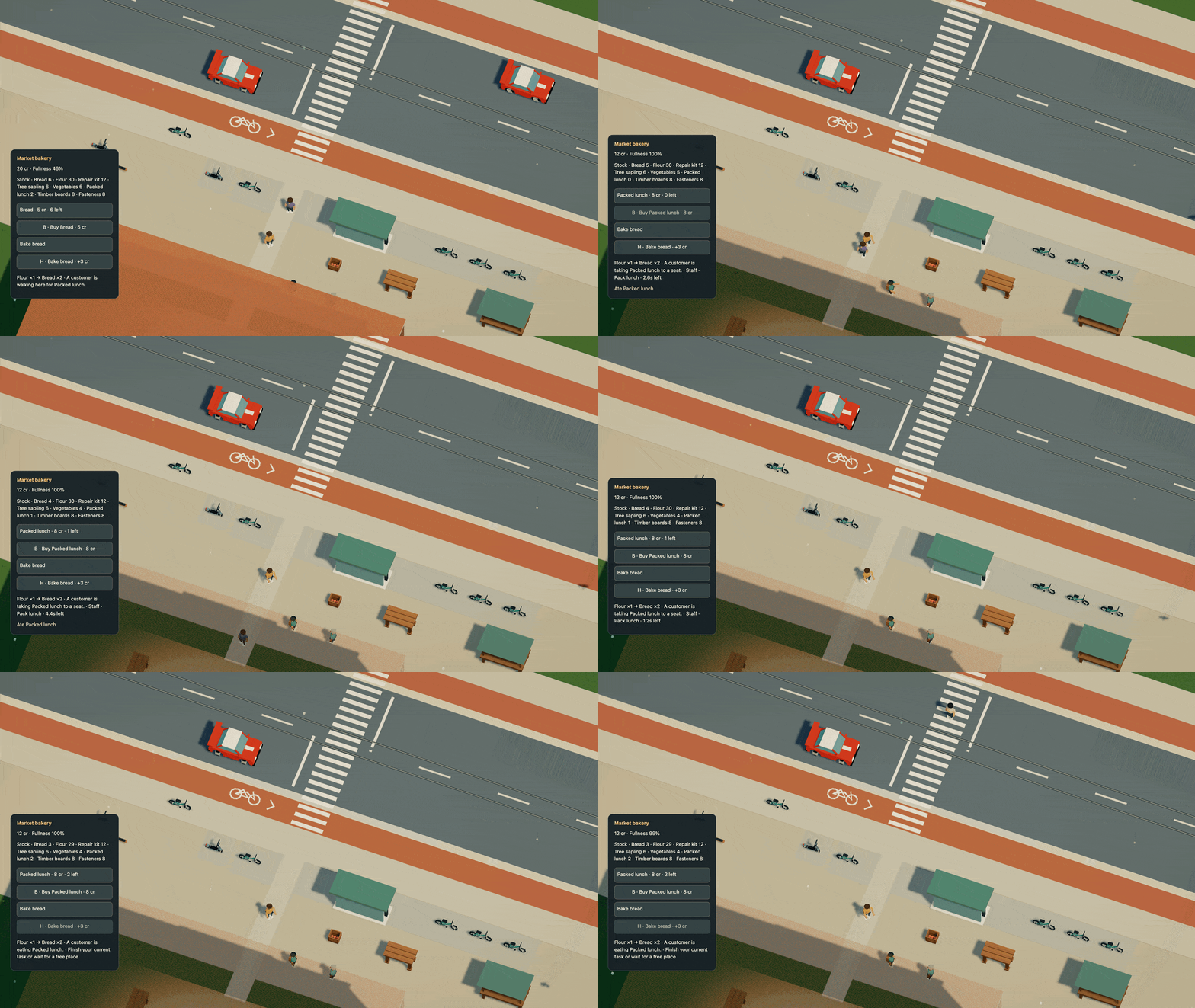
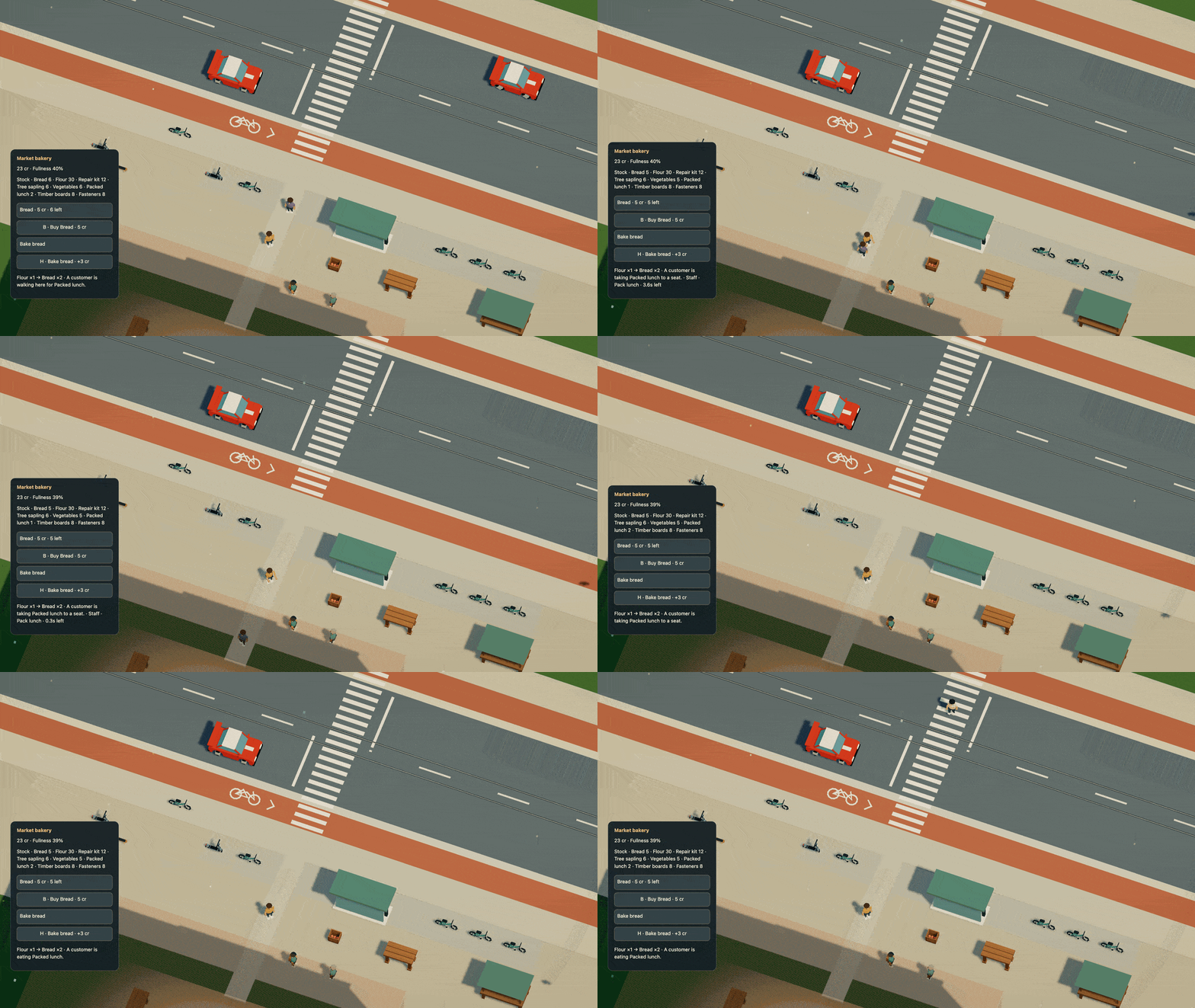
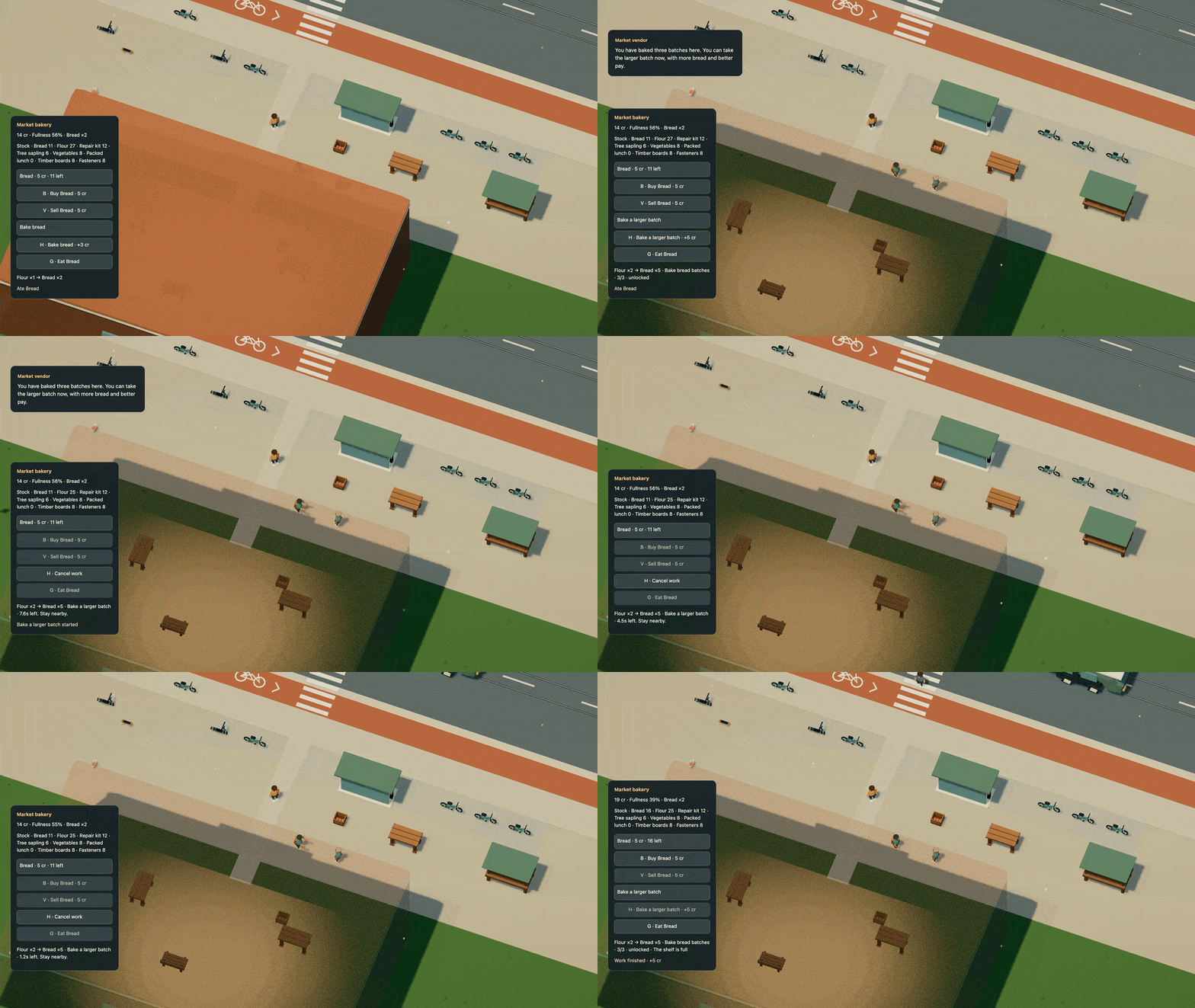
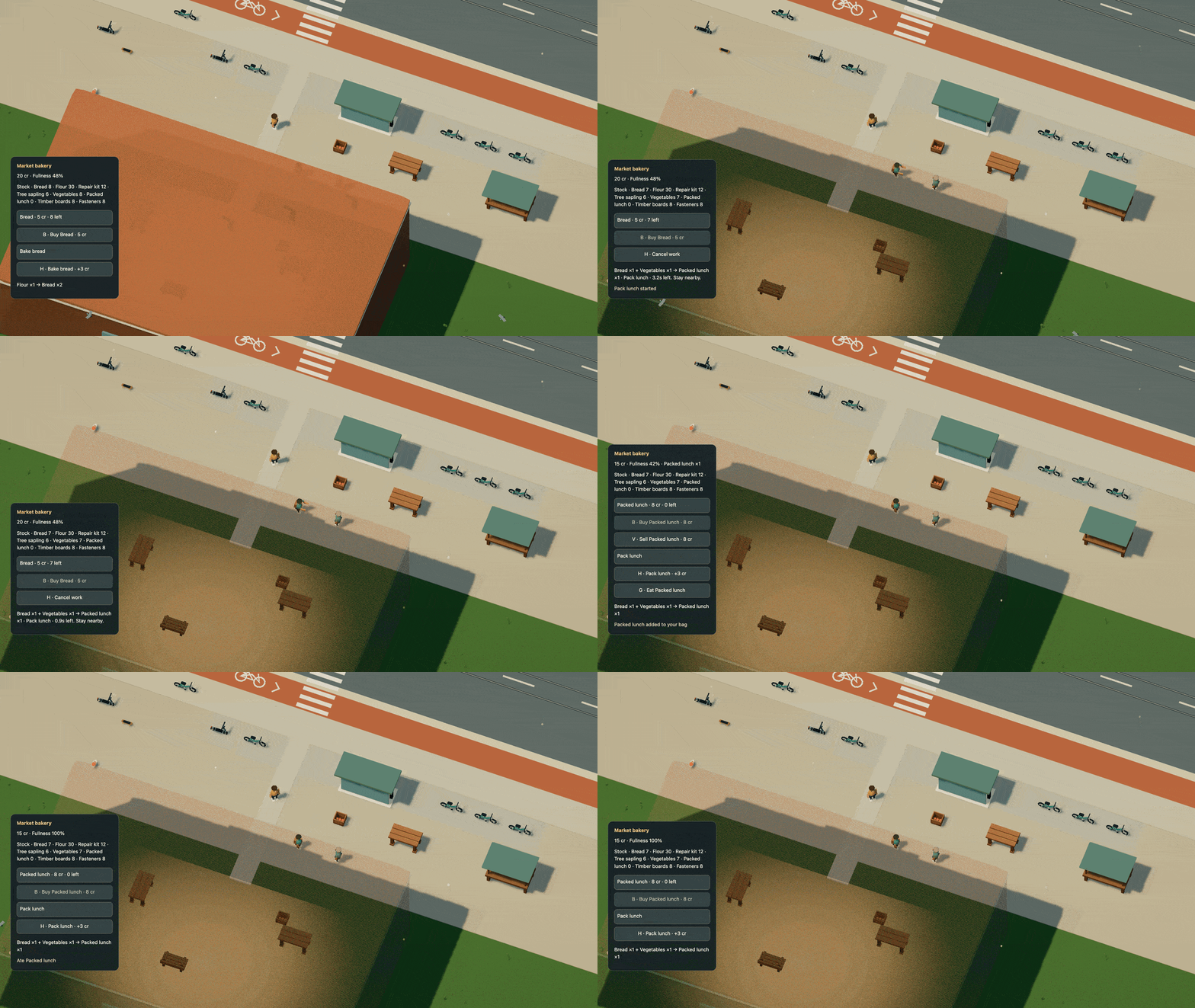
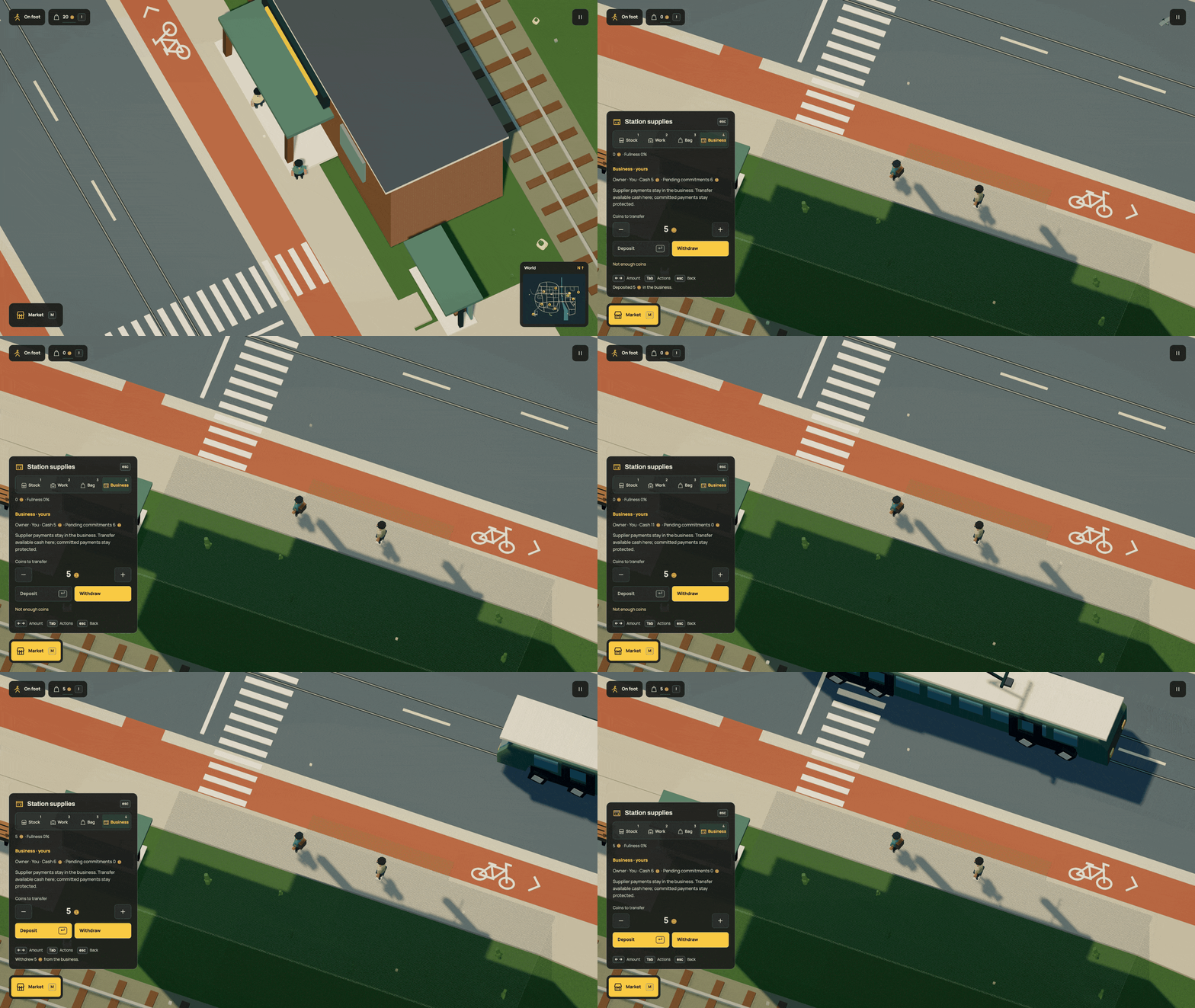
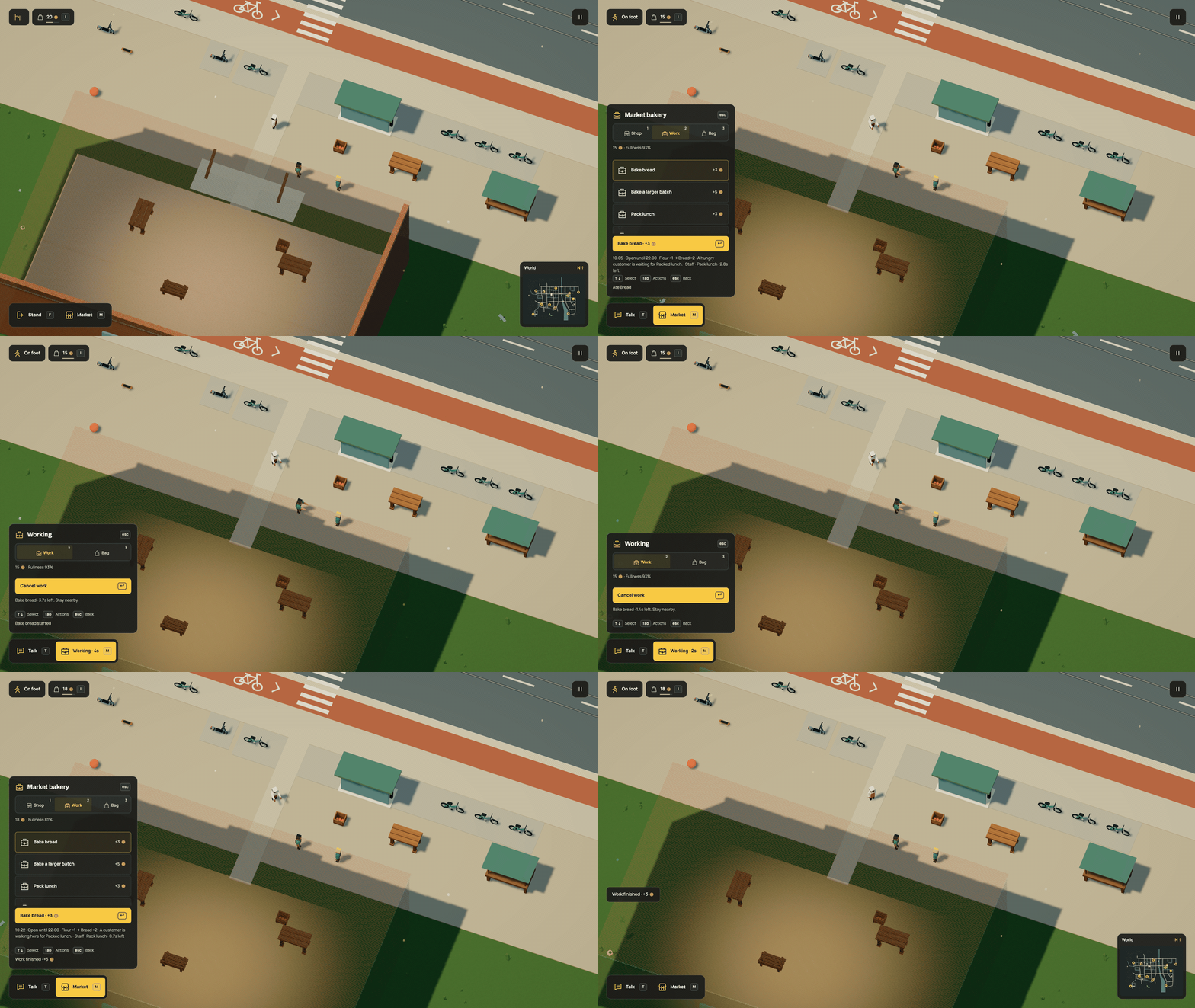
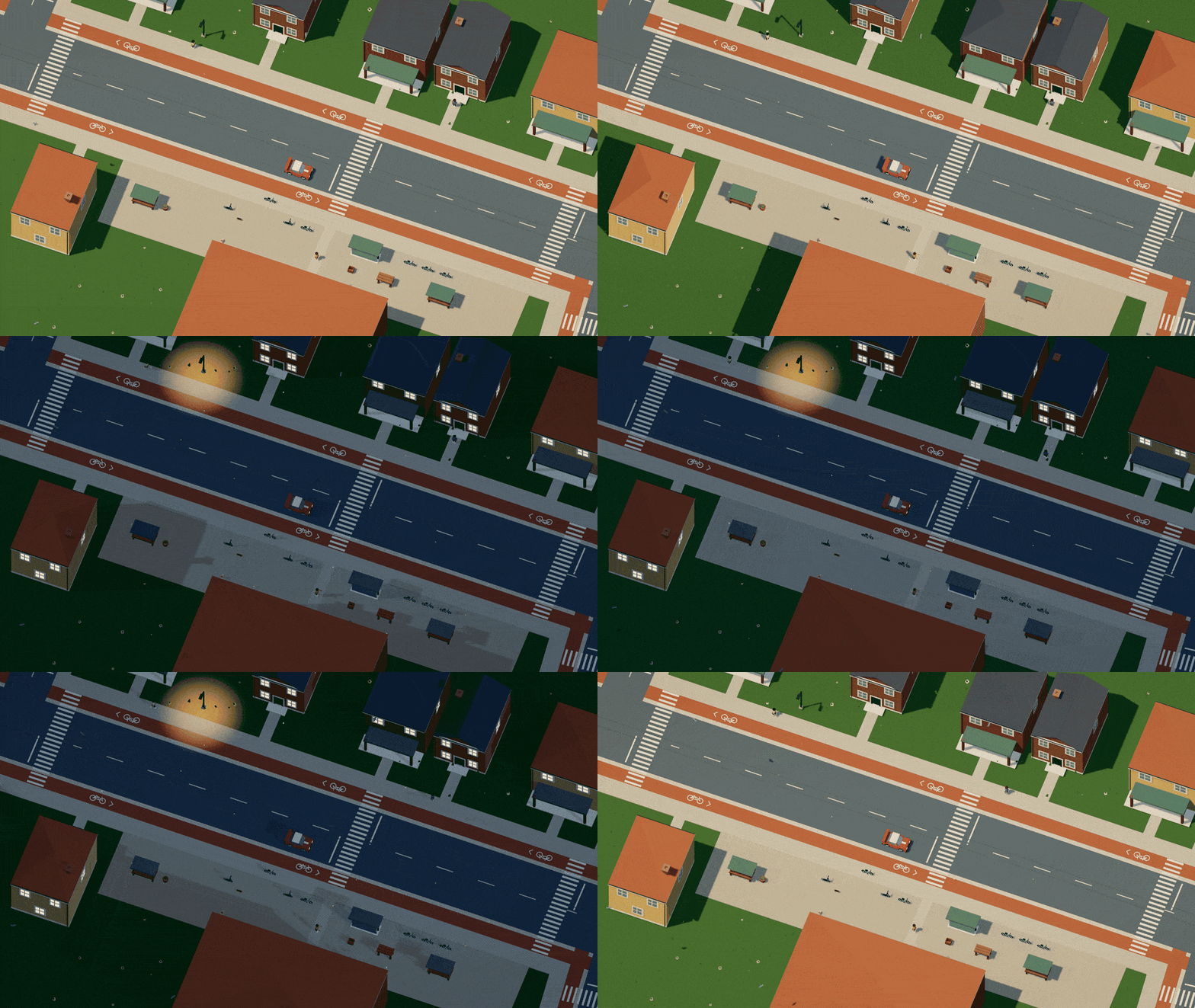
The main-game captures use the real simulation, follow camera, scenery, particles and post-processing. The destruction review replays fixed simulation phases. These are offline exports, not frame-rate benchmarks. GIF timing is rounded to hundredths of a second by the format; the video preserves the 30 fps clock.
Refresh the captures
Run npm run dev, then open http://127.0.0.1:5173/?capture. Choose driving, switching, locomotion, swimming, daynight or flight and press Capture PNG frames. Export destruction at http://127.0.0.1:5173/tests/visual/destruction.html?docs&capture.
The exporter advances the live renderer by 1/30 second only after the previous PNG has been saved. Frames go to .npm-cache/media/<clip>/. Its local Vite endpoint accepts only same-origin PNGs for the allowlisted named clips; it is absent from the production build. The capture layout is 1600 × 900 CSS pixels, with the renderer's existing pixel ratio applied to the source PNGs.
Encode after the selected clips finish, using local FFmpeg and Gifsicle installations:
node scripts/encode-media.mjs /absolute/path/to/ffmpeg /absolute/path/to/gifsicleAppend clip names to refresh only those captures, for example switching locomotion swimming. Refresh each selected clip's GIF, HD video and corresponding still together. jumping.jpg and swimming.jpg use original frames from their named clips.
The encoder checks for consecutive source frames before replacing a GIF and video. Generated dist-docs/ and .npm-cache/ files are excluded from the development watcher, so documentation builds, source-comparison archives and frame writes do not restart the game or interrupt a capture. Keep source frames local. Commit only the finished media. Still images use the original render or a native browser screenshot at its full resolution, with high-quality JPEG encoding where useful.
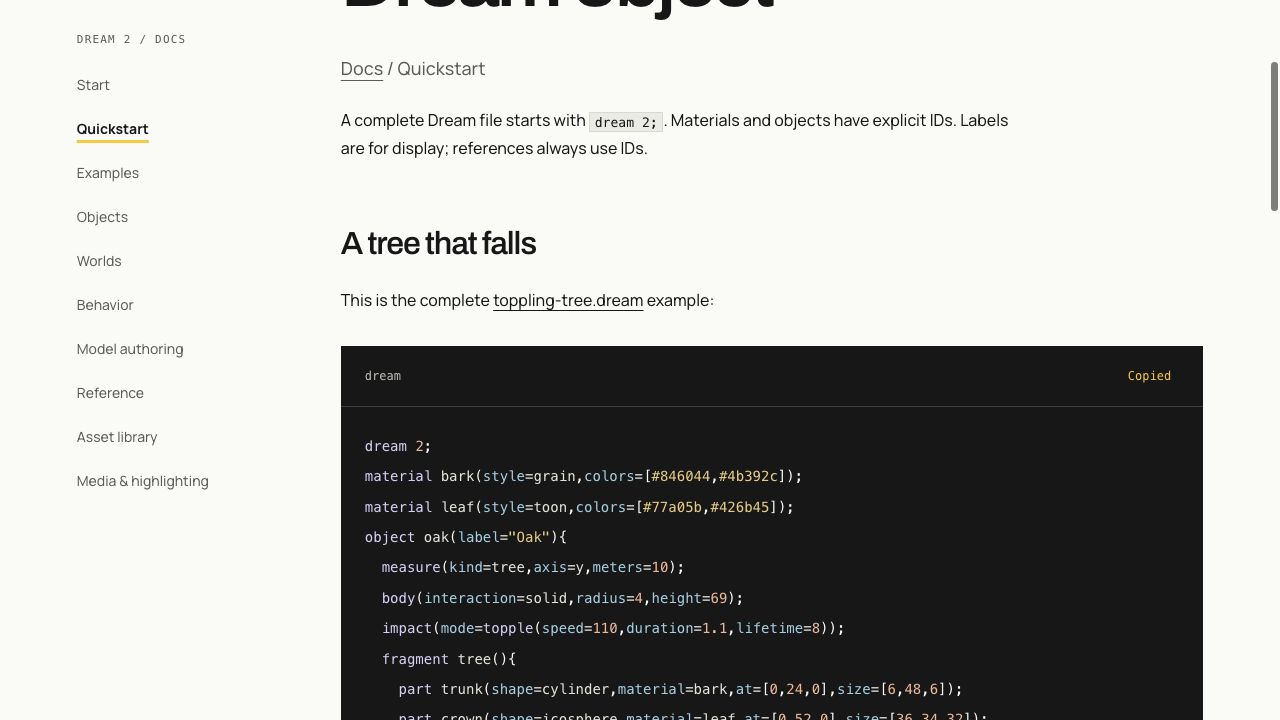
world.jpg, on-foot.jpg and riding.jpg come from the main game. cycle-meadow.jpg uses the terrain/road review. assets.jpg and assets-all.jpg use the Dream assembly gallery. woodland.jpg uses the gallery with ?all&asset=Standing%20deadwood&asset=Fallen%20log; repeated asset filters focus a review without changing the world. ecology.jpg, fauna.jpg and flora.jpg are focused native gallery captures of the new wildlife and plants. Sets of more than two focused assets use 360-pixel cards; single objects and pairs retain the larger inspection view. proportions.jpg uses the shared metre grid. code-to-tree.jpg shows the complete checked tree source beside its rendered result. pipeline.svg labels the planned sketch/Muse boundary separately from the implemented engine.
exploration-hud.jpg is a native main-game screenshot of the current HUD, with lap progress and checkpoint targets removed. This older screenshot predates the current keyboard HUD. Recent motion exports composite the visible HUD over the WebGL canvas.
The birch refinement refreshes birch.jpg, the complete assets-all.jpg atlas, the shared-scale proportions.jpg, the cycle meadow and HUD screenshots, both driving/switching GIF and HD-video pairs, and their world.jpg, on-foot.jpg and riding.jpg stills. The clips include a birch near the castle. The focused birch gallery uses ?all&asset=Birch&asset=Leaning%20birch; both trees are checked from four sides. See the media audit for captures kept unchanged and why.
Syntax highlighting
The documentation shares Minimum Effort's visual identity: Manrope body text, Archivo headings and wordmark, warm white #fafaf7, charcoal #171717 and yellow #f7c843. Page gutters use clamp(1.25rem, 6vw, 5.5rem) with a 1304-pixel maximum, the same spacing scale and a shared alignment for header and content. Code panels use the site's charcoal surface, with Dream tokens kept distinct and readable.
The tokens in docs/site/style.css follow Minimum Effort's src/app/globals.css and src/app/site-theme.css, checked against the live site. The Latin variable fonts are hosted with the docs, so reading needs no Google Fonts request. Font sources and their SIL Open Font Licenses are included in docs/site/fonts/README.md. Keep this identity when extending the docs.
The published documentation is built from the repository's Markdown using npm run docs:build. The custom Dream highlighter recognizes commands and nested constructors from the compiler's generated contract, named fields, symbols, numbers, colors, strings and comments. It preserves source text and escapes HTML before adding spans. Copy buttons copy the original code, without markup.
Use a dream fence in Markdown. Complete examples are checked by the compiler, and tests compare the guide's snippets with their downloadable source files. JavaScript is only needed for the copy button; highlighting and navigation are already in the generated HTML.
The site is published to GitHub Pages by .github/workflows/docs.yml. Relative links let the same output work under the repository subpath or in a local preview. The workflow runs the complete test suite with two workers and a 60-second test timeout: the full-world mesh checks take longer on GitHub runners. Test assertions and the local default timeout are unchanged.
GitHub's repository viewer has its own syntax system. Adding our grammar to this repository cannot change how github.com renders a dream fence or a .dream file. Native support there requires an accepted Linguist language and grammar. The highlighted site and code-to-object image provide the visual treatment now, while the README keeps selectable source and links to complete files.
Planned-world captures
town-center.jpg, suburbs.jpg, sports-park.jpg, basketball.jpg, golf-park.jpg and south-lake.jpg come from the live geometry review's native canvas, with untrimmed context captures retained in the verification record. urban-assets.jpg and the updated assets-all.jpg come from the same actual Dream gallery. Assets, turf, streets and shorelines are procedural engine output; these are not concept images. The README and planned-world guide link the corresponding Dream sources and current mock limitations.
NPC programs
npc-attention.jpg is a native screenshot of the actual game at
/?test-npc=vendor, with the market vendor watching the nearby walking player.
npc-people.jpg retains the standalone assembly gallery for Town pedestrian, Park visitor,
Football player, Basketball player and Park walker. The complete and urban asset atlases, town, sports park,
basketball court, golf and south-lake stills were refreshed after the people gained
faces and +X-facing assemblies. They retain native render resolution and JPEG 95
encoding. The new NPC guide contains the checked complete example.
The existing driving/switching and destruction GIFs, HD videos and stills remain
accurate: their visible geometry and prescribed actions did not change. The baker
and naturalist keep their continuous joint routines, now selected by Dream programs.
See the verification and media audit.
Connected transport world, r24
city-cycle-lanes.jpg shows the actual canal bridge, connected tracks and open junctions. connected-waterway.jpg shows the larger lake/river/bay/canal layout. Both use the native geometry-review canvas. Town, suburb, sports, basketball, golf and southern-lake stills were replaced for the new lanes and shoreline. cycle-meadow.jpg is retained as a historical capture; the live world no longer contains that oval and current product pages use the connected lane image.
Driving and switching were exported again at 30 simulation/rendered frames per second, and the GIF, HD video and world/on-foot/riding stills were refreshed together. The destruction review uses an isolated fixture with unchanged bench geometry, so its source frames remain accurate; the encoder regenerated the matching pair from those frames. Asset atlases, proportions, ecology, code-to-tree and birch/woodland captures stay accurate because this pass changes placement and infrastructure, not their assembly geometry. The HUD and NPC attention screenshot were refreshed for the expanded minimap and streets.
The transport verification keeps uncropped context, player-control checks, world counts and the matched local profiler report. These screenshots and offline recordings are evidence of rendered behavior, not a low-powered laptop benchmark.
River city, r26
The live layout was replaced, so the main-game driving, switching, locomotion and swimming GIFs, HD videos and their corresponding stills are refreshed together. The town, suburb, sports, basketball, golf, lake, cycle-crossing and waterway images come from the updated geometry review. city-assets.jpg shows the new civic architecture and transit assemblies from the actual Dream gallery; the live atlas is refreshed too. The map city-plan.svg is generated from the accepted Scene with node scripts/render-city-map.mjs, so its roads, footprints, entrances, stops and bridges cannot drift into a separate illustration.
The isolated destruction recording, tree/code example, flora/fauna galleries, birch/woodland details and physical-proportion comparison retain their existing valid geometry. Those images demonstrate unchanged asset definitions, not the removed city layout. Earlier media notes above describe historical passes; the city verification identifies the current captures and checks. No source frames are interpolated. Offline recordings do not measure browser frame rate.
r27 street populations, 2026-10-16
The population verification records the source fingerprint, coverage and limitations. Refreshed driving, switching, locomotion and swimming GIF/MP4 pairs use 210/240/180/180 actual frames at 30 fps, with matching world, on-foot, riding, jumping and swimming stills. Added street-assets.jpg and street-life.jpg; refreshed the 78-assembly atlas, source-derived city map and all district, sports, bridge and waterway scene views affected by the new populations.
Retained closeups show unchanged authored geometry: wood, birch, flora, fauna, proportions, civic buildings, people and isolated destruction. These do not claim to show a new world layout. The earlier evidence sections describe their own revisions.
r28 day and night, 2026-10-16
daynight.gif and daynight.mp4 use 360 actual rendered frames at 30 fps. The lighting clock advances through the full ten-minute cycle over twelve seconds; ordinary street activity retains normal replay timing. daynight.jpg is a matching native replay frame. city-day.jpg, city-dusk.jpg, city-night.jpg and city-dawn.jpg come from one fixed city-review camera at 10:00, 17:30, 22:00 and 06:30.
Driving, switching, locomotion and swimming GIF/HD pairs and matching stills were refreshed for the current renderer. Existing static district/asset views retain unchanged geometry and daytime appearance, while the new captures show the lighting states. The isolated destruction fixture is unchanged. The day/night verification records executed checks, browser evidence and limitations.
r29 aircraft, 2026-10-16
aircraft.jpg and four evidence angles show the rebuilt 31-part Cloudhopper. Refreshed assets.jpg, assets-all.jpg and proportions.jpg; the scale viewer uses the live Commuter after its former character was removed from the city. flight.gif, flight.mp4 and flight.jpg come from 300 actual main-game frames at 30 fps, covering takeoff, climb, banking and descent. Existing city and other-vehicle recordings retain unchanged visible geometry. The aircraft verification records the surface-overlap regression, runtime checks and limitations.
r30 ground vehicles, 2026-10-16
vehicle-kit.jpg shows the rebuilt rally car, town car, hatchback, delivery van, bicycle and scooter. Four gallery angles are retained with the construction verification. Refreshed the activity/full/street asset sheets and physical-scale comparison. Complete car and bicycle examples match the live assemblies; the Dream guides explain bounded extruded profiles and rigid distance-driven joints.
Driving, switching, locomotion, swimming and day/night GIF/HD pairs use 210/240/180/180/360 newly rendered frames, with matching world/on-foot/riding/jumping/swimming/daynight stills. Vehicle-visible district, transport and four lighting views, the HUD and NPC context are refreshed. The unchanged aircraft/airfield flight and isolated fixture destruction recordings retain their accurate geometry. Civic buildings, people, trees and wildlife sheets and the source-derived map are unchanged. See the verification record for counts, native-input checks and retained-capture reasons.
Prompt and task lab, 2026-10-16
dream-lab.jpg is a native full-page capture of /lab/, paused at step 22 of the default town exercise. Source, declared connections, service capacity, agent state and metrics are actual runtime output. It is a logical network dashboard, not a screenshot of agents controlling the 3D city. The verification record includes the exported browser episode and its headless replay. Existing world/asset stills and recordings retain their unchanged geometry and mechanics. The game only gains a Dream Lab link inside its pause menu; its ordinary HUD and recordings remain current.
Aircraft terrain contact, 2026-10-16
Refreshed the flight GIF, HD video and matching still together after changing aircraft terrain contact. Native hillside taxi/takeoff screenshots use the actual eastern heath and player controls; see the verification record. Aircraft geometry, the city layout, lighting and render settings are unchanged, so the asset gallery, scale lineup, city stills and other movement/destruction recordings remain accurate. The survey uses a cached underside profile; it does not add mesh collision for buildings or aerodynamic simulation.
r31 city services and regional airport, 2026-10-16
airport.jpg and east-medical-center.jpg are native geometry-review canvas exports, with complete viewport context retained in the verification record. city-service-assets.jpg and the four evidence angles show the new Dream assemblies. The complete 82-assembly atlas and HUD screenshot are refreshed; the latter includes the semantic destination markers.
The flight GIF, HD video and still are refreshed together using 300 newly rendered frames at 30 fps. This recording includes the rebuilt airport surroundings. The wide waterway overview is refreshed too. Existing car, bicycle, swimming, day/night and destruction recordings retain their accurate local geometry and behavior. The new roads and buildings sit outside those camera views; those clips export the WebGL canvas without the HTML minimap. Existing car/plane models, school and hospital models, wildlife, tree and scale galleries are unchanged. The source-generated city map includes the airport link, separate service access, new medical entrance and bus services. All captures show actual procedural geometry; no image generation or frame interpolation was used.
Voxel city, r32
voxel-assets.jpg and assets-all.jpg are native screenshots of the actual Dream
asset gallery. The atlas now contains 83 assemblies. voxel-park.jpg is the
untrimmed geometry-review canvas showing the two wall sections beside the existing
bench and connected park paths. Four-angle context images are retained in
docs/evidence/voxels/. The new voxel wall and updated bench recordings each use
120 actual rendered frames at 30 fps, with GIF, HD video and still refreshed
together. They are offline fixed-step exports, not live browser benchmarks.
Reviewed README, object/impact guides, language reference, model instructions, examples and generated highlighting contract. Existing airport/medical, vehicle, woodland, flora/fauna and movement captures remain accurate: their visible models, placements and mechanics did not change. City overview/day-night captures still illustrate the same layout, lighting and proportions; the new captures above show the changed shell/board construction. Historical evidence retains its original revision and counts. No prompting UI was added or removed.
Constructed buildings and transport, r33
constructed-assets.jpg shows the actual rebuilt terraced house, garden house, bus, tram, regional railcar and launch. Housing, civic/transit, voxel detail and complete asset sheets are refreshed. All images retain native browser/canvas resolution; geometry-review PNG exports are encoded as JPEG at quality 95.
Driving, switching, locomotion, swimming, day/night and flight use 210/240/180/180/360/300 freshly rendered frames, with each GIF, HD video and corresponding still refreshed together. Town/suburb, sports, water/bridge, street and four lighting views show the current models. The construction verification records retained captures and limits. Isolated destruction, existing ground vehicle/aircraft detail, flora/fauna and character assets retain unchanged geometry. These are procedural runtime captures, not concept images or frame-rate measurements.
Whole-world voxel construction, r34
The live city now converts every shaped asset and landscape surface through the
world voxel policy. voxel-world.jpg, voxel-hills.jpg, voxel-water.jpg and
voxel-vehicles.jpg show the current renderer. The full 83-asset atlas, focused
vehicle/building/transport/plant/wildlife sheets, connected city/bridge/waterway,
sports, airport/medical and four lighting views are refreshed from native browser
or canvas exports. The full atlas uses ?all&sheet, a 1600-pixel native export
layout that fits all rows inside the WebGL renderbuffer limit.
Driving, switching, locomotion, swimming, day/night and flight GIF/HD pairs and matching stills use fresh, consecutive source frames at 30 rendered frames per simulation second. These offline exports are not browser FPS measurements. Explicit-volume wall/bench destruction remains an unchanged standalone fixture without a world policy. The code-to-tree example, physical-scale comparison, source-derived map and logical Lab dashboard remain accurate standalone views. Earlier evidence sections describe their original revisions. See the whole-world verification.
The r34 timber curb follow-up preserves the small example's existing deck transition. Its native review is tests/visual/roads.html?voxel. The live city uses three stone bridges, so its current screenshots and recordings remain accurate; their construction is unchanged by the taper fix.
Trackpad framing
zoom-overview.jpg and zoom-close.jpg are native browser captures at the same player position and view angle, using the minimum and maximum manual car zoom. The pause-help capture in the verification record shows the new instruction. Default framing, world geometry, vehicle animation and lighting remain unchanged, so the existing 30 fps GIF/video pairs and their stills remain accurate. These screenshots demonstrate framing, not measured performance or a physical trackpad test.
Material finishes, r35
material-finishes.jpg shows the complete brick/oak/limestone example. The current 83-asset atlas, curated object sheet, constructed asset sheet, town/suburb, city cycle tracks, airport, medical center, sports, lake/waterway and four lighting views are refreshed from native browser screenshots or the review's Save PNG action. Evidence includes the terrace from four sides and a bakehouse section breaking into eight pieces.
All eight motion sets use new consecutive 30 fps frames: driving 210, switching 240, destruction 120, voxel wall 120, locomotion 180, swimming 180, day/night 360 and flight 300. GIFs, HD videos and their stills were refreshed together. The source frames are actual renderer output, not frame interpolation or a live performance benchmark.
The map, scale lineup, code-to-tree, logical Lab, focused wildlife/plants and dedicated car/bicycle/aircraft views retain their unchanged geometry and materials. Older focused city sheets remain construction references; the refreshed atlas and material example show the current finishes. The zoom/controls captures retain the same framing and mechanics; their earlier background paint is superseded by this pass. Material verification.
Manual car boost
boost.gif and boost.mp4 use 210 actual frames at 30 fps. The car accelerates,
then Shift triggers a single burst. Native screenshots car-boost.jpg and the
refreshed exploration-hud.jpg show the new control; the verification record
also keeps active, recharging and small-screen states. Existing canvas-only
recordings remain accurate because they don't boost a car or include the changed
HTML HUD. World geometry, assets and their stills are unchanged. The
boost verification records checks,
encoding and limits.
Walk-up sports, r36
football.gif / football.mp4 and basketball.gif / basketball.mp4 use 240
and 210 consecutive frames at 30 fps, with matched practice stills. Native
source frames are 2400 × 1350; videos are 1600 × 900 and GIFs 960 × 540, without
interpolation. Separate native HUD screenshots show the shot control, gold
power band and scores. The football park, both basketball image paths and full
85-assembly atlas are refreshed. sports-assets.jpg and four retained gallery
angles show the new balls and connected horizontal hoop.
Existing movement, boost, day/night and destruction recordings retain their unchanged local geometry and actions. Canvas exports exclude the updated HTML map legend and pause help. Other district, vehicle, material and flora/fauna captures do not show the modified grounds. Historical evidence retains its original revision. The sports verification records native controls, retained-capture reasons and the solo-practice limits.
Aircraft world-edge recovery
The boundary verification keeps native before/edge/returned screenshots with the actual controller readings. README and movement docs now explain steering back from edges and corners. The existing flight GIF, HD video and matching still remain accurate: that runway departure and bank stay inside the world, so their movement is unchanged. All other world, asset and action media retain their existing geometry and behavior. No new offline recording or performance claim was needed for this fix.
Shared interaction rules, r37
The rule verification keeps
native square/round table impacts under one shared policy, a gentle touch and
the older bench before/after its boards detach. Four bench angles retain the
construction review. These captures opt into the measured town car in the
isolated impact viewer. Existing action GIF/HD/still sets, city imagery and
asset sheets remain accurate: live furniture parameters and placements are
unchanged, and the older bench's intact geometry/materials keep their shape.
Its new destruction ownership is shown in the new guide and evidence.
rule-square-table.jpg, rule-round-table.jpg and rule-supported-bench.jpg
are unchanged copies of those native captures for the published guide.
Articulated characters · 2026-10-17
character.gif, its HD video and character-motion.jpg show the actual Explorer rig walking, running and crawling side by side. The close-up uses 180 newly rendered frames at 30 fps. The nine main-game GIF/HD pairs are refreshed too: driving/boost 210 frames each, football 240, basketball 210, switching 240, locomotion/swimming 180 each, day/night 360 and flight 300. Matching stills are refreshed with their recordings. No interpolated frames or image generation.
The full asset atlas, city-people.jpg, shared-scale lineup and NPC context now show the bound civic characters. Other model detail sheets, the city-layout map and isolated destruction/voxel wall clips retain unchanged content. The animation verification separates tests, native controls, capture counts and limitations. Offline frame exports are not performance benchmarks.
hill-taxi.png preserves the existing native aircraft-terrain screenshot in the published media directory, fixing its former evidence-folder image embed. Its geometry is unchanged.
World audit, r40
Street bends, crossing paint, boost placement and access to sports grounds and school yards were audited in the real world. The verification record retains matching before/after views and four public-space asset angles. public-space-assets.jpg shows the supported shelter seat, mounted hoop, table crossrails and market stall. The complete atlas and sports asset sheet reflect the same source. The source-derived map, affected district and four lighting stills are refreshed.
Driving, car boost, football, basketball, switching, locomotion, swimming, day/night and flight GIF/HD pairs and their matching stills use newly rendered 30 fps source frames. Existing isolated bench and voxel-wall destruction recordings remain accurate, as do focused galleries of unchanged vehicles, architecture, character motion, materials, plants and wildlife. These captures are rendered evidence, not a laptop benchmark.
Road overlaps, r41
The road verification keeps matched native views of the circuit joins and whole bicycle symbols. Refreshed the source-derived map, city/recreation/bridge/airport/medical views, voxel city/park/ water views and four fixed lighting states. The HUD uses the revised map polygons.
Driving, car boost, switching, walking/jumping, football and day/night recordings use 210/210/240/180/240/360 fresh source frames respectively, at 30 rendered frames per simulation second. Their GIFs, HD videos and matching stills are replaced together. Basketball practice, swimming and aircraft clips retain unchanged local geometry: their cameras stay around the court, canal and airport/flight corridor, away from the repaired circuit joins and crowded glyphs. These canvas exports do not include the HTML minimap. Focused asset, character, material and destruction galleries are unchanged. No performance benchmark or interpolated frames.
Fuller city and habitats, r42
The population verification
records 1,695 accepted placements, unchanged engine limits and matched local
rendering observations. city-residents.jpg shows four new resident variants;
population-assets.jpg shows the dog, cat, sparrow, meadow grass and hydrangea.
Both sets were reviewed from four angles. assets-all.jpg now shows 103
reusable assemblies. City/recreation/transport and four lighting stills, the
source-derived map, voxel terrain/park/water views and clean HUD are refreshed.
Additional population-*.jpg views show native habitat and hospital context.
Focused galleries of unchanged vehicles, original wildlife/flora, architecture,
materials, shared proportions and character mechanics remain accurate.
All nine main-game GIF/HD pairs use newly rendered source frames at 30 fps: driving/boost 210 each, football 240, basketball 210, switching 240, locomotion/swimming 180 each, day/night 360 and flight 300. Matching stills are replaced with them. Isolated bench and voxel-wall destruction clips are unchanged. No interpolation, image generation, per-instance geometry simplification or camera-based world unloading. The offline exports are separate from the local 300-sample rendering comparison and are not performance measurements.
Moving ground populations
The added 111 sidewalk residents now walk, and 60 ground animals and birds roam and
react to nearby players. pedestrians.gif / .mp4 use 360 newly rendered frames,
as do wildlife.gif / .mp4. Their matching JPEG stills come from frames 180 and
30. The deer clip shows initial flight and later recovery; the pedestrian clip
shows movement along the actual paving. Source PNGs remain local, without frame
interpolation. These offline recordings do not measure live performance.
The nine main-game motion sets are refreshed at 30 rendered frames per second:
driving/boost 210 each, football 240, basketball 210, switching 240,
locomotion/swimming 180 each, day/night 360 and flight 300. Each GIF, HD video and
matching still is updated together. The dog and cat now have four walking hip
joints; population-assets.jpg and assets-all.jpg show their current geometry.
Four native asset angles and the two motion sequences are in the
movement verification.
The source-derived city map, architecture, roads, plants, physical proportions, character-only motion and isolated destruction examples retain their accepted geometry. Their existing captures remain accurate. Existing district stills show the same layout at a particular moment; the new clips demonstrate moving populations. A separate native browser profile compares full-quality driving, with all members resident and the same pixel ratio, viewport and inputs.
Startup screen
The loading screenshot is a native browser screenshot taken while the live world was actually being constructed. Startup now uses the same bundled Manrope and Archivo files and warm-white, charcoal and yellow identity documented above. Column faces gained indices; the represented surfaces, asset shapes, clocks and animation controls remain unchanged. Existing gameplay recordings and their paired stills remain accurate, so this pass does not replace them.

Streaming and continuous contours
The streaming pass refreshes driving, boost, switching, locomotion, swimming, football, basketball, flight, daynight, pedestrians and wildlife as paired GIF/HD video exports, with their corresponding stills. All source frames were rendered at 30 per simulation second. This run produced native 1600 × 900 PNG frames; the media audit records frame counts, pixel dimensions and write times. No frames were interpolated. Exports hold while required chunks are missing and do not establish live frame rate.
world.jpg and voxel-world.jpg share the new driving still. voxel-vehicles.jpg
and voxel-contours.jpg use the native four-angle car, bicycle, plane and house
review. Untrimmed captures remain in the evidence.
loading.png shows the real first-neighbourhood loading phase. The follow-up
water/bridge review replaces swimming GIF/video/still and voxel-water.jpg after
fixing persistent water paint, continuous bridge tops and water seams.
The explicit fill/cut destruction clips, architectural construction examples, material examples, proportion references, maps and original terrain closeups were reviewed. They retain useful coverage of unchanged authored dimensions, exact carved cuts, finishes, layout and stepped ground. Their dated verification records remain historical evidence; use the refreshed world/vehicle captures above for the current contoured appearance. Dream vocabulary and its checked examples are unchanged by streaming.
Night visibility
The night pass re-exports all 360 frames of daynight.gif and daynight.mp4
at 30 rendered frames per simulation second. daynight.jpg is frame 240;
city-day.jpg, city-dusk.jpg, city-night.jpg and city-dawn.jpg use frames
30, 117, 180 and 300. The new source images are native 2400 × 1350, with no
interpolation. Earlier streaming recordings used 1600 × 900 inputs. The night verification
keeps the earlier still and current native town view. Geometry, daytime light,
controls and the other clips retain their accepted contracts; those captures
remain accurate.
Conversations and saved progress
conversation.gif, conversation.mp4 and conversation.jpg share 240 native
2400 × 1350 source frames, rendered at 30 frames per simulation second. The still
uses frame 60. The dev exporter composites the currently visible caption's actual
text, bounds, font and colours over that frame's renderer canvas; it does not
interpolate motion. Its temporary 2D buffer is released when export completes.
return-greeting.jpg comes from a native browser screenshot of the reload.
The original save controls are preserved in the conversation evidence.
README, NPC guide/reference/model instructions, generated contract, systems priorities and saving guide were refreshed together. Existing asset, movement, destruction, lighting and population captures retain their represented geometry and controls; the new contextual reply is shown in this dedicated sequence.
Backups and compatible updates
save-menu.jpg and backup-preview.jpg are refreshed from native 1280 × 720
screenshots of the production build. The pause menu keeps Controls collapsed;
Backups opens a local file preview before any restore. Source PNGs and browser
state checks live in save continuity evidence.
There is no image upscaling or interpolated motion. That iteration added save tooling with native UI stills. The market pass below
refreshes these stills and the conversation sequence for the new pocket status
and vendor wording.
The playable market
commerce.gif, commerce.mp4 and commerce.jpg share 360 actual source frames
at 30 rendered frames per simulation second. The exporter presses the same buy,
eat and work controls used by the live UI. It composites visible market/speech
text and buttons from their DOM bounds/styles over the rendered canvas; it is
not a general HTML rasterizer. The conversation GIF/video/still are refreshed
together for the new nearby market UI. Save-menu/backup-preview stills are also
refreshed for the pocket status. No interpolated frames or offline FPS claims.
Verification.
The remaining driving, switching, locomotion, swimming, sports, lighting, wildlife and destruction captures retain the same represented geometry and controls. Their review starts carry no bought food and are outside the market interaction area, so the contextual market panel stays hidden there.
Delivery work
The delivery pass refreshes commerce and conversation GIF/video/poster together for the work selector, then adds delivery GIF/video/poster. Delivery uses 360 actual rendered frames at 30 per simulation second. Its development-only script selects the bread job, collects it, walks to the car, boards, reverses and exits. The visible market panel and live map canvas are composited over the actual renderer frame; the map line points directly to the destination. It is not a route solver or a recording of the complete trip. Native browser checks cover the real journey, handoff and reload separately. No interpolation or FPS claim.
All three UI clips use 1280 x 720/256-color GIFs and matching 1600 x 900 videos.
Existing asset, movement, sports, lighting, destruction and population captures
retain the represented geometry and controls. Pause/backup stills without cargo
retain their visible controls; a new native cargo view documents the extra state.
cargo-save.jpg is the native production-build pause menu after restoring a
two-loaf delivery. It is converted from production-cargo-save.png at its original
size, without upscaling. The delivery evidence
records the save/reload and cancellation checks.
UI overlays use the same 1600 x 900 capture layout as the renderer, so their position no longer changes when the Codex browser panel is resized. Live gameplay keeps its responsive layout. The delivery map retains its rounded native bounds.
The moving delivery GIF keeps 1280 x 720, all 360 source frames and a 256-color palette, with no dithering and Gifsicle loss 80. It is offered as an optional animation link rather than downloading automatically in README/the guide; the full-color HD video and native poster remain primary. Market/conversation GIFs retain their earlier no-additional-Gifsicle-loss settings.
Startup preparation
The startup responsiveness pass changes cache transfer and build scheduling. The loader's visible design, accepted world, assets, shaders, animation, controls and saved rules stay the same. Existing paired recordings and loading still remain accurate. Native before/after stills and actual browser timing reports are kept in the startup responsiveness evidence; no offline capture is a startup measurement.
The later terrain/outline query pass keeps the r56 accepted world, placement transforms, road mask and navigation exact. It changes no geometry, asset, shader, animation or control. Existing loading design, city map and paired gameplay recordings remain accurate; native timing reports and a matched frozen view verify this pass separately. Recordings are not loading-time or live frame-rate measurements.
Usable destination parking
parking.gif, parking.mp4 and parking.jpg share 360 native rendered frames
at 30 frames per simulation second. The script boards a generated market bicycle,
rides across the avenue, parks, reboards and rides again. The poster uses frame
100. Video is 1600 x 900; the 1280 x 720 GIF retains all frames with a 256-color
palette, no dithering and Gifsicle loss 80. No interpolated frames or live FPS
claim. The GIF is an optional link, not an automatic README download.
The existing asset, movement, sports, lighting and destruction captures retain the same construction and controls. Existing market/conversation/delivery recordings retain their UI and journey; default prop geometry has not moved. This dedicated sequence shows the newly available parking. Native reload, old-save upgrade and diagnostic fleet images remain with the parking evidence.
Local repair work
repair.mp4, repair.gif and repair.jpg come from 840 actual rendered frames,
30 frames per simulation second. The dev recording drives through the table,
brakes, leaves the car, then watches the caretaker collect a kit, walk to the
nearest damaged crate, restore it and return. The table stays broken until the
next dispatch; one service now covers tables, crates and planters. The poster is frame 720, after restoration.
The video is 1600 x 900 and the still retains its native 2400 x 1350 pixels; the 1280 x 720 GIF keeps
all frames, 256 colours, no dithering and Gifsicle loss 80. This is an offline
fixed-step render, not a live frame-rate measurement.
Commerce (360 frames, still 300), conversation (240, still 60) and delivery (360, still 100) are refreshed together with their GIFs, videos and stills for the multi-category work label and replacement-supply vocabulary. Their ordinary controls and trips stay the same. Other recordings, asset sheets, the city map and existing save stills remain accurate: this release changes no geometry, placement, physical scale, ordinary movement, lighting or unrelated backup controls.
The exporter permits only the repair clip to reach frame 839. Other clips keep
the earlier 600-frame request ceiling; same-origin PNG/content/size checks are
unchanged. Repair verification.
The r49 refresh is documented in replacement-supply verification.
Connected neighborhood repairs, r50
maintenance.mp4, maintenance.gif and maintenance.jpg show the caretaker
walking along the accepted market pavement and crossing toward a distant repair.
The dev review first runs 44 seconds of real fixed-step driving, damage and
worker dispatch, then follows the worker with the review camera. It exports
600 actual rendered frames over the next 20 simulation seconds; the poster uses
frame 300. This is a short journey excerpt, not the full eleven-minute round trip
or a live performance measurement. The fixed-engine replay in the
verification covers that entire trip.
Repair (840 frames, still 720), commerce (360, still 300), conversation (240, still 60) and delivery (360, still 100) are re-exported for the new neighborhood job label and smoother maintenance presentation. All five sets retain paired HD video, GIF and native 2400 x 1350 stills. The new maintenance GIF follows the existing repair settings: 1280 x 720, 256 colors, no dithering and loss 80. Every source frame is rendered at 30 per simulation second; none is interpolated.
The city map is regenerated from the accepted scene to include the two connected seating pockets. Native park evidence shows the paving and damage restoration. Existing asset sheets, isolated destruction clips, lighting, vehicles, sports, vegetation and general movement retain their represented geometry and controls. Existing district stills show the same buildings and street layout; the dedicated park view records the new small seating surface. Backup controls are unchanged.
Streetlights and pooled destruction, r51
lamps.mp4, lamps.gif and lamps.jpg show the existing park streetlight falling
from an actual car impact, its ground pool switching off and the driver reversing
clear. The clip has 240 actual rendered frames over eight simulation seconds.
lamprepair.mp4, lamprepair.gif and lamprepair.jpg show the caretaker finishing
work, the intact lamp and pool returning, and the start of the return journey.
Its 360 frames cover twelve simulation seconds. Before that clip, the dev exporter
cooperatively replays the actual impact, dispatch and pedestrian journey to the
work phase. It does not teleport the worker. Both clips select 22:00 lighting for
review; this is not a recording of the full trip or a live performance benchmark.
Both sets use 1600 × 900 H.264 video, 1280 × 720 GIFs with the existing repair palette/compression settings, and matching native 2400 × 1350 stills. Existing asset, district, city-map, vehicle and movement captures remain accurate: this release preserves their geometry, placement, materials and ordinary controls. Older repair recordings show the same furniture jobs and connected grounds; the new pair records the newly interactive lamps. See the verification and media audit for the executed checks and remaining service-coverage limit.
Street-verge repairs (r52)
streetrepair.mp4, streetrepair.gif and streetrepair.jpg show the caretaker
repairing a lamp beside Market Avenue. The dev-only streetrepair exporter
pre-rolls actual car impact, dispatch and walking, then records 360 consecutive
rendered frames over 12 simulation seconds at 30 fps. The selected night lighting
is a review override. Encode all three together with
node scripts/encode-media.mjs /path/to/ffmpeg /path/to/gifsicle streetrepair
(poster frame 250). No interpolation
or live frame-rate claim. The prior park/furniture clips remain accurate: their
models, contacts, work and pay are unchanged. The new crossing is outside their
views. The city-plan SVG is regenerated for the added crossing.
Native checks, media audit and remaining limits.
Orchard recovery
planting exports 360 frames / 12 simulation seconds from the caretaker's actual
arrival through ten-second planting and departure. growth exports 900 frames /
30 simulation seconds starting immediately after planting; it shows the first
thirty seconds of the live three-minute growth clock. The dev exporter pre-rolls
the actual impact, dispatch and pedestrian journey in cooperative fixed steps,
without teleporting the worker. Both select 14:00 lighting for readability.
Encode with node scripts/encode-media.mjs /path/to/ffmpeg /path/to/gifsicle planting growth.
The HD videos, 1280 × 720 GIFs and full-resolution stills are refreshed together.
These exports do not measure live frame rate. Guide and
verification.
The natural-ground refinement refreshes both orchard GIF/HD/poster sets and the
compiled city plan. The recordings use the same actual planting journey and
30 rendered frames per simulation second, with the orchard's terrain and grass
visible. planting.jpg is frame 310; growth.jpg is frame 750. Historical r53
evidence describes that release's painted ground and pinned media hashes.
Current refinement verification.
Walking resupply, r55
courier exports 360 actual rendered frames (12 simulation seconds) as the
caretaker leaves for the station. handoff exports 540 frames (18 seconds) near
its return to the bakery. Both pre-roll real furniture impacts, two paid repairs
and the complete pedestrian journey through the fixed-step engine. The review
player walks into the market's interaction range through normal movement so the
stock and worker status are the actual production UI. The worker is never moved
to a presentation coordinate. Daylight is held around 14:00 for readability.
The full recorded engine journey takes about 19 simulation minutes. These clips
show selected continuous moments, with no missing-frame interpolation, offline
catch-up, time-compressed motion or live-FPS claim. Source frames are 2400 × 1350;
HD video and matching posters are 1600 × 900, with 1280 × 720/256-color GIFs using
the existing no-dither/loss-80 pipeline. Posters use departure frame 180 and handoff
frame 300. Video, GIF and still are refreshed together. Run the native ?capture
exporter, then node scripts/encode-media.mjs <ffmpeg> <gifsicle> courier handoff.
Courier verification separates native save/recovery checks, complete fixed-step replay, media and browser measurements. Existing repair, planting, architecture, road, vehicle and lighting captures keep the same geometry and their depicted controls. The city map remains accurate: no placement, road, public graph or ground footprint changed in this release.
Enter the market, r56
interior records 600 consecutive rendered frames over twenty simulation seconds:
walking through the actual doorway, paid baking, buying and eating, then moving
through the hall while rotating the view. interiornight records 240 frames over
eight seconds with the same floor and furniture at 22:00. Its floor pool is an
engine surface effect, not wall lighting. Both use native 2400 × 1350 source
frames, 1600 × 900 H.264 videos and matching posters, and 1280 × 720/256-color GIFs
with the existing no-dither/loss-80 pipeline. Posters use frames 430 and 180.
Commerce (360 / still 300), conversation (240 / 60), delivery (360 / 100), repair (840 / 720), courier (360 / 180) and handoff (540 / 300) are refreshed together for the relocated hall, real opening and additional repair grounds. Delivery's current short review boards the nearby bicycle through the normal F control; the earlier car-based review above describes its previous release. The courier still pre-rolls every actual walking step. Each set includes HD video, GIF and poster. Nothing is interpolated, and these offline recordings make no live frame-rate claim.
All eight sets use accepted Dream source
269c818e0f333fe8fb11fe881219eb363ab59e54da8817787ba24191002c5464, simulation
rules 12. The interior verification separates
engine replay, native controls, compatibility and performance. The city plan is
regenerated from the accepted scene. Existing out-of-market vehicle, sports,
vegetation, destruction and terrain captures retain their represented assets and
controls; earlier evidence stays pinned to its historical release.
Embedded tram tracks
The tram refinement refreshes driving, boost, switching, locomotion, daynight, conversation, commerce, delivery, parking, repair, maintenance, streetrepair, courier, handoff, interior and interiornight. Together they contain 6,060 actual 2400 × 1350 frames, exported at thirty rendered frames per simulation second. The HD videos, GIFs and matching posters are refreshed together with the existing encoder settings. Frame choices and output hashes are pinned in the track verification. Exporting these frames offline does not measure live gameplay FPS.
World/voxel-world use driving frame 40; on-foot/riding use switching 35/110; jumping uses locomotion 70. Day/night stills keep frames 30/117/180/240/300. Conversation, commerce, delivery, parking, repair, maintenance, streetrepair, courier, handoff, interior and interiornight use frames 60/300/100/100/720/180/180/180/300/430/180 respectively.
Town, station, school, football, suburbs, cycle crossing, waterway and street-life stills use the native geometry-review canvas (1920 × 934), reduced proportionally without cropping or enlarging. Four additional bridge angles remain in the verification record. HUD and car-boost stills come from ordinary native controls in a declared review session. The focused NPC-attention view does not show the tram corridor and remains accurate. Remote vegetation, wildlife, water/sports, airport and isolated destruction recordings retain their unchanged construction; asset galleries and the accepted-scene map are unchanged. Historical evidence keeps its release-specific images and claims.
Passenger exits
transit records 240 consecutive rendered frames over eight simulation seconds.
It starts beside the actual tram through the normal exit helper. F boards at
frame 20, leaves at 105, boards again at 120 and leaves at 210. The service keeps
its real route clock; there is no presentation path or moved NPC. Existing capture
backpressure waits for required render chunks instead of dropping frames.
The native source frames are 2400 × 1350 at thirty rendered frames per simulation
second. GIF, 1600 × 900 H.264 video and matching poster are refreshed together with
node scripts/encode-media.mjs <ffmpeg> <gifsicle> transit. The GIF uses the same
1280 × 720/256-color, no-dither/loss-80 settings as parking. transit.jpg uses frame
110. No missing-frame interpolation or live-FPS claim is made.
The other recordings retain their pictured construction and controls. Their F transitions use unchanged single-cylinder cars/bicycles, or the existing boat and aircraft clearance. No accepted placement, material, road, map or asset model changed. Historic evidence stays pinned to its release. See the exit verification for native controls, released-engine backup fixtures, complete-world identity and resource limits.
Recipes and the expanded market panel
Recipes, commerce, conversation, delivery, parking, repair, courier, handoff, interior and interiornight are refreshed together for the eight-good market, recipe hints and goods/work selectors. They contain 4,260 consecutive native frames at 30 rendered frames per simulation second. Recipes uses ordinary work, buy and eat actions; the default bread-work recording still uses bread. Capture starts reset the selectors, so a preceding clip cannot choose its next job. The recipe poster uses frame 250. The other still indices remain 300/60/100/100/720/180/300/430/180 for commerce, conversation, delivery, parking, repair, courier, handoff, interior and interiornight. HD video remains 1600 × 900; GIFs retain their existing quality settings, with recipes using the 1280 × 720, 256-color, no-dither/loss-80 profile used by parking. All three outputs share the same rendered source frames; there is no interpolated motion.
The final UI fix reads a restored active job for its hint. It does not change these clips, which do not reload work and select their matching job before starting. The exact capture source and the one-file final source delta are kept in the recipe verification. Native restored work is checked separately. Maintenance, lamp/street repair, planting/growth, transit and other world/asset recordings retain their unchanged visible scene and controls; none shows the altered market goods/recipe panel. The school handoff still remains accurate. These offline captures do not measure live FPS.
progression prepares three paid bread batches through the ordinary fixed-step
simulation, then records vendor recognition and a larger paid batch. Its 480
source PNGs are native rendered frames. progression.jpg is frame 90 from that
same export. Preparation is a dev-only mock review start, not a recorded journey
or live performance measurement. Existing recipe, market, delivery, interior and
repair captures still show accurate transactions and geometry; their selected
jobs do not use the new requirement or its changed conversation state.
Customer meal journey
meals prepares a player-made packed lunch and advances the existing commuter's
outgoing trip through the complete fixed-step engine. The player uses the review
start beside the real shop; the NPC is never moved to the counter. Recording starts
within 18 world units of arrival. Export 480 native frames through ?capture,
then node scripts/encode-media.mjs <ffmpeg> <gifsicle> meals. HD video is 1600×900,
GIF 1280×720; meals.jpg is native frame 90 at 2400×1350. No interpolated frames.
The clip shows arrival, eating and part of a longer return, not the entire journey.
node scripts/replay-meals.mjs checks the complete trip and outgoing/eating/return
save round trips. These are mock simulation/capture checks, not live FPS or human
behavior evidence. See docs/evidence/meals/verification.md for the checked state.
Existing captures still show supported controls, recipes, work, interiors and
geometry. Their selected actions remain valid; they do not claim to show the new
meal policy. The new GIF/video/still document this policy together.
Staffed bakery
kitchen lets the actual vendor prepare the initial lunches and advances the
customer's real walk until they are within 18 world units of arrival. The player
uses the isolated vendor review start, then buys one lunch at frame 15 and eats
it at frame 90 through ordinary controls. Staff refill the finite shelf while
the customer buys and eats. Export 480 native 2400×1350 PNGs at 30 rendered frames
per simulation second. Encode with node scripts/encode-media.mjs <ffmpeg> <gifsicle> kitchen; keep the 1600×900 video, 1280×720 GIF and native frame-90 JPG
together. No interpolation or live FPS claim. scripts/replay-kitchen.mjs checks
this counter flow and a separate complete flour pickup/handoff/return.
Existing recipe and work examples remain available; the earlier meal recording
shows the player-made version of the same transaction. This new recording covers
autonomous production and shared player/customer demand. Historical captures keep
their pinned sources; they do not claim to show the new vendor policy.
Continuous roof panels, 2026-10-18
roof-surfaces.jpg shows the corrected gable and hip roof surfaces. The construction
sheet and complete live atlas are refreshed from the same accepted Dream source.
The four-angle native comparisons and the full-world geometry comparison are in
the roof verification. The renderer
now preserves planar boundary contours instead of leaving thin panels between
sample rays or adding false bands to flat slopes.
Driving, switching, locomotion, swimming, day/night and flight use newly rendered 30 fps source frames; their GIF/HD pairs and matching stills are refreshed together. The source-generated map, carved-volume destruction fixtures and organic/character closeups retain their represented geometry. Historical verification and economic scenario clips stay pinned to their earlier source; their mechanics remain accurate, while the new roof images show current roof appearance.
Startup fingerprint preparation
This pass changes no world, asset, animation, controls, shader or visual setting.
Existing matched HD/GIF/still sets and the loader image remain accurate. Native
before/after frozen-view screenshots, buffer counts and live render reports are
kept in docs/evidence/startup-fingerprints/; those screenshots are retention
evidence, not new product footage. Loader timings come from actual warmed browser
reloads; the separate Node/GC reports are not browser memory or frame-rate claims.
Shared seating refresh
The r61 pass refreshes seating, meals and kitchen as matching 30 fps HD
video, 1280 × 720 GIF and 2400 × 1350 stills. Each uses 480 actual 2400 × 1350
rendered frames. The seating clip prepares real purchased food and a completed
customer approach, then places the review player at the other bench slot. It
shows shared occupancy, eating, standing and sitting again. Meal and bakery clips
show the counter purchase and movement toward the hall; the seating clip shows
the indoor meal. These are offline exports, not live performance measurements.
Existing roof, driving, material, destruction and interior-shell captures keep the same geometry, scale and demonstrated actions. The new seating guide links the new footage and runnable source. Verification.
Daily counter hours refresh
The r62 hours recording uses 480 rendered PNGs at 30 frames per simulation
second. Preparation buys one loaf and advances the complete city to three
seconds before 22:00, including all people, needs, resources and clocks. At frame
30 the player starts baking; the batch finishes after closing with its reserved
wage, and frame 300 eats the carried loaf. Lighting follows the same elapsed
time in this recording. The GIF, HD video and full-size still are refreshed
together. The export is not a live performance benchmark.
Other counter recordings retain their daytime actions and older UI captions; use this new clip to inspect availability and the clock. Existing roofs, assets, interiors, vehicles, sports, plant/animal motion and destruction keep unchanged geometry and demonstrated rules. Verification.
Staff leave and return, 2026-10-18
shifts.gif, shifts.mp4 and shifts.jpg show 600 actually rendered PNG frames
at 30 frames per simulation second. The review buys bread through the ordinary
counter, advances the complete simulation to closing time and follows the baker
through normal walking controls into the hall. Frame 540 presses talk; the still
is frame 570. The shared transaction ledger, path and NPC memory remain real
mock simulation state. No actor pose or task completion is assigned for the shot.
The hours GIF/HD video/still are refreshed together from 480 newly rendered frames, with poster frame 300, because its staff now leave the counter. The map is regenerated from the accepted scene; the split school path retains its paved union. Existing daytime business/seating, assets, driving, destruction, sports, lighting and interior captures retain their represented geometry and mechanics. Earlier evidence remains pinned to its own source. The tiny school work-anchor correction is outside those focused views. These offline exports do not measure live FPS or low-powered-laptop performance. See verification.
Shared meals (r64)
shared.gif, shared.mp4 and shared.jpg come from ?capture's shared
sequence: 720 actual rendered PNG frames at 2400 × 1350 and 30 frames per
simulation second. Setup buys two portions, meets the baker, advances the full
simulation through closing and walks through the hall doorway to the bench.
Y invites; the companion walks over, both eat, and later dialogue remembers the
completed meal. Frame 180 supplies the still, encoded at JPEG q2 with 4:4:4
chroma. The repository encoder makes the matching 1600 × 900 HD video and
1280 × 720 GIF; it does not interpolate missing frames. These are offline
captures, not live frame-rate measurements.
The verification record includes native ordinary-input screenshots and a whole-state replay across an actual saved meal. The school bench reuses the unchanged slatted-bench template; the asset sheets, roof views and earlier scenario recordings retain their represented geometry. The source-generated map's roads, access paths and destination positions are unchanged. Earlier captures remain pinned to the experience they demonstrate; the shared sequence is the current social activity reference.
School bench recovery (r65)
schoolrepair.gif, schoolrepair.mp4 and schoolrepair.jpg share 600 actual
rendered 2400 × 1350 PNG frames at 30 frames per simulation second. The sequence
starts within 60 units of the caretaker's approach, then shows the eight-second
repair, restored bench and start of the physical return. Its pre-roll uses the
ordinary car impact, a real reverse/exit to clear the footprint, finite dispatch
and every pedestrian step from the market. No worker pose is injected.
The capture's visual clock is set to 14:00 for legibility; simulation time, market hours, needs, pay and travel retain their actual progressed values. This is offline documentation footage, not live FPS or a performance measurement. The dev-only exporter limits this clip to frames 0000–0599, with unchanged same-origin, PNG, 12 MB and path checks. Encode with:
node scripts/encode-media.mjs /path/to/ffmpeg /path/to/gifsicle schoolrepairHD remains 1600 × 900 H.264 CRF 18; the GIF is 1280 × 720, 256 colors, no dithering and loss 20. The matching still is source frame 450, encoded at high JPEG quality without chroma subsampling. All other assets, infrastructure, lighting and shared-meal captures retain their represented geometry/mechanics; this change extends an existing repair area without moving a placement or altering an asset. Native checks and source identity.
Pedestrian spacing
The current pedestrians export uses 720 actual rendered source frames at 30 fps,
2400 × 1350, showing eight visitors on Garden park's shared paths. Its HD video,
GIF and matching JPEG are refreshed together. It is an offline recording, not an
FPS measurement. The earlier moving-population section records that release's
360-frame city clip; this park recording supersedes it as the current walking
behavior example. Asset geometry, the city plan and other local mechanics are
unchanged. Older world recordings retain the paths taken in their recorded
release. Spacing checks and measured costs.
Airport junction, r70
hospital-junction.jpg is a native rendered still of the separate airport and
hospital approaches. city-plan.svg is regenerated from the accepted r70 scene.
The before/after browser captures live in docs/evidence/cycle-junctions/.
Existing transport recordings show the main avenue, station and bridge; the
driving, park and activity clips do not traverse this changed approach, so their
represented local geometry and mechanics remain accurate. There is no new motion
export in this change. These stills are visual evidence, not frame-time measurements.
Planted walking contacts, 2026-10-19
character, pedestrians, locomotion, switching, football and basketball
are refreshed together from 2,280 actually rendered 2400 × 1350 PNG frames at
30 frames per simulation second. The close-up uses the native Turn and stop
review: accelerate, turn through 90 degrees and stop, beside the same instanced
walker, a runner and a swimmer. The city clips keep their ordinary fixed-step
movement, vehicle handoff and sports controls. No frame interpolation is used.
The repository encoder retains each clip's existing GIF settings and 1600 × 900 H.264 video. Matching stills use character frame 90, pedestrians 90, locomotion 70, switching 35/110 and both sports 180. The complete source/frame/output audit is in contact verification. These are offline exports, not browser performance measurements. Static people, architecture, roads and the city map remain accurate because source geometry and placements are unchanged. Older activity clips retain their recorded actions and construction; this set is the current reference for walking contacts. Swimming keeps its unchanged crawl/tread policy and recording.
Movement query cost, 2026-10-19
This pass changes no rendered asset, pose, placement, control or world trajectory.
The existing matched GIF/HD/still sets remain accurate. New native comparisons
and CPU diagnostics are recorded in docs/evidence/movement-queries/; they do
not replace product footage or establish performance on weaker laptops.
Longer strides and reversals, 2026-10-19
The character close-up adds a Reverse and stop path. The player and instanced walker take longer steps, keep grounded feet through the reversal, and stop over the same fixed grid. The source-derived geometry, wardrobe, roads and city plan are unchanged. The primary walking sets are refreshed together: character, pedestrians, locomotion, switching, football, basketball and park. Each uses new 30 fps rendered PNGs, the existing GIF/HD encoder and matching posters. Older activity footage retains its recorded transactions; it does not demonstrate this stride revision. Swimming and static asset sheets remain accurate. Verification and exact frame manifest.
NPC-hosted meals, r72
hosted.gif, hosted.mp4 and hosted.jpg show a known baker offering its own
bread, consent with Y, the walk to the adjacent seat and a completed shared meal.
The pre-roll uses real paid lunch packing/baking and finite counter purchases;
it does not grant food or money. shared.gif, shared.mp4 and shared.jpg are
refreshed with the same runtime and keep the player-funded path: decline the
pending NPC offer, invite with the player's purchased bread, eat and speak again.
Together these use 1,140 actually rendered 2400 × 1350 PNG frames, at 30 frames per simulation second: 420 hosted frames and 720 shared frames. The GIFs retain 1280 × 720, 256 colors, no dithering and loss 20. HD uses the existing 1600 × 900 H.264 CRF-18 encoder. Posters use hosted frame 30 and shared frame 120, JPEG quality 95 without chroma subsampling. There is no frame interpolation or browser FPS claim. Capture preparation runs the ordinary fixed-step simulation; its elapsed time is not part of the clip's duration.
The two clips use the existing daylight capture preset for legibility, while simulation time, needs, opening hours, wages and resource changes remain real. Native consent, narrow HUD and save/restore screenshots in the evidence folder retain their actual visual clock. Source/frame/output manifest and checks.
README, social/commerce guides, the examples index, model contract and persistence notes now describe both food donors. The city layout, assets, lighting and walking construction are unchanged. Their latest capture sets remain accurate. Earlier kitchen, shift and other economy recordings retain their pinned transactions; the two meal sets demonstrate the current social activity.
Returning feet through turns, 2026-10-19
The character, pedestrian and locomotion GIF/HD/poster sets are refreshed together from 1,080 newly rendered 2400 × 1350 PNG frames at 30 frames per simulation second. The close-up uses Reverse and stop to show the player and instanced walker on the same ground grid. Pedestrians retain their accepted pavement and crossing routes; locomotion moves its development-only start to the open park so a building cannot hide the run and jump. It keeps the same controls. These are offline exports, with no interpolated frames or live FPS claim.
The world, clothing, geometry, materials, proportions and scene/save identity are unchanged. Static construction sheets and the city map remain accurate. Earlier sports, work and social clips retain their recorded actions and are historical motion examples; this set demonstrates the current returning-foot correction. Swimming retains its existing crawl/tread recording. Posters use character frame 68, pedestrians 90 and locomotion 70. Checks and source/frame provenance.
City-wide lamp repairs, r73
airportrepair.gif, airportrepair.mp4 and airportrepair.jpg show the existing
caretaker walking the last approach, doing paid work and leaving the restored
streetlight. Preparation uses the complete 120 Hz engine: a real car impact,
finite dispatch and a 952-metre walk from the market. No worker position, supplies
or money are granted to prepare the clip. It follows the worker through the
existing inspection camera and uses the existing 14:00 capture lighting preset;
simulation time and needs retain their real prepared values.
The set uses 600 actually rendered 2400 × 1350 PNG frames, 30 frames per simulation second. The encoder retains the existing 1280 × 720 GIF settings and 1600 × 900 H.264 video; the matching poster uses frame 240. These are offline exports, without interpolated frames or a live FPS claim. Native backups and screenshots separately record the browser work, completed repair and older-save restore. Provenance and checks.
README, the repair guide, persistence, rendering and world-systems notes now reflect full lamp coverage. Static construction sheets and the source-derived city map remain accurate: no object, road, terrain or placement changes. Earlier repair, planting and supplier footage retains its recorded mechanics; the new set demonstrates the expanded reach. The current walking sets retain the released returning-foot correction.
Wind-safe trees and street replanting, r74
treefall, planting and growth each refresh their GIF, HD video and still.
They use 240, 360 and 900 actual 2400 × 1350 rendered PNG frames, respectively,
from the native dev exporter at 30 frames per simulation second. The shared
encoder keeps 1280 × 720 GIFs, 256 colors without dithering, loss 80, and
1600 × 900 H.264 CRF-18 video. Posters use frames 150, 325 and 450.
There is no interpolated frame or live FPS claim.
The source-to-tree still is also refreshed from the native illustration page. Its code matches the complete swaying tree example, with the full tree and source visible at the ordinary 1280 × 720 viewport. The illustration uses the shared Minimum Effort fonts and colors and no longer grows beyond its grid row.
Treefall records a real car impact and four camera views. Planting and growth
now follow garden_rowan_north in Garden park. Preparation simulates the impact,
dispatch and complete caretaker walk using the ordinary 120 Hz engine, finite
saplings and pay. The daylight preset keeps foliage and shadows readable;
simulation and economy clocks remain real. Growth shows the first thirty seconds
of the three-minute replacement process. Source/frame manifest and native save checks.
README, shared rules, growth, commerce, object and behavior guides, language/model contract, rendering and persistence notes were reviewed and refreshed. Static asset sheets and the city map remain accurate because intact construction and layout are unchanged. Current walking and social sets retain their released behavior. Historical lamp and orchard footage keeps its recorded transactions; the new sets demonstrate street-tree coverage and the shared wind-safe fall.
Route walkers on slopes, 2026-10-19
The shared actor transform keeps bound people upright before their feet fit the ground. Refreshed character, pedestrian and locomotion GIF/HD sets and matching stills use 180/720/180 actual rendered frames at 30 frames per simulation second. The close-up uses Hill, Turn and stop and the three-quarter view. Static asset sheets and the city map remain accurate: geometry, layout and materials are unchanged. Other activity recordings retain their historical walking poses; use the refreshed walking set for current motion. No live performance claim. Verification.
Utility fleet, r75
utility.gif, utility.mp4 and utility.jpg show the checked pickup and parcel
truck together. The native gallery exporter records 240 unique 2400 × 1350 PNG
frames at 30 frames per simulation second, with rolling axles and a complete
camera orbit. The shared encoder produces a 960 × 540 GIF with 192 colors and
loss 100, plus 1600 × 900 H.264 CRF-18 video. The still uses frame zero.
No frames are interpolated and this is not a live performance measurement.
The complete 109-assembly atlas is refreshed from the native gallery's Save PNG action. Two unused rock studies move to the optional creations catalogue while the pickup and truck join the loaded library. The source-derived city map now includes four connected loading aprons. Four untrimmed construction angles and the actual truck boarding/reload screenshots are retained in the verification record.
README, construction, assets, proportions, behavior, populations, persistence, rendering, world systems and the language/model contract were reviewed and updated. Other vehicle and city captures retain their recorded geometry and mechanics; the new fleet set shows the new vehicles and bays. The current walking recordings retain the released upright-foot correction.
Tree construction, r76
The canopy set records 240 native 2400 × 1350 frames at 30 rendered frames per
simulation second. Four species orbit with their existing wind motion. The
shared encoder produces a 960 × 540, 192-color GIF at loss 100 and 1600 × 900
H.264 CRF-18 video. Frame zero supplies canopy.jpg.
Driving, switching, treefall, planting and growth GIF/HD sets and their paired stills are refreshed from the current mock world. Treefall, planting and growth retain their 150/325/450 poster frames and existing encoder settings. Growth shows thirty seconds of the three-minute process; preparation uses ordinary fixed-step damage, dispatch, walk and finite sapling/pay transactions. No frames are interpolated and offline exports are not live performance measurements.
The complete atlas, birch pair, mixed plant sheet, twelve-tree sheet, shared-scale view and compiled city map are also refreshed. The shared-scale development view now fits its complete lineup and labels at narrow widths. Four-angle tree captures compare the released models with the current models on the same neutral stage. Other activity recordings retain their historical vegetation and remain valid for their recorded controls and transactions. Unchanged deadwood, vehicle, character and architectural sheets retain their existing construction.
README, asset/construction guides, Dream reference/model/contract, voxel, rendering and persistence guides were reviewed and updated. The complete new fir example is compiler-checked. Verification and frame manifest.
Landscape plants, r77
The botany turntable uses 240 native 2400 × 1350 PNG frames at 30 rendered frames per simulation second. It orbits the current fern, foxglove, planted tub and hydrangea. Driving, wildlife and pedestrian sets refresh their GIFs, HD videos and stills from 210, 360 and 720 actual rendered frames. The shared encoder retains 960 × 540, 192-color GIFs at loss 100 for botany, driving and wildlife; pedestrians use 1280 × 720, 256 colors and loss 20. HD video remains 1600 × 900 H.264 CRF 18. Paired stills use frame zero. These are offline exports, with no interpolation or live performance claim.
The complete 109-export atlas, six-species flora sheet, ten-export street kit (including the two hatchback/van aliases), five-object neighborhood sheet and thirteen-plant family sheet come from the native gallery's Save PNG action. Matched front/right/back/left captures compare the released r76 plant templates with r77 on the same neutral stage. A lone final atlas specimen now spans its row. The compiled city map is regenerated from the accepted scene; placement and infrastructure are unchanged.
README, construction, assets, object authoring, model instructions, persistence and rendering notes are refreshed with the compiler-checked plant example. The generated contract and language reference were reviewed; no command or field was added. Other activity recordings retain their historical vegetation and remain valid for their recorded controls and transactions. Vehicle, person, tree, deadwood and architecture close-ups retain their unchanged construction. The separate breakable terracotta planter remains in the pending prop pass. Verification and source/frame manifest.
Constructed ground cover, 2026-10-19
The cover turntable shows the two actual engine-provided Dream templates and their combined inspection object. It records 240 native 2400 × 1350 PNG frames at 30 rendered frames per simulation second. Current driving, wildlife and pedestrian sets refresh 210, 360 and 720 rendered frames, respectively. The shared encoder retains 960 × 540, 192-color GIFs at loss 100 for cover, driving and wildlife; pedestrians retain 1280 × 720, 256 colors and loss 20. HD video remains 1600 × 900 H.264 CRF 18. All paired posters use frame zero. There is no interpolation or live performance claim.
Four gallery angles inspect blade roots, attached leaves and the solid flower center. The matched wildlife frame retains the preceding plant release as its baseline. README and the construction, asset, example, object, model, rendering and media notes now describe the shared Dream source. The generated command contract and language reference were reviewed; no vocabulary changes. The 109-export atlas, other construction close-ups and compiled map stay accurate: their object geometry and accepted layout are unchanged. Other recordings keep their historical background details and recorded mechanics. Scatter density and palette remain engine-owned. Verification and source/frame manifest.
Furniture construction, r78
furniture.gif, furniture.mp4 and furniture.jpg come from the native gallery's
?furniture&capture exporter: five live voxel assemblies, 240 rendered frames
at 30 fps, no interpolation. The five cards use three 300-pixel rows on a
1600-pixel-wide canvas. Four 2400 × 1620 native stills retain the preceding
r77 models and the rebuilt versions from matching angles.
Driving, seating and furniture repair GIF/MP4 pairs and their posters are refreshed
together from 210/480/840 main-game rendered frames. The slatted bench destruction
pair uses 120 actual frames from the destruction review. assets-all.jpg and
public-space-assets.jpg show the updated live definitions. The existing
constructed architecture/transit, flora, fauna and shared-scale sheets keep their
unchanged focus objects. The generated map has unchanged coordinates and
footprints. Older economic recordings retain their recorded background furniture;
current seating and repair footage demonstrate the new models with the same rules.
The README and construction, library, object, proportions, persistence, impact and model guides were reviewed and updated. The language reference, generated command contract and highlighter need no vocabulary changes. Source/frame hashes, checks, native save/reload evidence and limitations are recorded in the furniture verification.
Wildlife construction, r79
fauna.gif, fauna.mp4 and fauna.jpg share the native ?fauna&capture
sequence: all nine live animal exports, 240 rendered PNGs, 30 frames per
simulation second, an eight-second turntable. The three-column stage has no
floor so a bird's wing motion remains visible. It changes no in-world support.
GIF uses 1280 × 720, 256 colors and loss 20; HD video uses 1600 × 900, CRF 18.
The poster is original frame 0. Four matching 2400 × 2700 still exports retain
r78 and r79 from front/right/back/left views.
The main-game wildlife, driving and park sequences are refreshed with 360, 210 and 360 real rendered frames respectively. Their GIF/HD pairs and matching wildlife/world/park posters come from the same sequences, frames 180/120/180. Wildlife and driving retain the 960 × 540 / 192-color encoder settings; park retains 1280 × 720 / 256 colors / loss 20. All source PNGs are 2400 × 1350. These offline exports do not measure live frame rate or interpolate frames.
ecology.jpg, population-assets.jpg, street-assets.jpg and the complete
109-export assets-all.jpg are fresh native Save PNG gallery exports, encoded
as high-quality JPEGs. The street filter selects ten unique names and retains
two repeated hatchback/van exports. The new fauna poster replaces the older
four-animal sheet with the complete nine-template family. Other focused sheets
keep their unchanged construction geometry. The compiled map keeps the same
coordinates and physical envelopes. Earlier economic and sports recordings
retain their historical background wildlife; they document their recorded rules.
README and construction, asset, object, population, rendering, persistence and
model guides were reviewed and updated. The language reference, generated
compiler contract, feature packets and highlighting include joint stride.
Two complete executable examples are checked. Source and frame hashes, native
save evidence and checks live in the
wildlife verification.
Street furniture toppling, r80
fixturefall.gif / .mp4 show a real car impact at the east produce stall.
fixturerepair.gif / .mp4 follow the existing caretaker restoring a planted
street tub. Both come from the native main-game ?capture exporter: 240 and
600 consecutive 2400 × 1350 PNGs at 30 rendered frames per simulation second.
The repair setup advances ordinary fixed steps through driving, impact, foot
exit, dispatch and the full pedestrian journey before recording work. The
camera follows the caretaker; daytime is held for visibility. Nothing grants
free repair or advances an economic clock independently.
GIFs use 1280 × 720, 256 colors and loss 20. HD videos use 1600 × 900, CRF 18. Matching posters use source frames 85 and 270. The impact before/after stills use frames 0, 85 and 190. No interpolation or live performance claim. The existing construction galleries and compiled map remain accurate because this change preserves geometry, materials, body envelopes and placement. Earlier recordings retain their historical behavior and background details. README, asset, impact, repair and persistence guides were reviewed and updated; the model instructions, compiler contract and highlighting need no vocabulary change. Checks, native saves and source/frame manifest.