A market you can use
The market now opens on request: use its icon or M, then choose Shop or Work. Use I for carried food. Only the current view is shown, and leaving the counter closes its actions. Contextual controls.
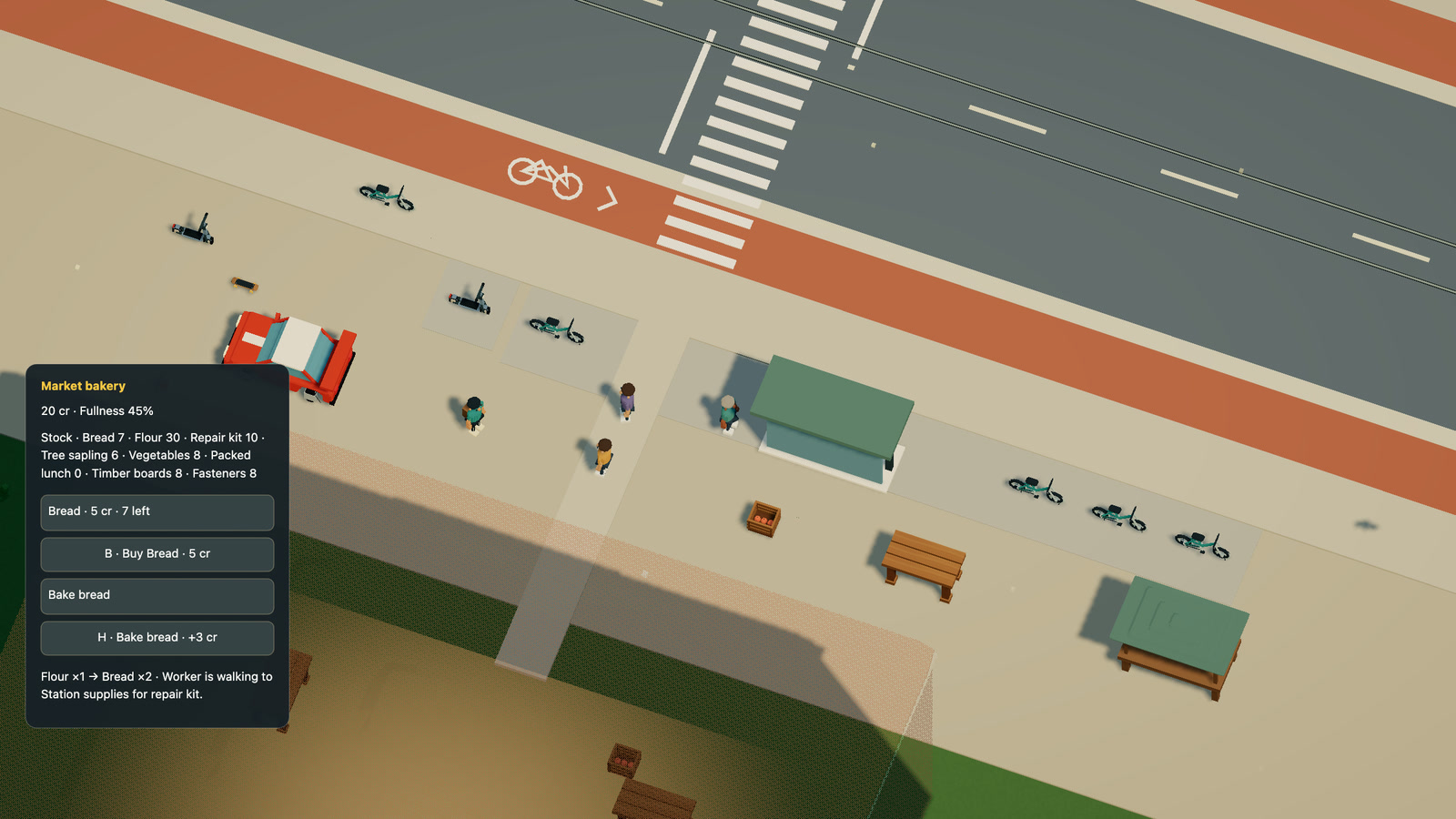
Walk up to the market vendor and buy bread with B. Shelf stock drops by one, your credits move to the business and your bag records one loaf. G eats it and restores fullness. V sells an owned item back at the listed price, if the business has money and room for it.
Want to earn some credits? H starts a six-second bread batch. The business reserves flour, three credits and space on its shelf. Stay nearby until the batch finishes: two loaves reach the shelf, the reserved wage reaches you and work uses some fullness. Press H again or leave the work area to cancel; the reservations return without a wage or finished bread.
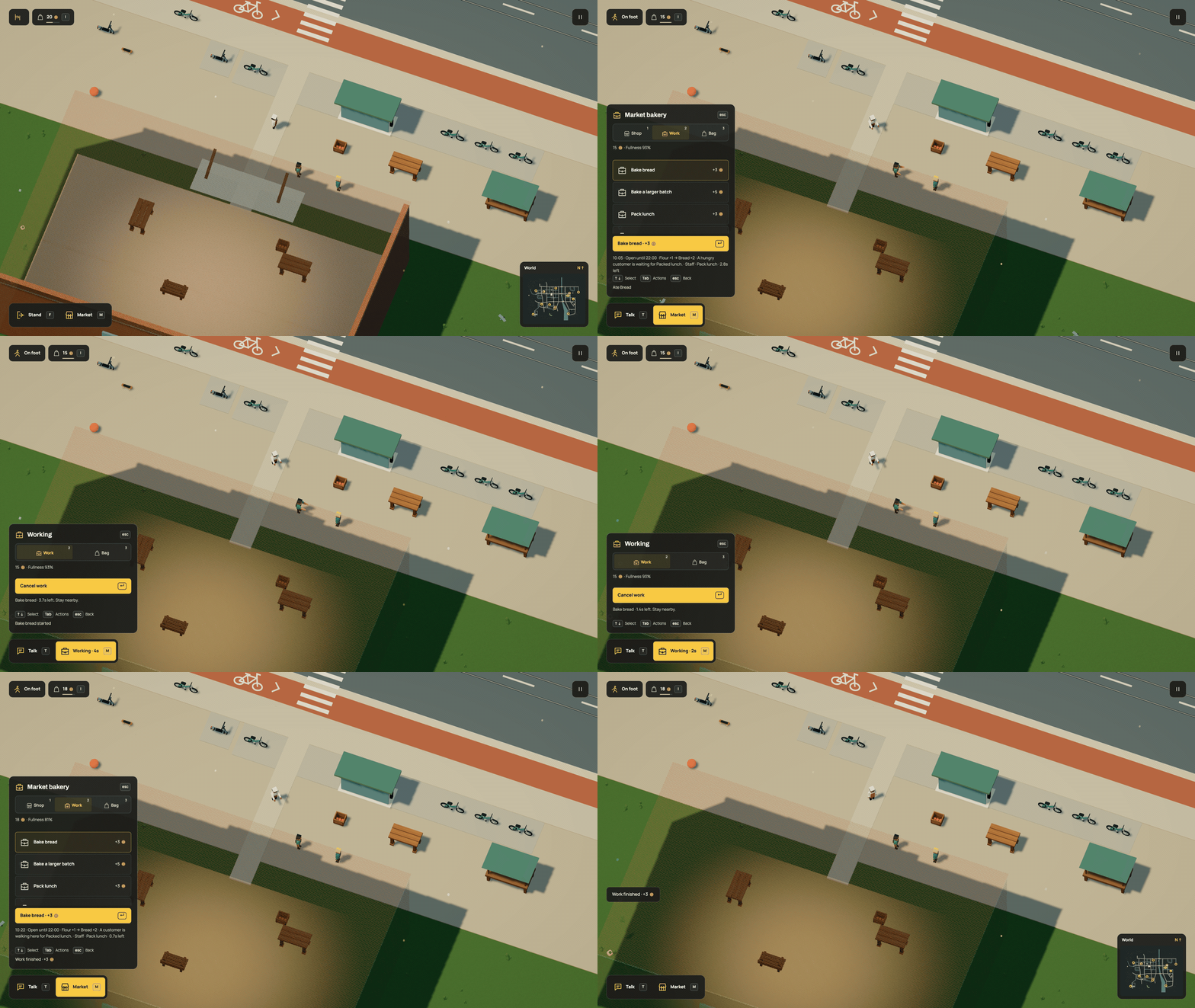
The vendor packs lunches and bakes when bread runs low. The commuter buys and eats when hungry, using actual route positions and the same transactions as the player. Neither gets free food or money. Flour is finite, customers have finite budgets and work stops when ingredients, shelf space, wages or fullness run out. Player delivery jobs now connect the station depot, bakery and school canteen; there is no automatic supply generation.
Author it in Dream
One economy() block owns the system for a linked world. Goods, accounts, markets and work have explicit IDs. Accounts reference the player or existing NPC placements. Markets and production workers require stationary NPCs; repair workers start from a stationary home and use their declared grounds, service streets and connecting pedestrian pavement. Customers may use the existing walking routes. The complete-world compiler checks ownership after module linking.
| Declaration | Meaning |
|---|---|
good |
A named inventory unit; optional food value restores 0..100 fullness |
account |
Actor-owned integer credits, carrying capacity, fullness and drain per simulation second |
market |
A stationary vendor, treasury and interaction radius of 20..80 world units |
lot |
One good's initial stock and capacity; optional positive integer price allows buying and selling |
work |
Timed conversion of one or several input goods into another, with wage, effort, shared capacity and refill target |
The player acts through controls. NPC shop=true attempts food purchases/consumption at fullness 40 or below. Optional account work refills its job's output toward target. Policies submit the same transactions and meet the same range, capacity, inventory and money checks. These are bounded engine policies, not generated scripts or general life AI.
dream 2;
material blue(style=toon,colors=[#537eaa,#3c5f87]);
material skin(style=toon,colors=[#c59774,#a97655]);
object pedestrian(label="Pedestrian"){
  measure(kind=person,axis=y,meters=1.8);
  body(interaction=decor,radius=4,height=18);
  part torso(shape=capsule,material=blue,at=[0,11,0],size=[5,6,4]);
  part head(shape=sphere,material=skin,at=[0,16,0],size=[4,4,4]);
  part nose(shape=sphere,material=skin,at=[2,16,0],size=[1,1,1]);
  repeat legs(index=i,count=2){
    joint leg(at=[0,8,i*3-1.5],motion=swing(axis=z,deg=18,hz=.6,phase_deg=i*180)){
      part shin(shape=capsule,material=blue,at=[0,-4,0],size=[2,8,2]);
    }
  }
}
behavior welcome(start=waiting){
  state waiting(action=idle){on talk(event=interact,to=hello,radius=55,familiar=false);on again(event=interact,to=returning,radius=55,familiar=true);}
  state hello(action=idle,face=player,say="Hello. Welcome to the neighborhood."){
    on ask(event=interact,to=about,radius=55);
    on finish(event=after,to=waiting,seconds=6);
  }
  state returning(action=idle,face=player,say="Good to see you again."){
    on finish(event=after,to=waiting,seconds=6);
  }
  state about(action=idle,face=player,say="I like walking by the river. See you around."){
    on finish(event=after,to=waiting,seconds=6);
  }
}
place neighbor(object=pedestrian,at=[580,710],role=npc,behavior=welcome);
world(size=[4000,2400],spawn=[525,609],heading_deg=0);
road circuit(width=118,points=[[300,590],[660,590],[810,500],[810,220],[660,130],[300,130],[150,220],[150,500]]);

checkpoint start(at=[480,612.5],dir=[1,0],width=100);
checkpoint east(at=[828.75,360],dir=[0,-1],width=100);
checkpoint north(at=[480,107.5],dir=[-1,0],width=100);
checkpoint west(at=[131.25,360],dir=[0,1],width=100);

place customer(object=pedestrian,at=[620,730],role=npc,behavior=welcome);
economy(){
 good bread(label="Bread",food=45);
 good flour(label="Flour");
 account pocket(actor=player,credits=20,capacity=8,satiety=40,drain_s=.05);
 account baker(actor=neighbor,credits=0,capacity=4,satiety=65,drain_s=.05,shop=true,work=bake);
 account regular(actor=customer,credits=20,capacity=4,satiety=25,drain_s=.05,shop=true);
 market corner(label="Corner bakery",actor=neighbor,credits=100,radius=70){
  lot bread_shelf(good=bread,quantity=8,limit=16,price=5);
  lot flour_sack(good=flour,quantity=12,limit=12);
 }
 work bake(label="Bake bread",market=corner,input=flour,take=1,output=bread,make=2,seconds=2,pay=3,effort=12,capacity=1,target=4);
}
Run npm run -s dream -- check docs/examples/market-work.dream. The example uses short work durations for testing; the live market takes six seconds. The example's simple pedestrian has swing joints; full humanoid rigs in the live world also get a planted work gesture through their explicit bone bindings.
What the engine guarantees
Buying and selling transfer credits atomically. A rejected action changes no stock, inventory or balance. Work reserves wages and input, plus room for its output and any returned input. Cancelling cannot duplicate supplies or earn a wage. Completion is counted once, including the initiating simulation step. One account can hold one job; the job's capacity is shared by NPCs and the player. Stable rotating account order resolves contention.
Food consumption and completed recipe batches are recorded, so restore can check material conservation as well as total credits, including wages in reserve. Fullness is an arcade work resource, not a nutrition or health model. Non-food goods can be owned and traded; they do not yet have item-specific actions or physical pickup/drop models.
Needs and work settle on a resident 4 Hz simulation clock. NPC decisions are at most once per second. Player actions and work interruption are checked at the fixed-step boundary. There is no frame-driven income or offline catch-up. Pause freezes the system; R preserves it and cancels work if recovery leaves its range; Start over resets it. Render chunks own no stock, accounts or clocks.
Save format and the first-market migration preserve earlier world changes while introducing this new system. Later changes to economy rules still need an explicit migration. Limits are in the generated command contract and reference. Logical Lab scenarios remain independent.
The market has a usable ground-floor interior and short food and repair-supply chains. Enterable kitchens, supply production, relationship progression and broader needs planning remain future work. Bounded food destinations are now available through the meal trips below. The supply ledger is working; those institutions should not be described as complete yet.
Counter hours
Markets optionally declare hours=[6,22], requiring a world daylight clock.
Player and NPC trade, production starts, shipment pickup and handoff share service
hours. Committed jobs still finish, couriers can wait with real escrow, and owned
food, refunds and repairs remain usable. Full contract and runnable world.
Recipes with several ingredients
At the market, choose Pack lunch and press H. One loaf and one vegetable unit leave the business shelves together. Five seconds later, one packed lunch reaches its counter and you earn three credits. Select Packed lunch in the goods menu, buy it with B, then eat it with G. Baking and packing now form a small production chain: flour becomes bread, then bread and vegetables become lunch.
Assemble a repair kit uses one timber board and one fastener unit, takes seven seconds and pays three credits. It needs room on the repair-kit shelf, so repair some damage first. The caretaker can use the resulting kit through the existing repair jobs. The market starts with eight vegetables, eight boards and eight fastener units. They are finite supplies, added once for existing saves. Neither job creates ingredients or business money, and kit assembly does not replace all the world's supply needs.
The work panel shows the selected recipe. A missing ingredient blocks the whole start; it cannot take the bread and fail halfway through taking vegetables. Wages, output room and room to refund every ingredient stay reserved. Cancel or walk away before completion to return all inputs and wages without output or pay. NPC workers use the same rule; the live vendor now packs lunches before restocking bread through its ordered work policy.
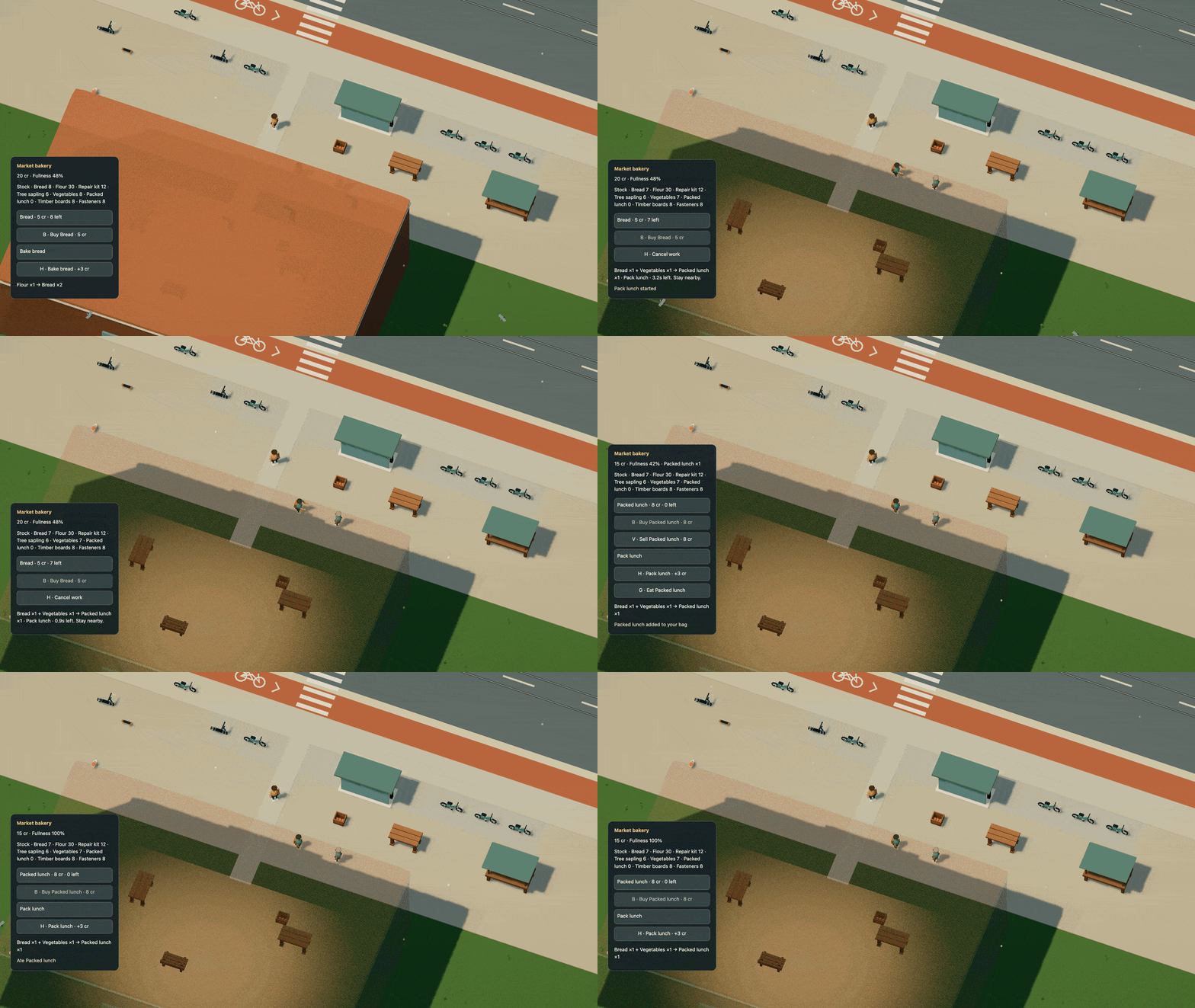
HD recording · Complete recipe world
Use either the original input/take fields or an ingredient block, never both.
A block has one to four unique goods, each backed by a matching lot at that
market. Each take is a positive bounded integer and fits the lot's capacity.
Inputs cannot also be the output. Empty blocks, duplicate goods and unknown
supplies fail with a located compiler diagnostic. No generated code runs.
The same construct describes cooking and workshop assembly:
dream 2;
material blue(style=toon,colors=[#537eaa,#3c5f87]);
material skin(style=toon,colors=[#c59774,#a97655]);
object pedestrian(label="Pedestrian"){
  measure(kind=person,axis=y,meters=1.8);
  body(interaction=decor,radius=4,height=18);
  part torso(shape=capsule,material=blue,at=[0,11,0],size=[5,6,4]);
  part head(shape=sphere,material=skin,at=[0,16,0],size=[4,4,4]);
  part nose(shape=sphere,material=skin,at=[2,16,0],size=[1,1,1]);
  repeat legs(index=i,count=2){
    joint leg(at=[0,8,i*3-1.5],motion=swing(axis=z,deg=18,hz=.6,phase_deg=i*180)){
      part shin(shape=capsule,material=blue,at=[0,-4,0],size=[2,8,2]);
    }
  }
}
behavior welcome(start=waiting){
  state waiting(action=idle){on talk(event=interact,to=hello,radius=55,familiar=false);on again(event=interact,to=returning,radius=55,familiar=true);}
  state hello(action=idle,face=player,say="Hello. Welcome to the neighborhood."){
    on ask(event=interact,to=about,radius=55);
    on finish(event=after,to=waiting,seconds=6);
  }
  state returning(action=idle,face=player,say="Good to see you again."){
    on finish(event=after,to=waiting,seconds=6);
  }
  state about(action=idle,face=player,say="I like walking by the river. See you around."){
    on finish(event=after,to=waiting,seconds=6);
  }
}
place neighbor(object=pedestrian,at=[580,710],role=npc,behavior=welcome);
world(size=[4000,2400],spawn=[525,609],heading_deg=0);
road circuit(width=118,points=[[300,590],[660,590],[810,500],[810,220],[660,130],[300,130],[150,220],[150,500]]);

checkpoint start(at=[480,612.5],dir=[1,0],width=100);
checkpoint east(at=[828.75,360],dir=[0,-1],width=100);
checkpoint north(at=[480,107.5],dir=[-1,0],width=100);
checkpoint west(at=[131.25,360],dir=[0,1],width=100);

place customer(object=pedestrian,at=[620,730],role=npc,behavior=welcome);
economy(){
 good bread(label="Bread",food=45);
 good vegetables(label="Vegetables",food=20);
 good lunch(label="Packed lunch",food=65);
 good boards(label="Timber boards");
 good fasteners(label="Fasteners");
 good kit(label="Repair kit");
 account pocket(actor=player,credits=20,capacity=8,satiety=60,drain_s=.05);
 account cook(actor=neighbor,credits=0,capacity=4,satiety=65,drain_s=.05,work=pack_lunch);
 market corner(label="Market workshop",actor=neighbor,credits=100,radius=70){
  lot bread_shelf(good=bread,quantity=8,limit=16,price=5);
  lot produce(good=vegetables,quantity=8,limit=16,price=2);
  lot lunches(good=lunch,quantity=0,limit=8,price=8);
  lot wood(good=boards,quantity=8,limit=8);
  lot hardware(good=fasteners,quantity=8,limit=8);
  lot repair_kits(good=kit,quantity=0,limit=8);
 }
 work pack_lunch(label="Pack lunch",market=corner,output=lunch,make=1,seconds=2,pay=3,effort=6,capacity=1,target=2){
  ingredient(good=bread,take=1);
  ingredient(good=vegetables,take=1);
 }
 work assemble_kit(label="Assemble a repair kit",market=corner,output=kit,make=1,seconds=2,pay=3,effort=6,capacity=1,target=2){
  ingredient(good=boards,take=2);
  ingredient(good=fasteners,take=1);
 }
}
Run npm run -s dream -- check docs/examples/multi-input-work.dream. Its two-second
jobs keep the example short; the live city uses five and seven seconds. Saved
work keeps its original deadline and reserved supplies. Reloading, leaving a
render chunk or changing vehicles never finishes a job twice.
Personal work and recognition
At the live bakery, bake three batches to unlock Bake a larger batch. It uses two flour, makes five bread and pays five credits for nine seconds of work. You still need enough fullness, ingredients and shelf room. Buying food, packing lunches and school deliveries make room for more baking. The vendor recognizes your practice when you talk; the teacher thanks you after your own school delivery.
The baker earns the same qualification independently. Their work does not unlock
yours. milestone reads an account's completed tasks, and work.requires uses it
as a condition. Starting or cancelling a task earns no progress. Collection does
not count as delivery. Recognition changes the authored conversation; it creates
no stock, pay or relationship score.
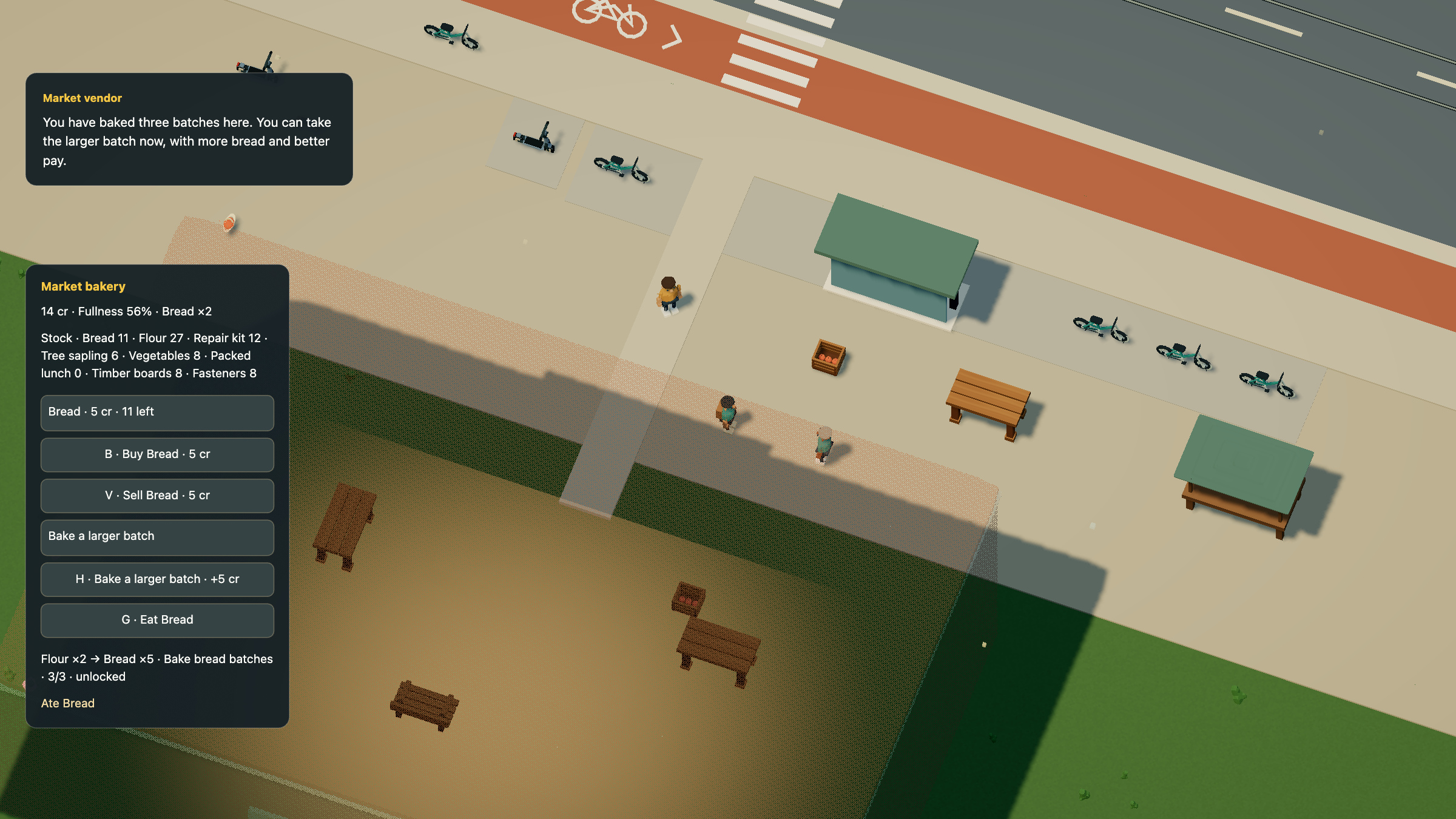
Watch the work in HD · Animated version
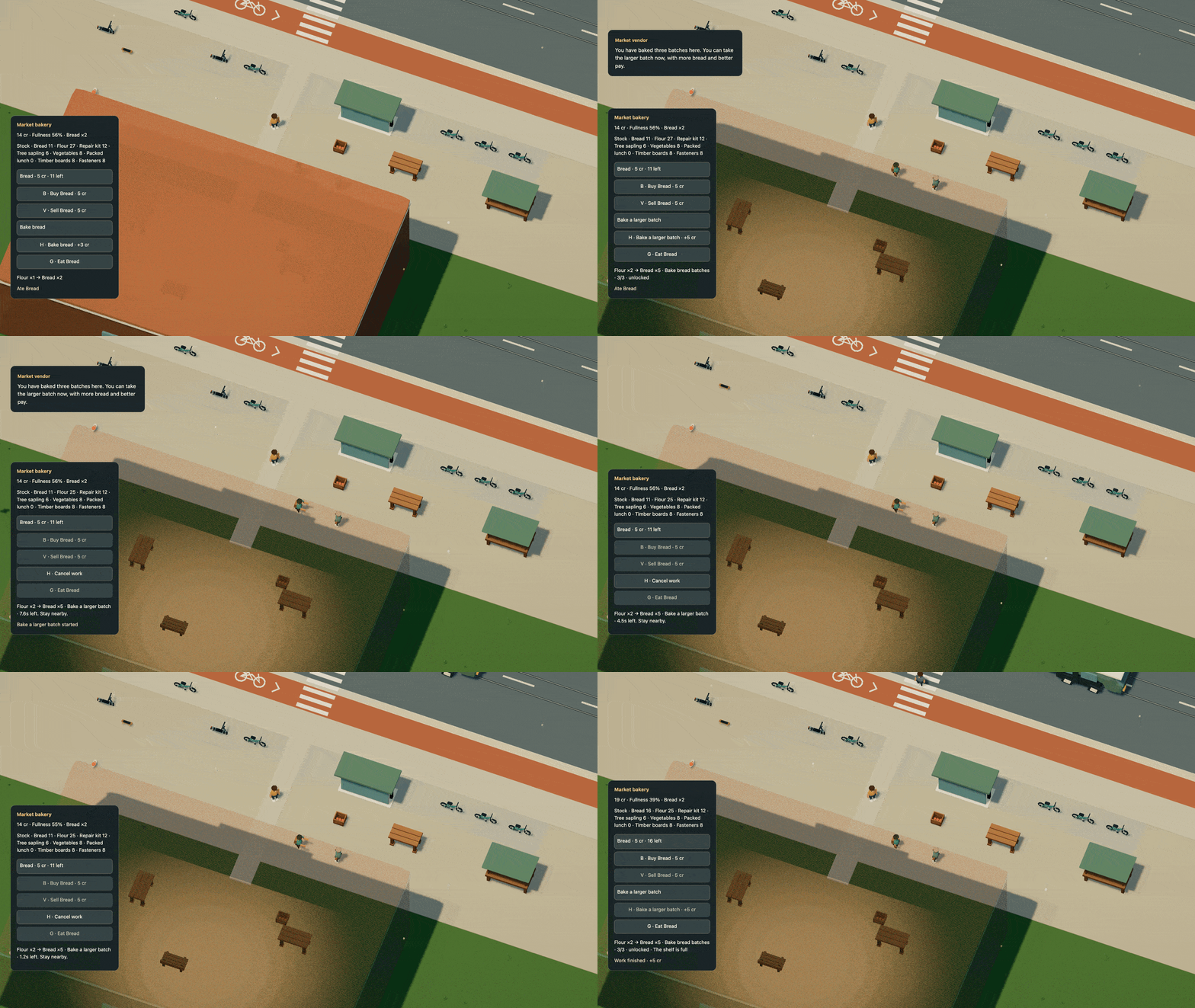
This complete runnable world uses shorter work
times for checking the rule. works=[large_bake,bake] gives NPCs an ordered list:
try eligible work below its target, using the same reservations and pay as you.
dream 2;
material blue(style=toon,colors=[#537eaa,#3c5f87]);
material skin(style=toon,colors=[#c59774,#a97655]);
object pedestrian(label="Pedestrian"){
  measure(kind=person,axis=y,meters=1.8);
  body(interaction=decor,radius=4,height=18);
  part torso(shape=capsule,material=blue,at=[0,11,0],size=[5,6,4]);
  part head(shape=sphere,material=skin,at=[0,16,0],size=[4,4,4]);
  part nose(shape=sphere,material=skin,at=[2,16,0],size=[1,1,1]);
  repeat legs(index=i,count=2){
    joint leg(at=[0,8,i*3-1.5],motion=swing(axis=z,deg=18,hz=.6,phase_deg=i*180)){
      part shin(shape=capsule,material=blue,at=[0,-4,0],size=[2,8,2]);
    }
  }
}
behavior welcome(start=waiting){
  state waiting(action=idle){on recognize(event=interact,to=recognized,radius=55,requires=practiced_baker);on talk(event=interact,to=hello,radius=55,familiar=false);on again(event=interact,to=returning,radius=55,familiar=true);}
  state hello(action=idle,face=player,say="Hello. Welcome to the neighborhood."){
    on ask(event=interact,to=about,radius=55);
    on finish(event=after,to=waiting,seconds=6);
  }
  state returning(action=idle,face=player,say="Good to see you again."){
    on finish(event=after,to=waiting,seconds=6);
  }
  state about(action=idle,face=player,say="I like walking by the river. See you around."){
    on finish(event=after,to=waiting,seconds=6);
  }
  state recognized(action=idle,face=player,say="You have helped here. The larger batch is now available."){
    on finish(event=after,to=waiting,seconds=6);
  }
}
place neighbor(object=pedestrian,at=[580,710],role=npc,behavior=welcome);
world(size=[4000,2400],spawn=[525,609],heading_deg=0);
road circuit(width=118,points=[[300,590],[660,590],[810,500],[810,220],[660,130],[300,130],[150,220],[150,500]]);

checkpoint start(at=[480,612.5],dir=[1,0],width=100);
checkpoint east(at=[828.75,360],dir=[0,-1],width=100);
checkpoint north(at=[480,107.5],dir=[-1,0],width=100);
checkpoint west(at=[131.25,360],dir=[0,1],width=100);

behavior customer_wait(start=rest){state rest(action=idle){}}
place customer(object=pedestrian,at=[1000,730],role=npc,behavior=customer_wait);
economy(){
 good bread(label="Bread",food=45);
 good flour(label="Flour");
 account pocket(actor=player,credits=20,capacity=8,satiety=80,drain_s=0);
 account baker(actor=neighbor,credits=0,capacity=4,satiety=65,drain_s=0,shop=true,works=[large_bake,bake]);
 account regular(actor=customer,credits=20,capacity=4,satiety=25,drain_s=0,shop=true);
 market corner(label="Corner bakery",actor=neighbor,credits=100,radius=70){
  lot bread_shelf(good=bread,quantity=1,limit=16,price=5);
  lot flour_sack(good=flour,quantity=12,limit=12);
 }
 work bake(label="Bake bread",market=corner,input=flour,take=1,output=bread,make=2,seconds=1,pay=3,effort=1,capacity=1,target=7);
 milestone practiced_baker(label="Bake bread batches",kind=work,task=bake,count=3);
 work large_bake(label="Bake a larger batch",market=corner,input=flour,take=2,output=bread,make=5,seconds=2,pay=5,effort=2,capacity=1,target=12,requires=practiced_baker);
}
There can be 16 milestones. Each names an existing work, delivery or repair
task and a positive integer completion count. Work requirements cannot form cycles.
An interact-only on.requires can recognize the player's contribution at the
task's receiving market actor: work.market, repair.market or delivery.to.
This is checked after linking, including every placement using that program.
Use the commerce agent context when authoring these conditions.
Personal work, delivery and repair counters persist independently of render chunks, R, NPC clocks and camera movement. Format 10 checks that personal records plus unassigned historical counts equal the shared totals. Earlier saves kept shared counts but no complete ownership history, so those counts remain unassigned and new personal records start at zero. An earlier saved job still counts for its owner when it finishes. The upgrade keeps balances, materials, deadlines and the original save slot.
Deliveries
At the bakery, choose Take bread to school in the work menu and press H. Two loaves leave the shelf and become your delivery cargo. The school reserves five credits and room for the bread. Follow the marked destination on the map; the panel shows its name and distance. Walk, cycle or drive there, get out and press H to hand it over. The school receives real stock and you receive the pay. Its staff member can then buy and eat that bread through the same market rules.
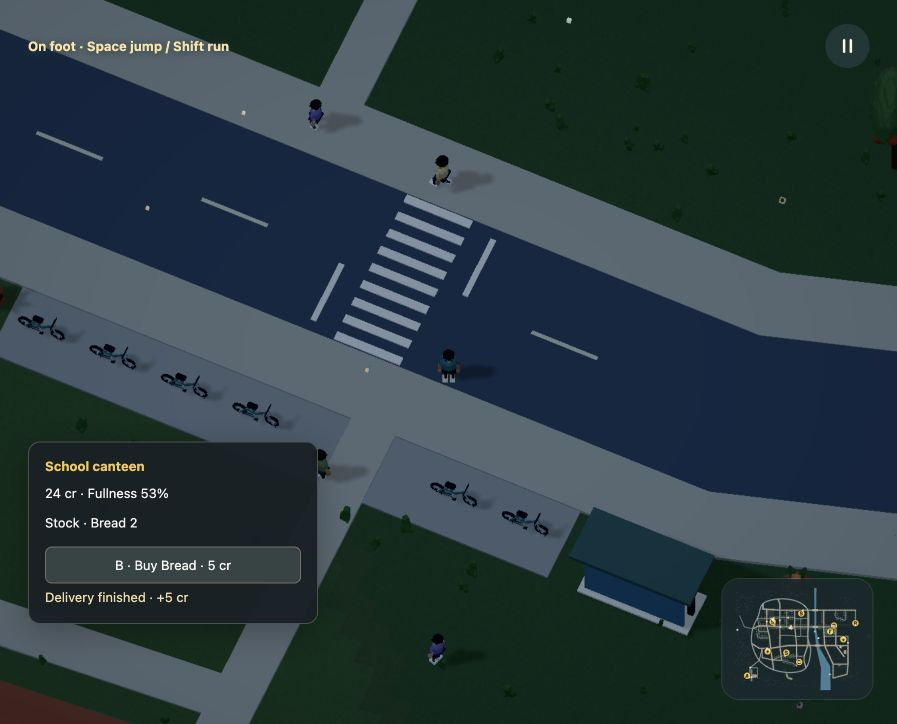
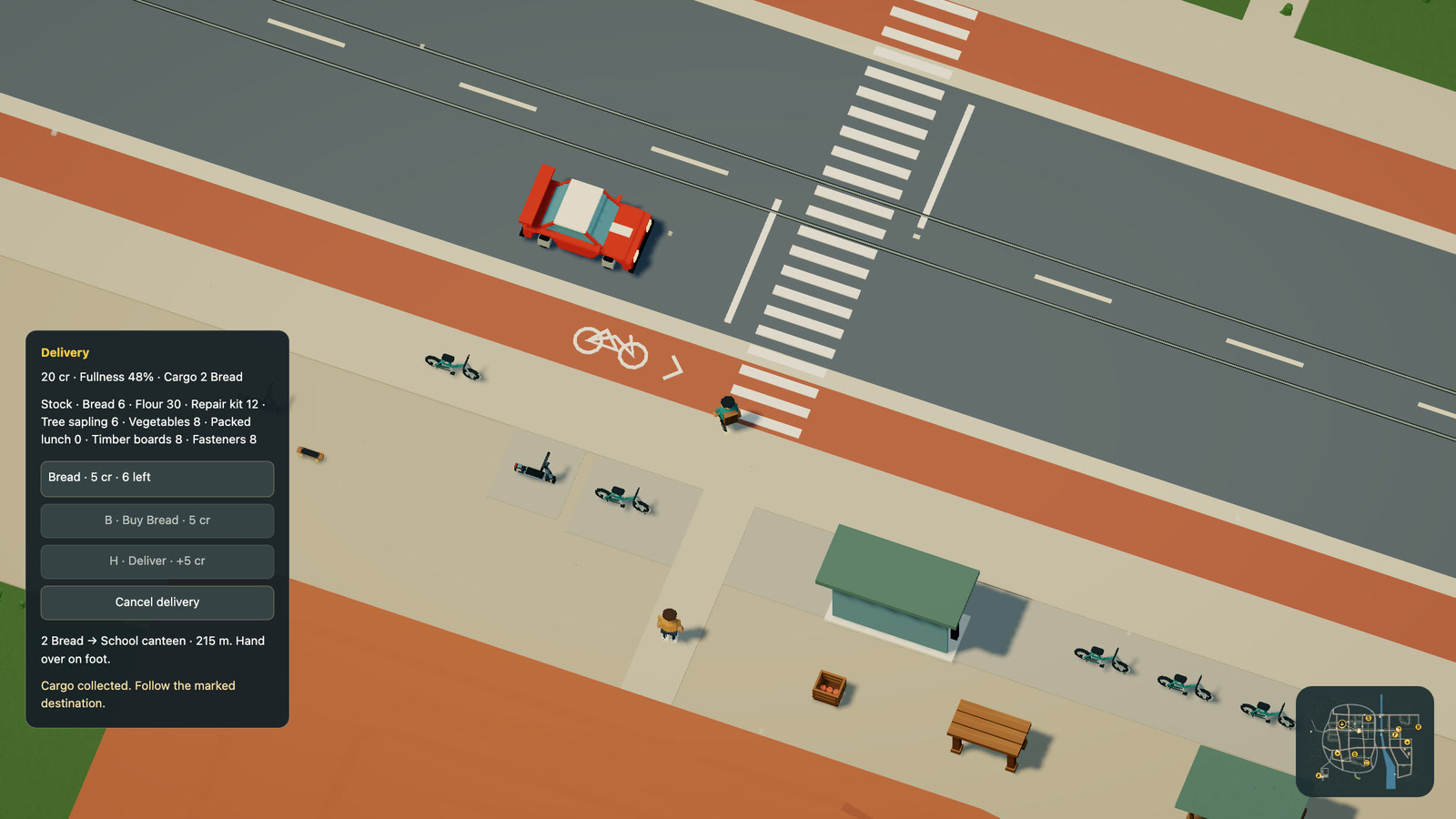
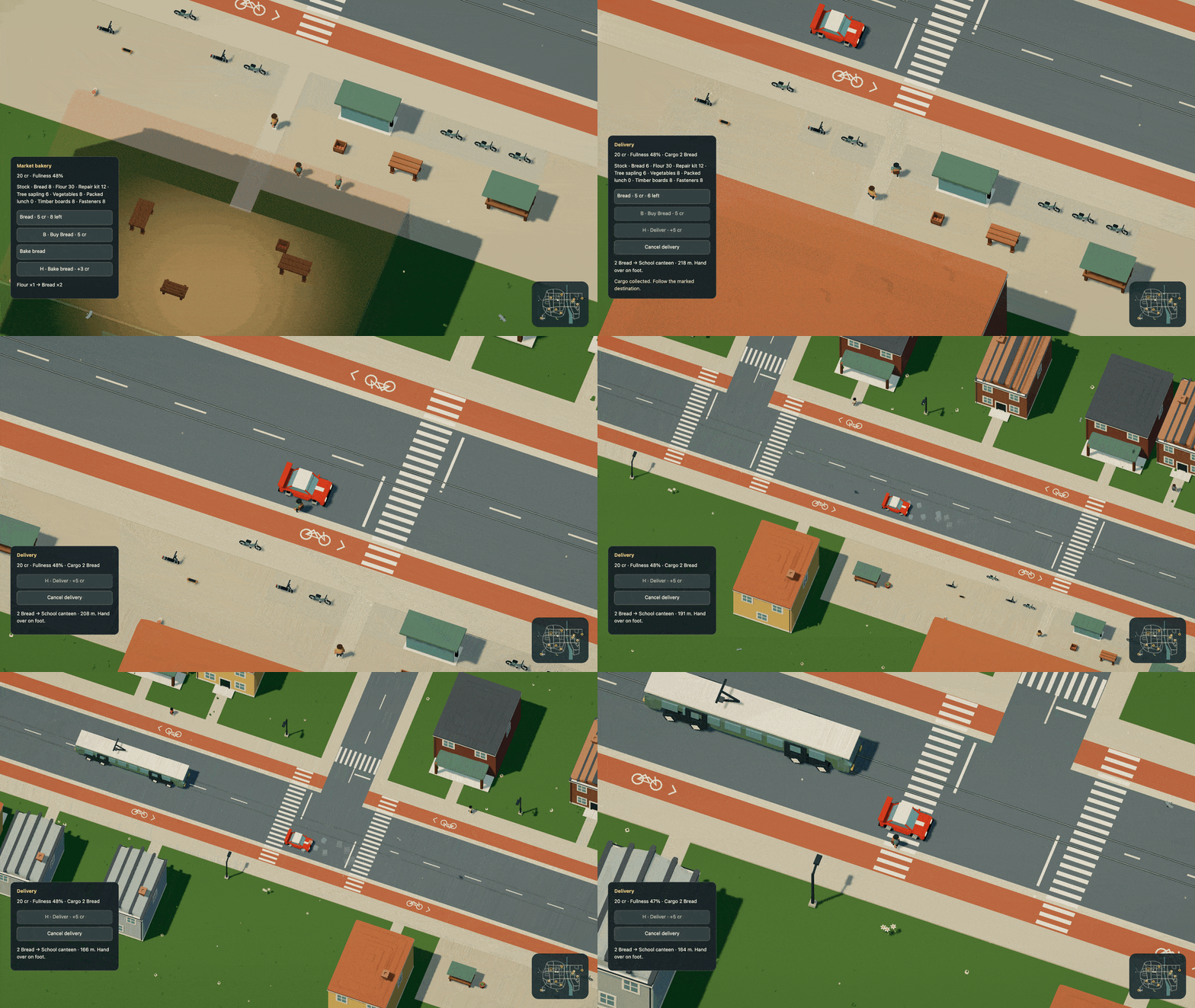
The other job carries two units of flour from Station supplies, beside the east railway station, to the bakery for four credits. Bake a couple of batches first to make shelf space. The depot starts with 80 flour; it cannot generate more. Bread at the school and flour at the bakery remain finite. Work and trade can stop for a full shelf, full bag, empty source or insufficient business money.
Cargo counts against your bag's capacity but cannot be sold, eaten or used for another job. You can eat your own carried food while on foot during a delivery; the sealed cargo stays intact. You can hold one production/delivery/repair task at a time. Cancel delivery returns cargo and reserved pay, without paying you. Travel, vehicles, R, pause, render unloading and save/reload keep the task; Start over resets it. The map line is a direction to the destination, not a solved route. Cancellation returns the reservation directly; there is no dropped package simulation.
Author it in the existing economy block:
delivery school_run(label="Take bread to school",from=market_stall,to=school_canteen,good=bread,quantity=2,pay=5,capacity=1);Both markets need a lot for the good, enough capacity and separate interaction
areas. Collection reserves source/refund space, destination/output space and the
wage atomically. Optional price adds a per-unit supplier invoice, paid by the
destination business. It defaults to zero for existing contracts. The invoice
and wage stay in escrow during travel; handoff pays the supplier and courier
once, and cancellation returns both to the destination. The source treasury
reserves enough headroom to receive its invoice. Completion transfers once; cancellation refunds once. No
per-item meshes or physics bodies are allocated. NPC customers consume delivered
stock. NPC supply trips use explicit contracts and bounded pedestrian routes.
Download a complete delivery world. Check it
with npm run -s dream -- check docs/examples/market-delivery.dream. Its short
example journey is for learning the rules; the live city jobs connect actual places.
Repair work
Drive into the table, produce crate or terracotta planter in the market square, then clear the wreckage. The caretaker notices the damage, waits 12 seconds for someone to take the job, collects a repair kit from the vendor and walks over. Eight seconds of work restores the object and its collision body. The bakery pays four credits and loses one kit. The caretaker walks back to their starting place before resuming their ordinary behaviour. A busy worker does not offer its suspended conversation prompt; you can still talk to other available people. Nothing is spawned from free stock.
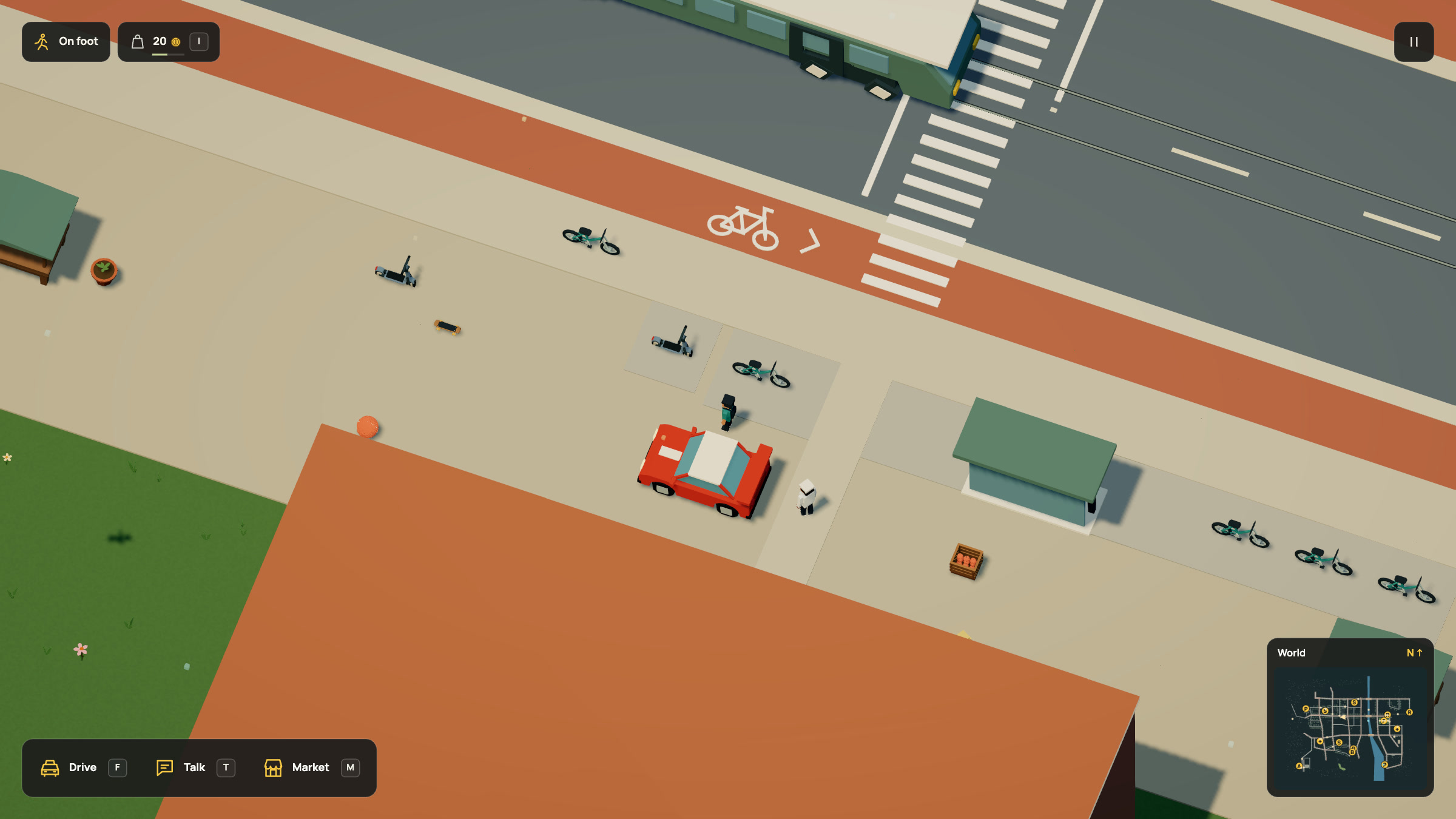
Watch the complete repair in HD · Animated repair
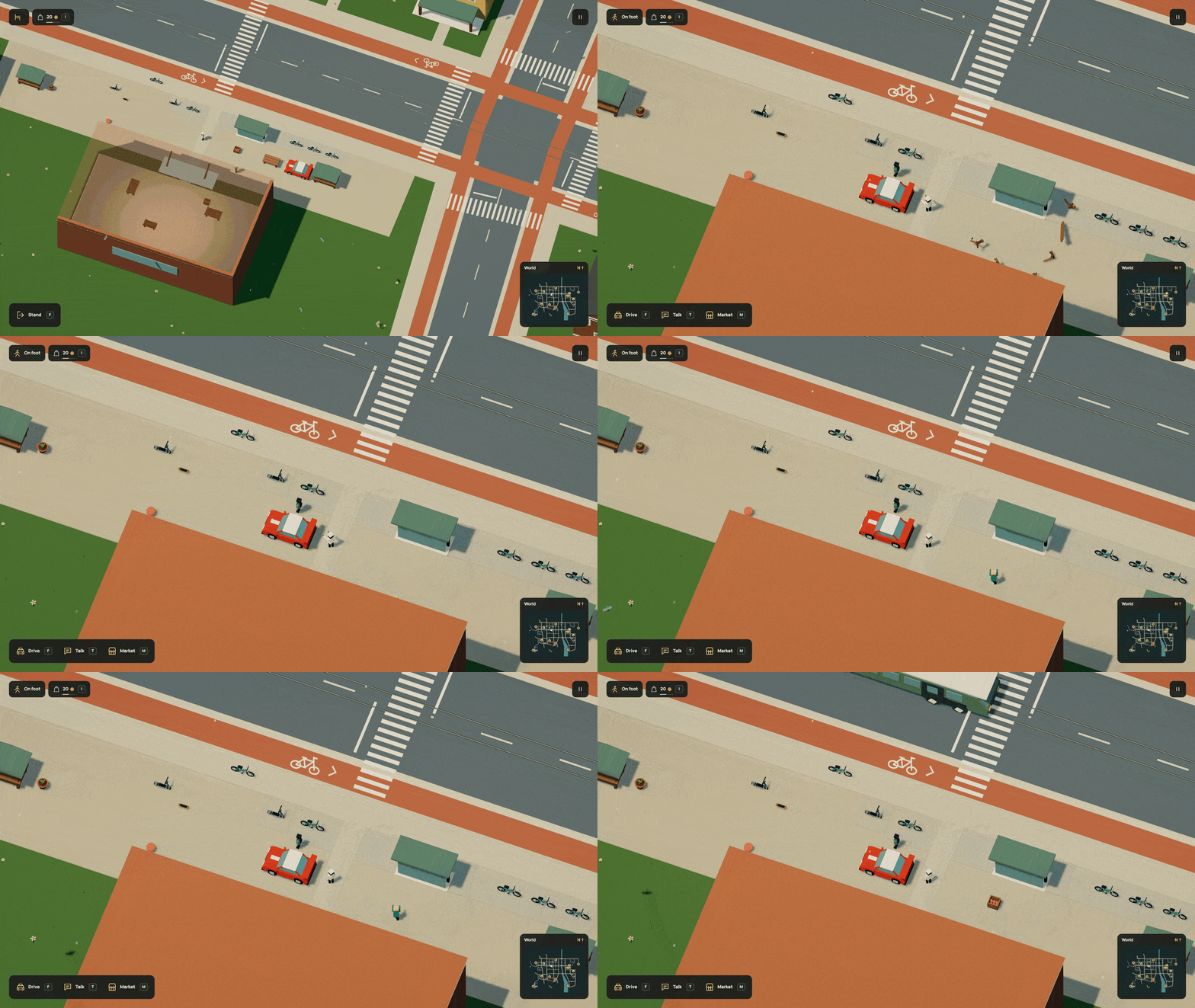
You can do it too. Go to the bakery before the caretaker collects the kit, choose Repair city fixtures and press H. Follow the map marker to the damage and stand beside it. Work pauses when you walk away, jump, swim or enter a vehicle; return to continue. Cancel repair refunds the unused kit and reserved pay. You receive the same four credits when the repair finishes.
A car, parked bicycle, boat, loose ball or another solid in the restoration footprint keeps it broken until the space is clear. A worker also stops for vehicles or the player on their path. Progress, supplies, wages, work position and return journey survive render unloading and save/reload. Pause freezes them; R preserves them; Start over resets them. There is no offline work.
Complete runnable repair world. Its short example timings make the loop easy to test. The following declarations are the repair portion of that file:
repair yard_tables(label="Repair a table",market=corner,on=work_yard,kind=table,input=kit,take=1,seconds=2,pay=4,effort=5,dispatch_s=0);Put the declaration inside economy. An NPC account uses repair=yard_tables to
notice and take those jobs automatically. The player never has an automatic
policy. Use repairs=[service_a,service_b] for one to four services in priority
order, skipping work that cannot currently start. It excludes repair and
automatic work; each account still holds one commitment.
kind selects one measured category, as shared destruction rules do. Use
kinds=[table,custom] for several categories under the same service. Declare
exactly one of kind or kinds; lists must be nonempty, unique and use existing
measure categories. It covers
eligible break/topple objects and ground-accessible break zones in the named
surface; it never selects by label or makes one table exempt. One account can
hold one commitment, and each damaged object or zone has one claimant across all
repair services. Kits and pay are reserved at collection. Completion consumes
kits and pays once; cancellation refunds once. The saved repair counter accounts
for consumed materials, independently of food and recipe batches.
This is bounded local maintenance. The supply vendor and worker's home must lie
inside the same convex surface, with the home in market reach. Work areas use at
most 4,096 local navigation samples and paths at most 128 points. Routes stay
inside that dry area and clear carriageways, cycle tracks, water and solid
contacts. Optional grounds connects explicitly declared service areas through accepted
pedestrian infrastructure. streets also enables network travel, with short dry
work approaches beside its sidewalks. When both are omitted, workers remain in
the primary area.
Blocked workers wait;
there is no ladder, construction scaffold or dropped-kit simulation. Trees use
a regrow_s repair service for paid planting and physical growth.
Planting guide and runnable source. The live fixture service covers 449 targets: existing market, park, station and school
furniture, the two park wall sections, sixteen planted street tubs, two produce stalls, and all 413 streetlights across 32 streets. It does not make other scenery destructible.
Replacement supplies
The station depot starts with 32 repair kits. After the caretaker or player has used at least two kits, go to Station supplies, choose Bring repair kits to the market and press H. Two kits leave the depot; the bakery reserves six credits for the supplier and four for the courier. Take the cargo back, get out and hand it over with H. The bakery receives two kits, the depot receives six credits and you receive four. No player credits are charged.
delivery kits_run(label="Bring repair kits to the market",from=station_supplies,to=market_stall,good=timber,quantity=2,pay=4,price=3,capacity=1,on=market_square);
repair market_tables(label="Repair city fixtures",market=market_stall,on=market_square,grounds=[park_seating,station_seating,market_hall,school_yard,school_yard_access,school_yard_return,garden_work],streets=[market_avenue,north_avenue,south_avenue,garden_collector,high_street,civic_walk,river_street,copper_street,weavers_street,library_lane,copper_lane,weavers_lane,garden_crescent,garden_lane,school_street,orchard_lane,hospital_street,south_terrace,south_school_lane,park_lane,eastbank,station_avenue,workshop_street,harbor_street,yard_link,east_gardens,lakefront,east_station_road,farm_road,airfield_road,airport_service,airport_connector],verge=24,kinds=[table,custom,bench,lamp],input=timber,take=1,seconds=8,pay=4,effort=5);
These declarations are the live world's policy. The earlier flour and bread
contracts omit price and retain their zero-price cargo transfers. Supplier
prices are integers 0..10,000 per unit; invoice plus wage must fit the
1,000,000-credit treasury bound. Shelves, carrying limits, treasury headroom and
shared contract capacity still apply. The depot can run out and the bakery can
run out of money. The caretaker can now fetch these shipments through NPC supply trips; the workshop can also assemble kits from finite boards and fasteners through the recipe above.
Complete maintenance and procurement example.
Run npm run -s dream -- check docs/examples/market-maintenance.dream. It includes
a table and a crate served by one category list, plus a separate supplier and a
paid kit contract. Verification and remaining limits.
Connected service grounds
The live caretaker also serves the park seating area, east station bench and school-yard bench. All use paving connected to their sidewalks. Parked scooters, lamps and the planter retain their original positions; the furnishing rules explicitly allow these new grounds. Repair selection still uses measured categories and available damage, so the worker may restore a nearer wall before a bench.
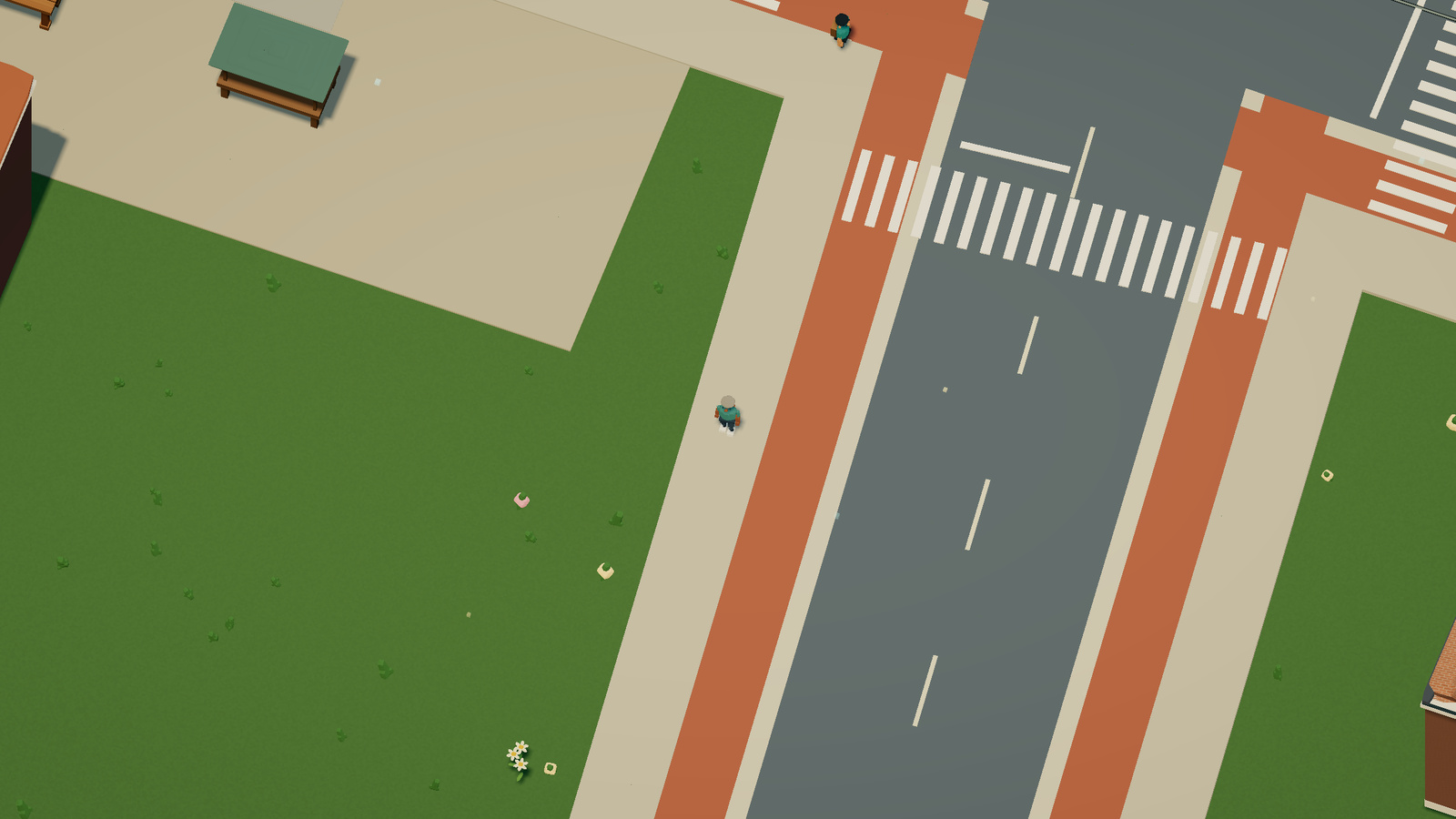
Journey in HD · Animated journey
Keep the market and worker home inside on. Add grounds=[park_seating,station_seating]
for distant work surfaces. The engine derives routes through sidewalks, crossings
and entrance paving, with supported bridge sidewalks where needed. It cannot
cut straight across an unpainted carriageway. The complete-world compiler rejects
unreachable targets. The player can carry a kit in a vehicle; the caretaker walks
at 1.4 m/s and returns after each job. A trip across the city takes several
simulation minutes. Nothing completes during pause or while the page is closed.
The primary ground plus extras are at most eight unique convex surfaces. Together they retain the 4,096 local-sample limit; the derived pedestrian graph has at most 8,192 nodes and 32,768 directed links. Saved paths still have at most 128 points. The world worker prepares topology before play; live contacts are checked during search and movement. The renderer interpolates worker poses with one commerce-tick visual delay, at most 35 cm while walking; physics, stock and work clocks remain resident simulation data. Reduced motion and recovery snap the presentation.
Complete connected repair world.
Run npm run -s dream -- check docs/examples/neighborhood-repairs.dream.
It connects two work grounds with a street and an authored crossing. When asking
an agent to author both services and infrastructure, use
node scripts/dream.mjs context --features commerce,city.
Checks, recordings and remaining limits.
Street verges
The live service reaches 449 targets, including all 413 city lamps.
A subset such as streets=[market_avenue,high_street,civic_walk] declares which
sidewalks a service covers; the live city lists all 32 streets.
verge=24 permits a short approach up to 2.4 metres beyond those sidewalks, near
eligible object contacts. Measured categories still select the targets; names
and coordinates cannot grant a special repair policy.
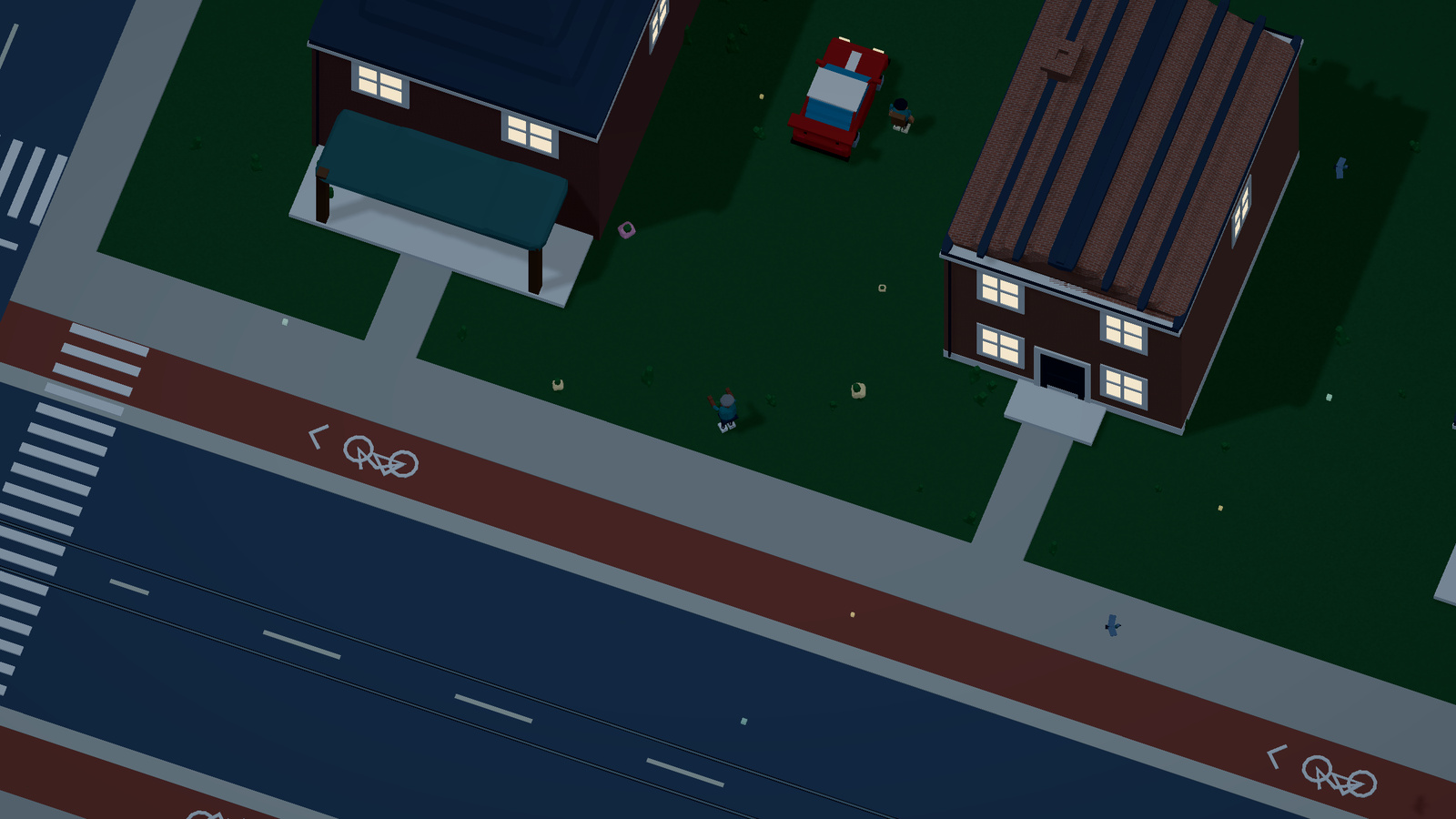
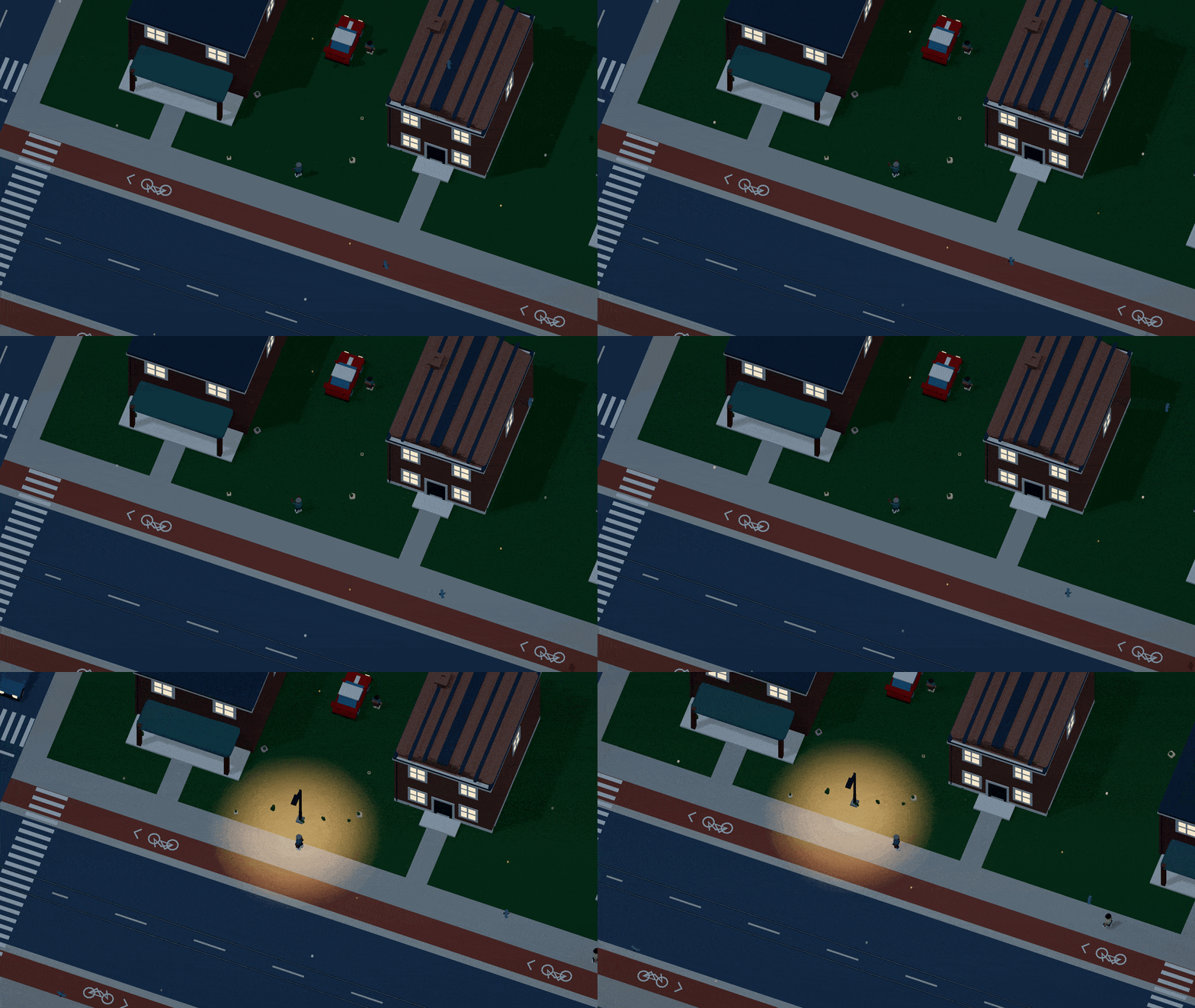
Approaches use the same miter joins as the streets. They are clipped away from carriageways, cycle tracks, the circuit and water. They add no paving or shortcuts across grass between distant targets. A full worker cylinder must connect through the accepted pedestrian network. The High Street/South Avenue junction now has an authored four-arm crossing; without it, four lamp jobs are unreachable and complete-world validation rejects the world.
A service can name 1..32 unique existing streets with sidewalks at least eight
world units wide. Verge is 0..128 units, defaults to 24 and requires streets.
At most 512 street targets and 2,048 derived approach polygons are allowed per
service. The existing local-sample, network and saved-path limits above still
apply. on remains the supply market and worker home; grounds stays optional.
Player jobs and NPC jobs use the same coverage, finite kits, pay and obstruction
checks. A stopped car can delay work or prevent safe restoration.
Complete street-verge repair world.
Run npm run -s dream -- check docs/examples/street-verge-repairs.dream.
It connects a home yard to a lamp outside the opposite sidewalk using a real
crossing, without a second work-ground surface. Ask for commerce,city in an
agent context packet when authoring these routes.
New repair categories still need declared, connected coverage. The caretaker now shares furniture and tree replanting duties and can fetch supplies from the depot. Damaged lamps lose their ground light pool until repair. Streetlight destruction uses the same pooled geometry and saved damage as before. Verification and media audit.
School-yard repairs
The school bench follows the same rule as the market furniture. Break it with a car, move clear and the caretaker notices the damage. After the 12-second claim window, they collect one kit and four credits of reserved pay, then walk from the market through the existing sidewalks, crossings and school access paths. Eight seconds of work restores the bench and its two seats. A body in the restoration space keeps the job waiting. The worker then walks home.
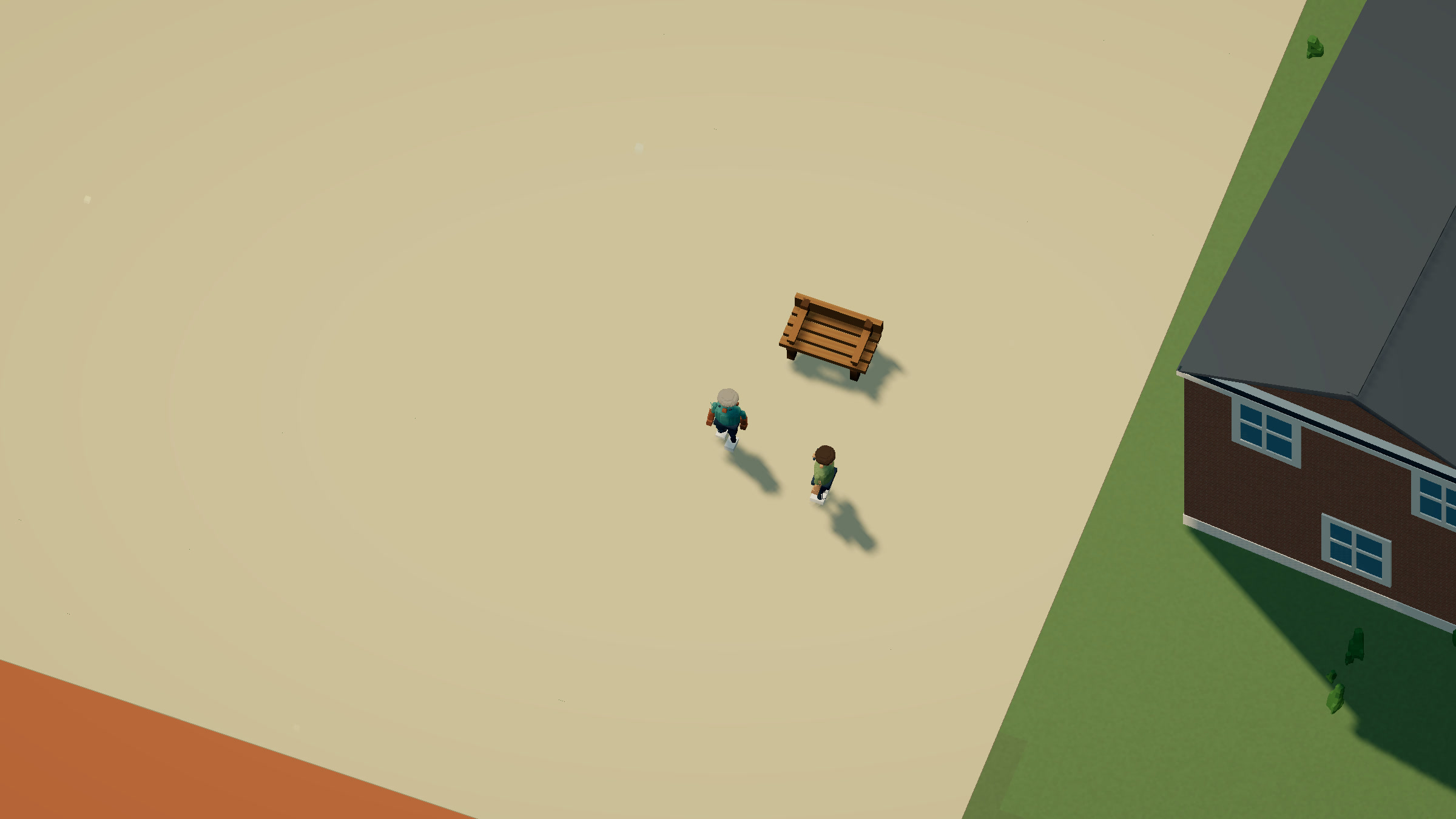
HD journey and repair · Animated repair
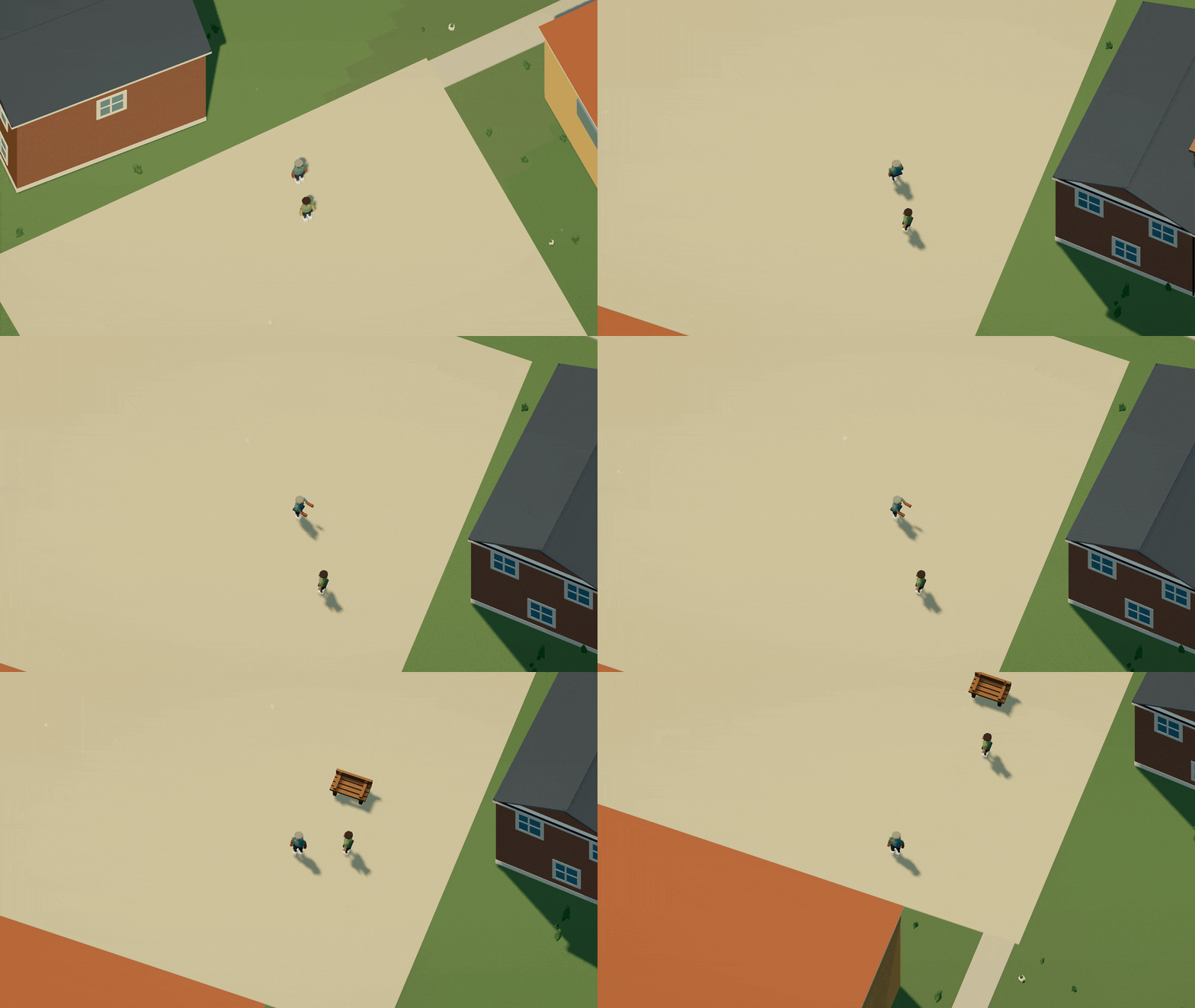
You can claim Repair city fixtures at the bakery before dispatch. Carry the kit to the map marker, then stand beside the bench to work. The same finite stock, wages, cancellation refund and clearance checks apply. The trip, work and return survive saves and render streaming. Breaking a seat also cancels an unfinished shared meal and returns its food; restoration makes it usable again.
Complete runnable connected-bench example.
It reuses the existing repair and grounds vocabulary:
 repair school_furniture(
  label="Repair school furniture",
  market=corner,on=work_yard,
  grounds=[school_access,school_yard],
  kind=bench,input=kit,take=1,
  seconds=8,pay=4,effort=5,
  dispatch_s=12
 );
The school grounds share the live 449-target service, including all 413 lamps. This extends one existing worker's connected area. It adds no worker, rig or physics body; every new destination still needs validated access.
Planting and growth
Repair services can plant a small replacement tree instead of restoring a mature
one immediately. Saplings and pay come from the market; a saved growth clock
then enlarges the tree and its collision body. The caretaker shares furniture
and orchard duties through repairs=[market_tables,orchard_trees].
Authoring, controls and current limits.
Network journeys now plan around parked vehicles and stationary physical actors. A newly blocked segment clears its stale path and retries while keeping its claim and reserved supplies. Moving transit causes a wait rather than changing the walking network. Adjacent declared grounds join only through a clear full-cylinder portal; they cannot bridge a real gap.
NPC supply trips
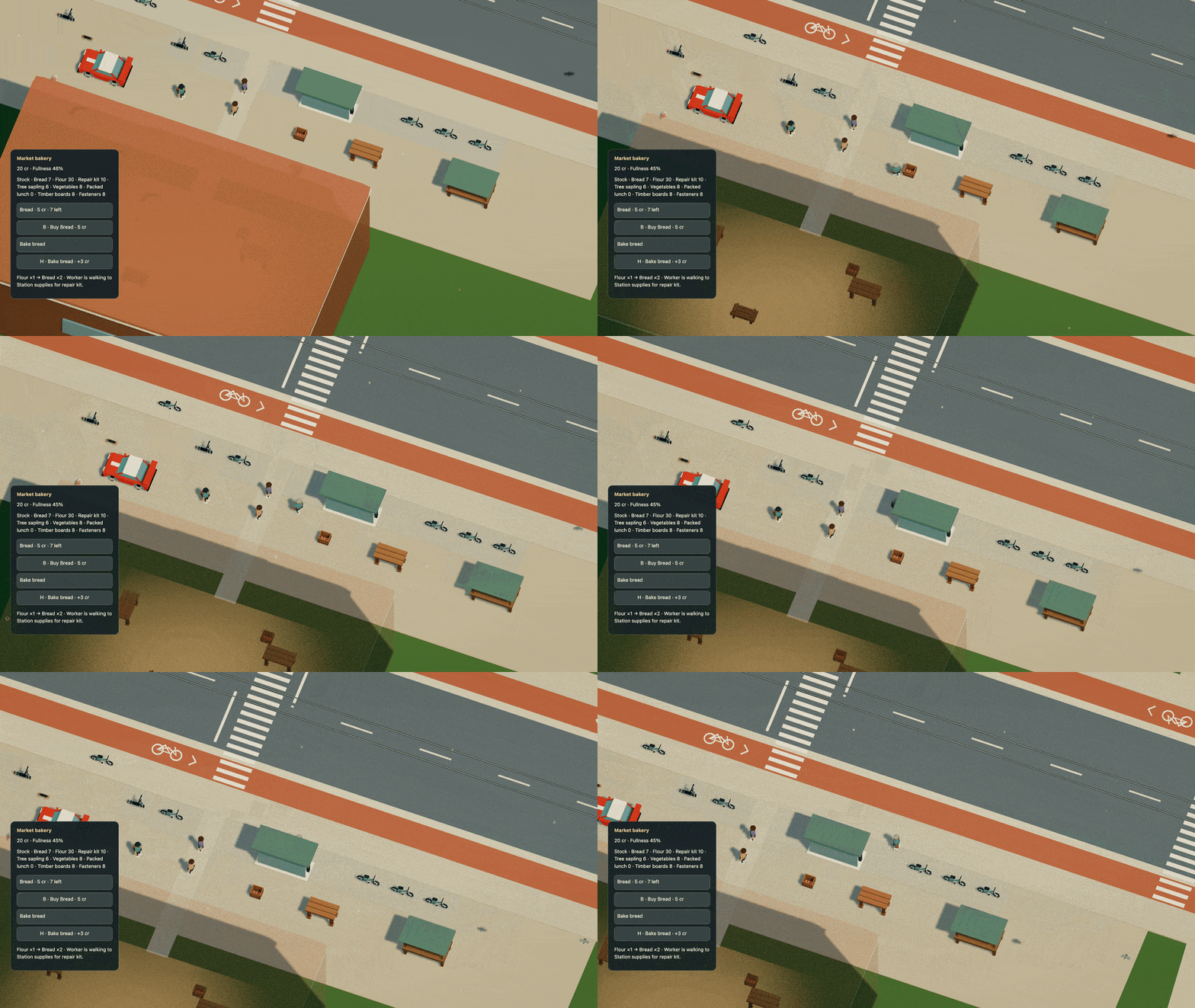
The caretaker now repairs and resupplies the neighborhood. If two replacement kits or saplings will fit on the bakery shelf, they can walk to the station, collect the shipment, bring it back and return home. Local food choices and available repairs take priority. Supplies, invoices and wages stay finite. The player can still take the same delivery contract.
Supply trip in HD · Animated trip
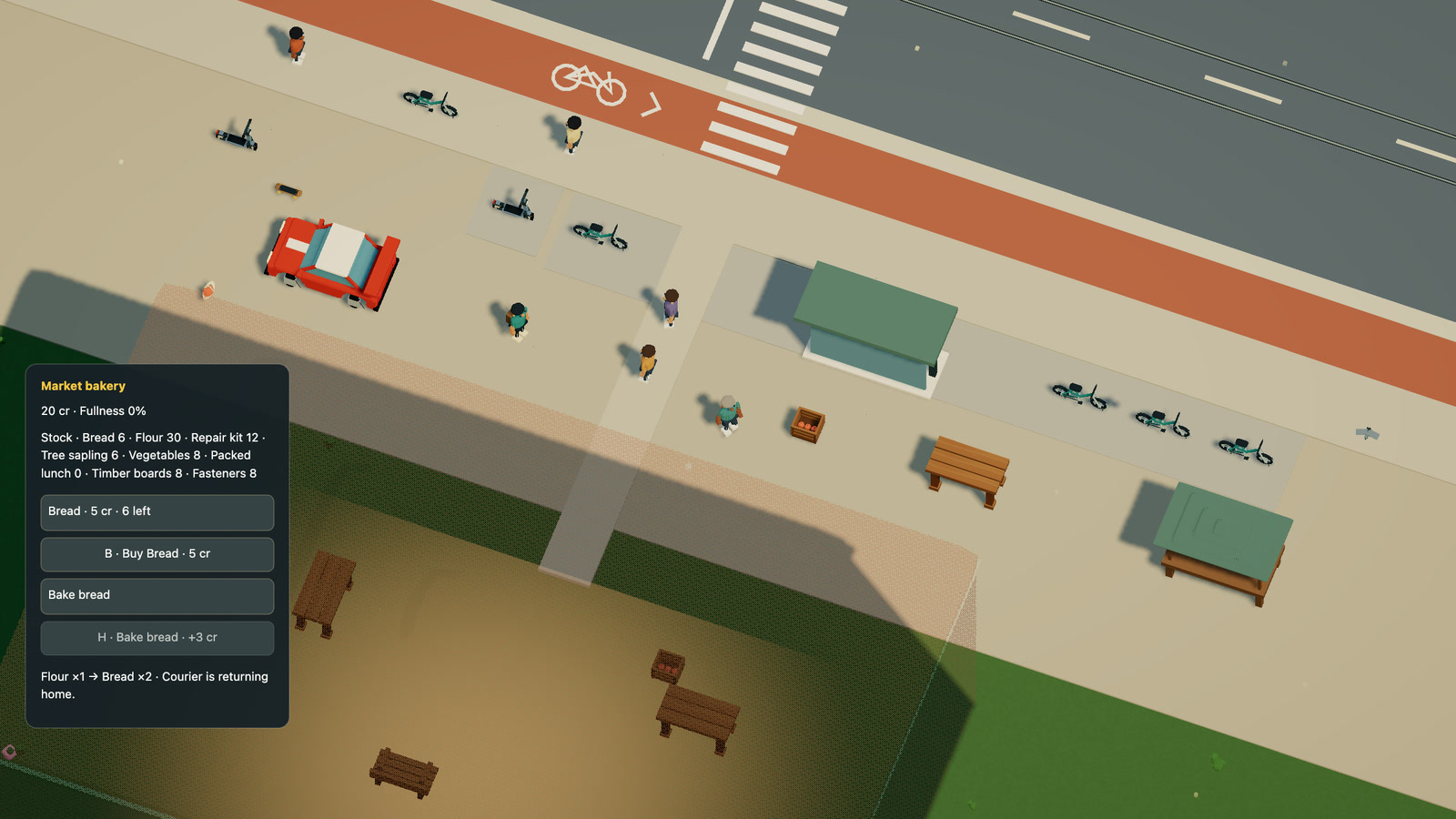
Handoff in HD · Animated handoff
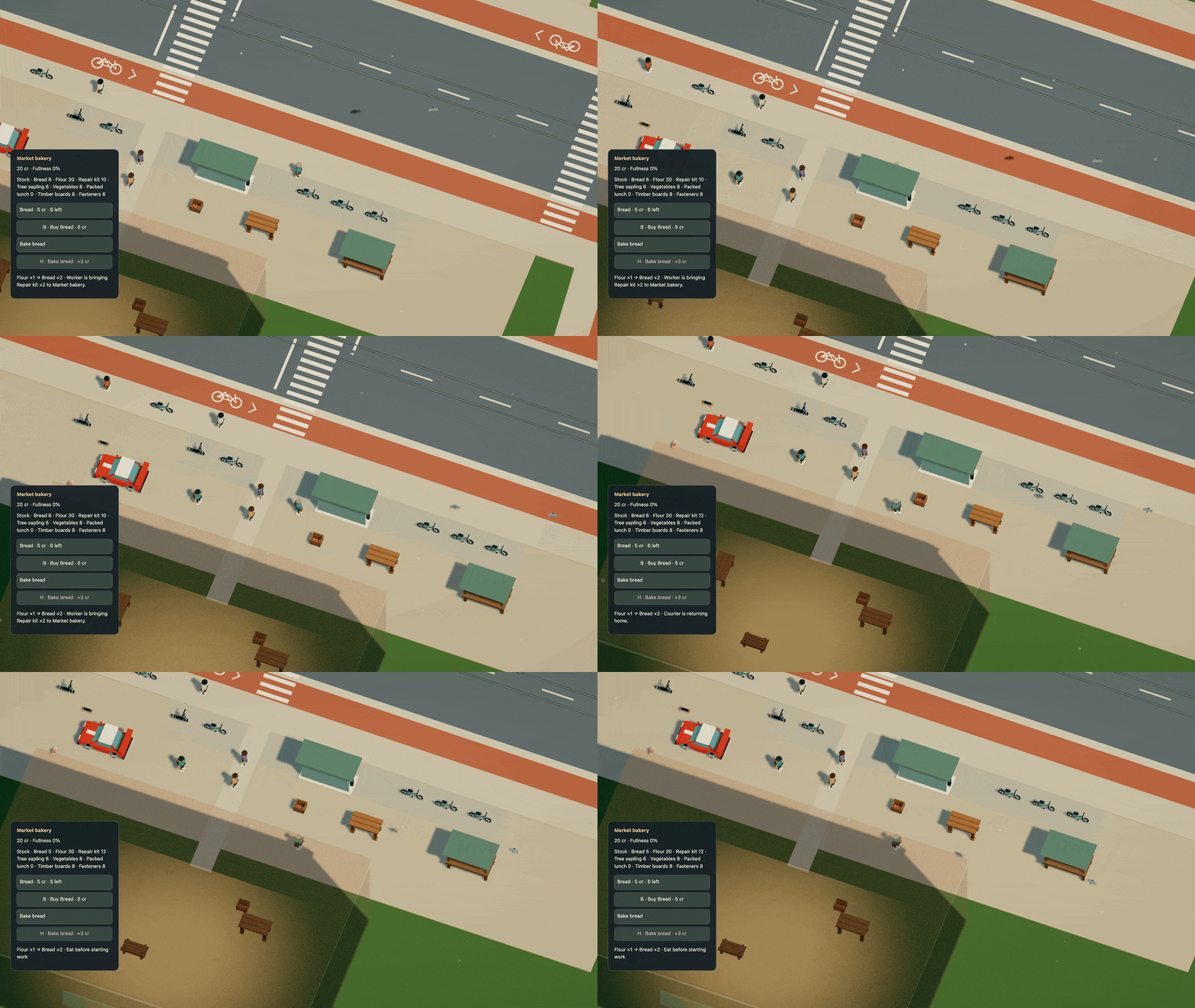
These declarations come from the complete runnable courier world:
 account regular(actor=customer,credits=20,capacity=4,satiety=65,drain_s=.05,shop=true,repair=yard_furniture,deliveries=[kits_run]);
 delivery kits_run(label="Bring repair kits",from=depot,to=corner,good=kit,quantity=2,pay=4,price=3,capacity=1,on=work_yard,grounds=[remote_yard]);
account.deliveries is an ordered list of 1..4 unique contracts. It can accompany
repair duties, but excludes automatic production work. The actor needs a stationary
home inside the receiving market's on ground and interaction radius. Market
vendors stay at their businesses. The player never gets an automatic policy.
Delivery on declares the receiving work ground. Optional grounds adds 1..7
unique convex areas for off-pavement approaches, such as the example's depot yard.
A supplier already on accepted pedestrian pavement needs no extra ground. These
areas create no road or paving. The complete-world compiler checks pickup,
handoff and return from every assigned home, using sidewalks, crossings and
supported bridge pavements. Public roads, cycle tracks and water are not shortcuts.
Walking to pickup holds one shared contract slot. It reserves no stock, money or shelf space yet. Collection rechecks the same rules as a player collection. If stock, funding or shelf space changed, the worker returns empty-handed without a wage or a refund of goods they never took. Collected cargo uses the existing sealed delivery reservation. Handoff pays the supplier and worker once.
One commitment owns the worker's position, program clock and walking animation. Vehicles can block a crossing; the worker waits and retries. Pickup, carrying and return paths survive streaming, R and save/load. Restoring performs no offline travel. Identical ordered delivery grounds share one prepared topology; the same 4096 local samples, 8192 nodes, 32768 links and 128 saved waypoints apply. Existing NPC, live-rig, physics and render-quality limits stay unchanged.
This is walking resupply through a finite depot. It adds no upstream production, courier vehicle AI, general logistics scheduler or item pickup body.
Pickup and handoff approaches stay less than four world units above/below the vendor. A steep unsupported counter needs a level, connected approach before the courier can use it.
Work inside a building
The market hall now has a usable ground floor. Stand in its foyer with a clear line through the doorway to buy, sell, begin baking or talk to the vendor. Walls block these interactions. Existing work cancellation, finite stock and conserved wages still apply. The vendor remains at the entrance; this does not add a restaurant or another business.
repair.on / repair.grounds and delivery grounds may name a placed building with an interior. The engine reuses its rotated floor footprint instead of a separate painted polygon. The live furniture service adds market_hall to its extra grounds; the worker uses the same doorway, floor and wall contacts as the player. No new worker, actor slot, inventory or money is created.
Customers with somewhere to go
The commuter now takes a meal break. You or the vendor can prepare a lunch at the market and leave it on the shelf. When hungry, they walk there, pay 8 credits, take one lunch, eat, and return to the point where they left their usual route. If you buy the last lunch first, they return without it. Money and food use the same transactions as yours.
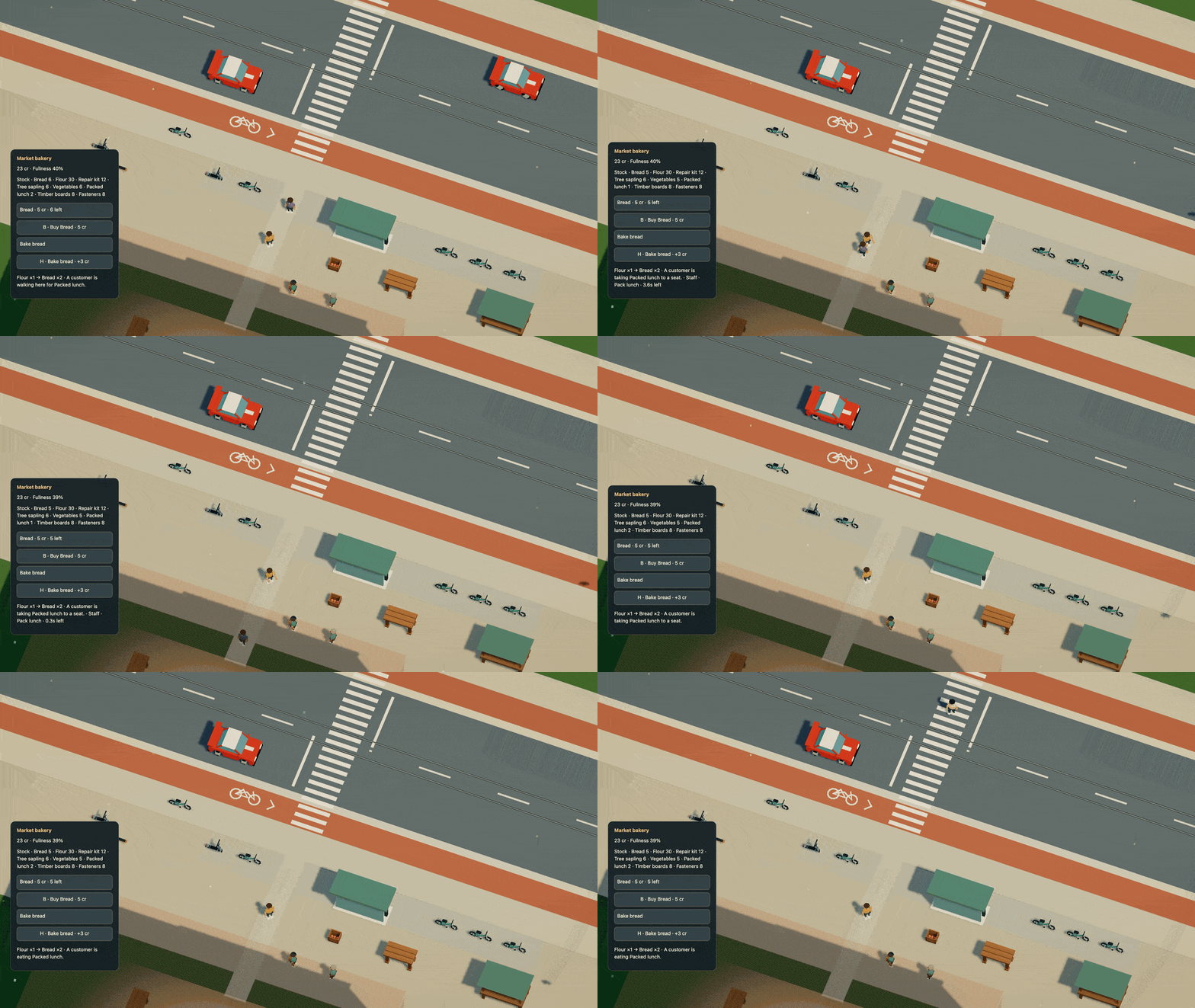
Watch in HD. This sixteen-second recording starts near the end of the actual walk to the market and shows the purchase and the walk toward the hall. The seating clip shows eating inside and the beginning of the return. The complete return takes longer. It is an offline capture with 30 rendered frames per simulation second, not a live performance measurement.
The shop panel shows waiting demand, approaching customers and eating. Their routine pauses until they get back; their position, food, clock and money survive leaving the area and reloading. Food is not reserved before arriving at the shop. Another customer can take the last item, and a vehicle can make the walker wait. This is a meal errand. Optional shared bench seating connects the meal to the indoor floor; restaurant queues and table service remain separate work.
Dream owns the choice of food, ordered markets, walking grounds and eating time:
dream 2;
material blue(style=toon,colors=[#537eaa,#3c5f87]);
material skin(style=toon,colors=[#c59774,#a97655]);
object pedestrian(label="Pedestrian"){
  measure(kind=person,axis=y,meters=1.8);
  body(interaction=decor,radius=4,height=18);
  part torso(shape=capsule,material=blue,at=[0,11,0],size=[5,6,4]);
  part head(shape=sphere,material=skin,at=[0,16,0],size=[4,4,4]);
  part nose(shape=sphere,material=skin,at=[2,16,0],size=[1,1,1]);
  repeat legs(index=i,count=2){
    joint leg(at=[0,8,i*3-1.5],motion=swing(axis=z,deg=18,hz=.6,phase_deg=i*180)){
      part shin(shape=capsule,material=blue,at=[0,-4,0],size=[2,8,2]);
    }
  }
}
behavior welcome(start=waiting){
  state waiting(action=idle){on talk(event=interact,to=hello,radius=55,familiar=false);on again(event=interact,to=returning,radius=55,familiar=true);}
  state hello(action=idle,face=player,say="Hello. Welcome to the neighborhood."){
    on ask(event=interact,to=about,radius=55);
    on finish(event=after,to=waiting,seconds=6);
  }
  state returning(action=idle,face=player,say="Good to see you again."){
    on finish(event=after,to=waiting,seconds=6);
  }
  state about(action=idle,face=player,say="I like walking by the river. See you around."){
    on finish(event=after,to=waiting,seconds=6);
  }
}
place neighbor(object=pedestrian,at=[580,710],role=npc,behavior=welcome);
world(size=[4000,2400],spawn=[525,609],heading_deg=0);
road circuit(width=118,points=[[300,590],[660,590],[810,500],[810,220],[660,130],[300,130],[150,220],[150,500]]);

checkpoint start(at=[480,612.5],dir=[1,0],width=100);
checkpoint east(at=[828.75,360],dir=[0,-1],width=100);
checkpoint north(at=[480,107.5],dir=[-1,0],width=100);
checkpoint west(at=[131.25,360],dir=[0,1],width=100);

place customer(object=pedestrian,at=[760,730],role=npc,behavior=welcome);
surface plaza(finish=terrain,points=[[530,680],[820,680],[820,816],[530,816]]);
economy(){
 good bread(label="Bread",food=45);
 good flour(label="Flour");
 account pocket(actor=player,credits=20,capacity=8,satiety=40,drain_s=.05);
 account baker(actor=neighbor,credits=0,capacity=4,satiety=65,drain_s=.05);
 meal bakery_break(good=bread,markets=[corner],on=plaza,eat_s=4);
 account regular(actor=customer,credits=20,capacity=4,satiety=25,drain_s=.05,meal=bakery_break);
 market corner(label="Corner bakery",actor=neighbor,credits=100,radius=70){
  lot bread_shelf(good=bread,quantity=8,limit=16,price=5);
  lot flour_sack(good=flour,quantity=12,limit=12);
 }
 work bake(label="Bake bread",market=corner,input=flour,take=1,output=bread,make=2,seconds=2,pay=3,effort=12,capacity=1,target=4);
}
meal allows up to eight plans and four unique markets per plan. Every listed
market needs a priced lot for the selected food. eat_s is 1..12 simulation seconds.
on and up to seven additional grounds use convex activity surfaces or interior
floors and the existing pedestrian network. Complete-world acceptance checks every
assigned home, shop approach and return. It creates no sidewalks or road shortcuts.
The local grid, sparse graph, path, actor, rig and physics limits stay unchanged.
A meal account is a measured person NPC with a decor body and a program. It may
have a walking route. It cannot own a market or mix this policy with shop,
production, repair or delivery duties. At fullness <=40 it eats carried food first,
otherwise checks markets in authored order for an affordable, stocked round trip.
Arrival rechecks range, sight, funds, stock, capacity and treasury before paying.
Purchased food remains owned until the eating timer completes. Failed purchases
return empty-handed. Saving an outgoing, eating or returning customer preserves
that phase and cannot repeat a purchase or consumption.
The staffed bakery composes the same jobs, customer meal plan and flour delivery. It works without player cooking, while keeping player jobs and all finite transaction checks available. The panel names active staff work and its remaining simulation time.
Furniture seats are named object-root seat declarations. Optional meal.seats
references 1–4 unique furniture placements, with complete humanoids, connected
approaches and shared player/NPC claims. Author shared seating.
Staff attendance
An optional daily shift gives a stationary staff account a connected rest destination. Finish committed work, walk out, rest and physically return. Counter trade, production and cargo handoff wait for attendance. The baker and school staff use it in the live mock; no idle wages or employment contracts exist.
Shared meals reserve two portions from the player or NPC host and an adjacent seat. NPC hosts buy food with their own money and wait for Y/X consent. The companion physically walks over; both portions are consumed once on completion. Interruptions refund the same owner, and completed time changes that person’s remembered dialogue.
Garden park furniture
garden_work extends the existing furniture service to six more benches and four
lamps. Both park entrances join the accepted pedestrian network; the caretaker
walks from the market, reserves a real kit and wage, and restores the same usable
furniture. These ten targets are part of the live 449-target service. The ground
uses the remaining existing service-ground slot and stays within the 4096 local
sample and 8192 network-node budgets. Paths and park authoring.
City fixture coverage
The live caretaker can reach all 413 lamps across the city's 32 streets, alongside 18 existing furniture and wall targets. Dream still declares the service's streets, grounds, categories, kit, pay and duration. The engine derives short access patches with room for the worker's complete body to join the sidewalk. Approaches remain inside the declared verge and clear riding surfaces and water; they do not create paths across arbitrary grass.
Compile the full-verge example. Its lamp stands 22 units beyond the outer sidewalk edge, within the declared 24-unit verge. A connected worker approach reaches it through the crossing. The example uses a complete measured humanoid rig, the same twelve bone bindings as the city.
Airport repair in HD · Animated repair · Coverage, migration and native checks
The same caretaker and finite market stock serve these jobs. Distant walks can
be long; there are no regional crews or maintenance vehicles yet. Returning,
eating, supplier deliveries and other duties use their existing rules. The separate
planting service now covers 106 trees, including all 93 furnished street trees,
using verge=112 and the same connected sidewalks. Wide services derive supported
turns around pavement corners when a straight connection would cut the road.
They create no new paving. Its 5,380 navigation nodes and 20,422 directed links
fit the unchanged network caps. Wind-tree example.
The 239 trees beyond those work areas and other structural damage still need
declared recovery coverage.