The asset library
Dream 2 docs / Assets
The mock world contains 109 reusable assemblies, all written in Dream 2. The assemblies include vehicles, buildings, wildlife and several layers of vegetation, with window frames, wheel hubs, bark markings and irregular foliage. Footballs and basketballs are measured bounce props, connected to playable grounds through sports data.
The live world's voxel_world policy converts all of these to occupied-cell geometry after linking. Profiles and beams remain compact shape stamps in Dream, with materials, measured envelopes, joints and destruction ownership preserved. How the whole world is constructed. Standalone examples without a world policy retain their original shaped rendering.
Shared interaction rules keep table and bench variants on one policy per category. The older Wayside bench now has detachable boards and armrests, with its foundation and supports retained. Its intact dimensions, materials and joins stay the same.
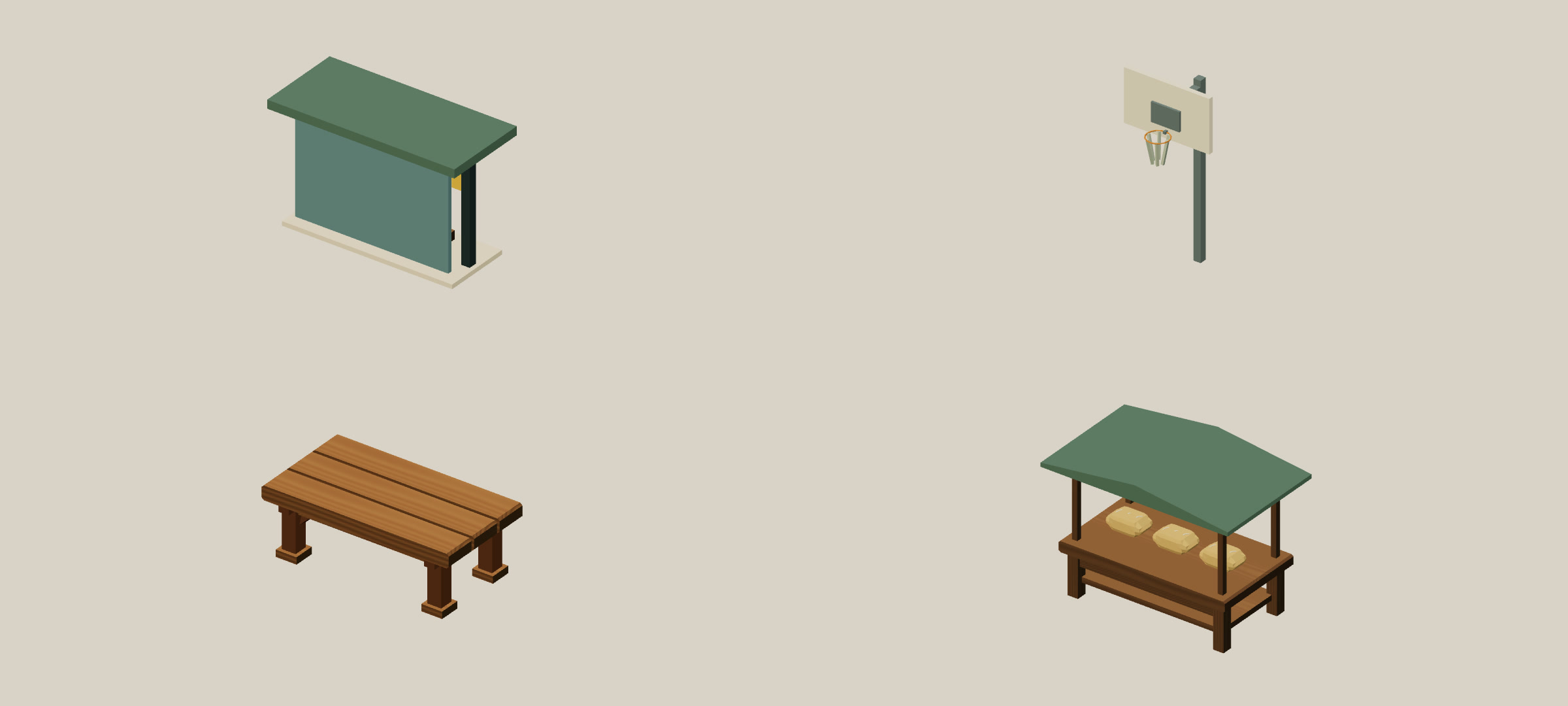
Shelter seats stand on two supports. Table planks rest on crossrails that stay attached to their leg fragments when the table breaks. The produce stall has a supported canopy and lower shelf. Fruit in the breakable crate forms contacting stacks supported by its floor. The world audit records the construction and path checks.
The furniture construction pass covers all 18 placements of the slatted bench, breakaway table, produce crate, clay planter and produce stall. The table is about 78 cm high; all ten slatted benches keep their usable seats. Complete Dream source.
What's in the world
| Family | Assemblies | Source |
|---|---|---|
| Transport | Field pickup, parcel truck, rally car, town car, hatchback, delivery van, scooter, city bus, tram, regional train, plane, launch, bicycle, skateboard | Street assets, Transit, landmarks, activities |
| Housing and shops | Three terraces, garden and courtyard homes, three apartment types, corner shop, bakery | Architecture |
| Civic and work | Enterable market hall, hospital, two schools, college, offices, library, workshops, stations, boathouse and pavilion | Market interior, civic assets, architecture |
| Airport and eastbank care | Glazed terminal, gabled hangar, control tower and medical center | Airport assets, Civic assets |
| People | Commuter, vendor, teacher, health worker, shopper, student, neighbor, resident, football and basketball players | City people, sports |
| Wildlife | Pigeon and gull flocks, live deer and route gull, roaming deer, hares, foxes, dogs, cats and sparrows; the library also defines kites | Fauna, habitats |
| Vegetation | Oak, pine, amber tree, birch, fir, rowan, apple, willow, ferns, flowers and shrubs | Nature, flora, landmarks |
| Props and destruction | Produce stalls, table, crate, planter, ball, slatted benches, toppling trees and breakable shop porches | Civic assets, impact props, destructible furniture |
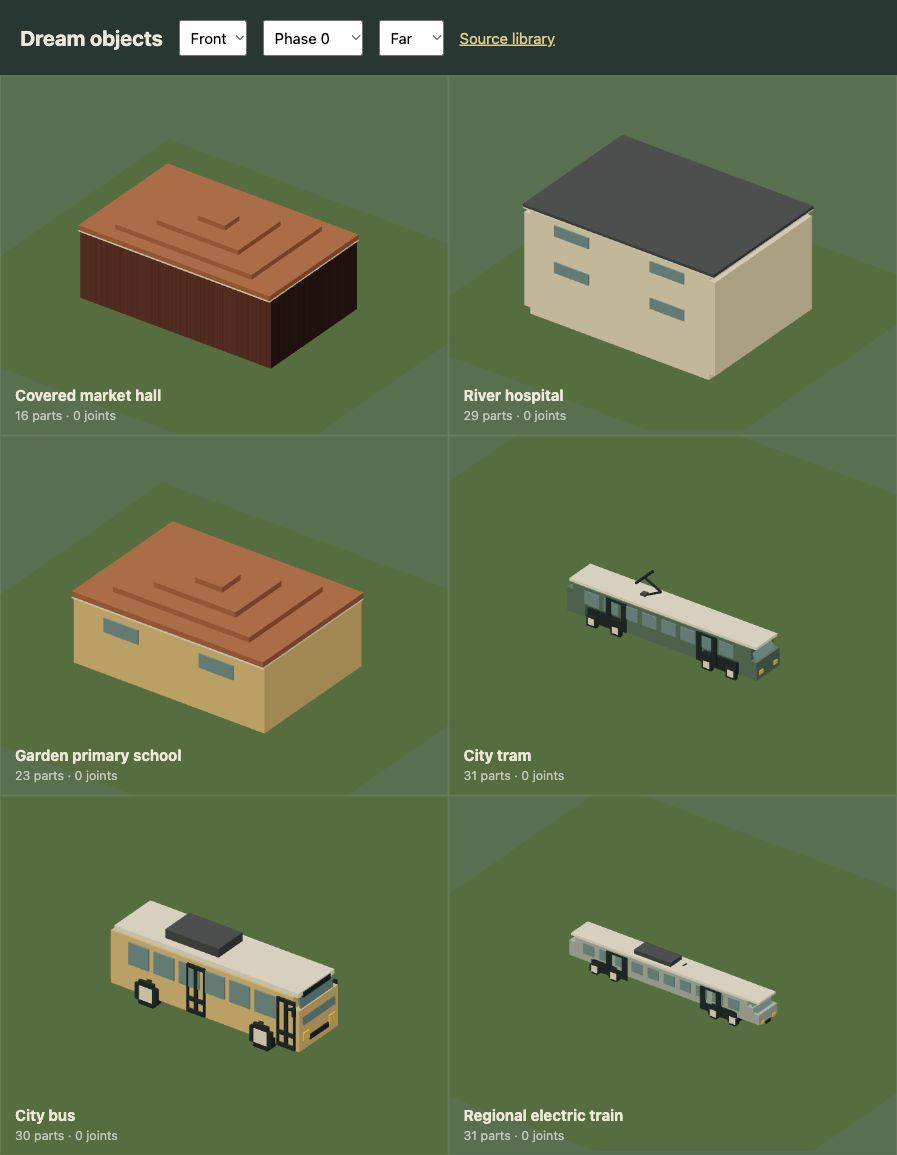
The seated traveler and standing Explorer are separate engine-provided Dream assemblies, with a shared face and matching clothes. The Explorer, eight civic characters and four sports variants use twelve bound joints for walking and running. The outfits include coats, aprons, skirts, hoodies, gloves, backpacks and carried items, with different hair, glasses and facial hair. The Explorer also crawls and treads in water, and keeps its own physical size when switching to a seated vehicle pose. Bread and a harvest bowl remain standalone authoring examples. Open the full atlas, or follow the local gallery setup for interactive inspection. Front, right, back and left views share the same geometry. The phase selector exposes wheel and joint motion.

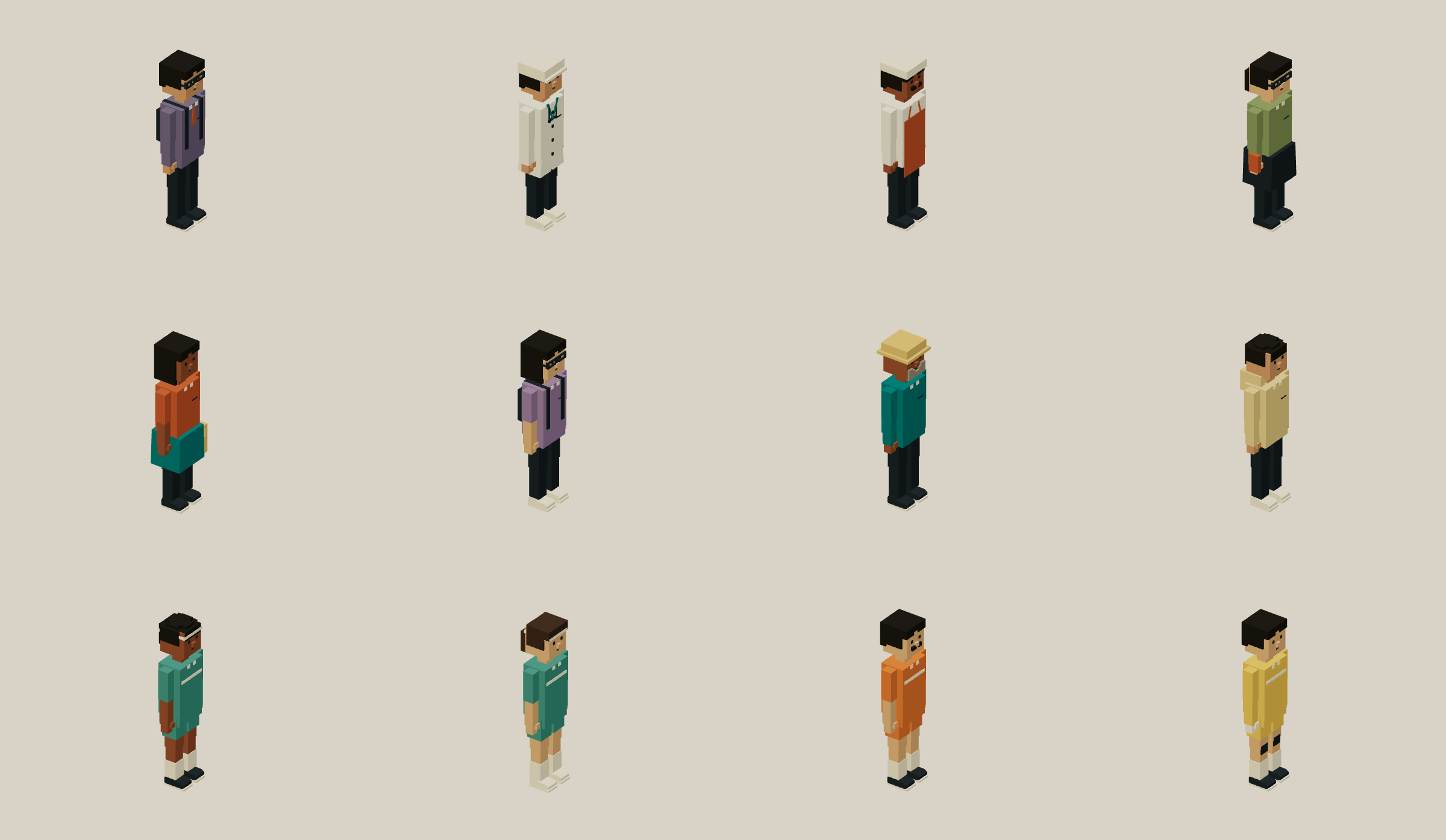
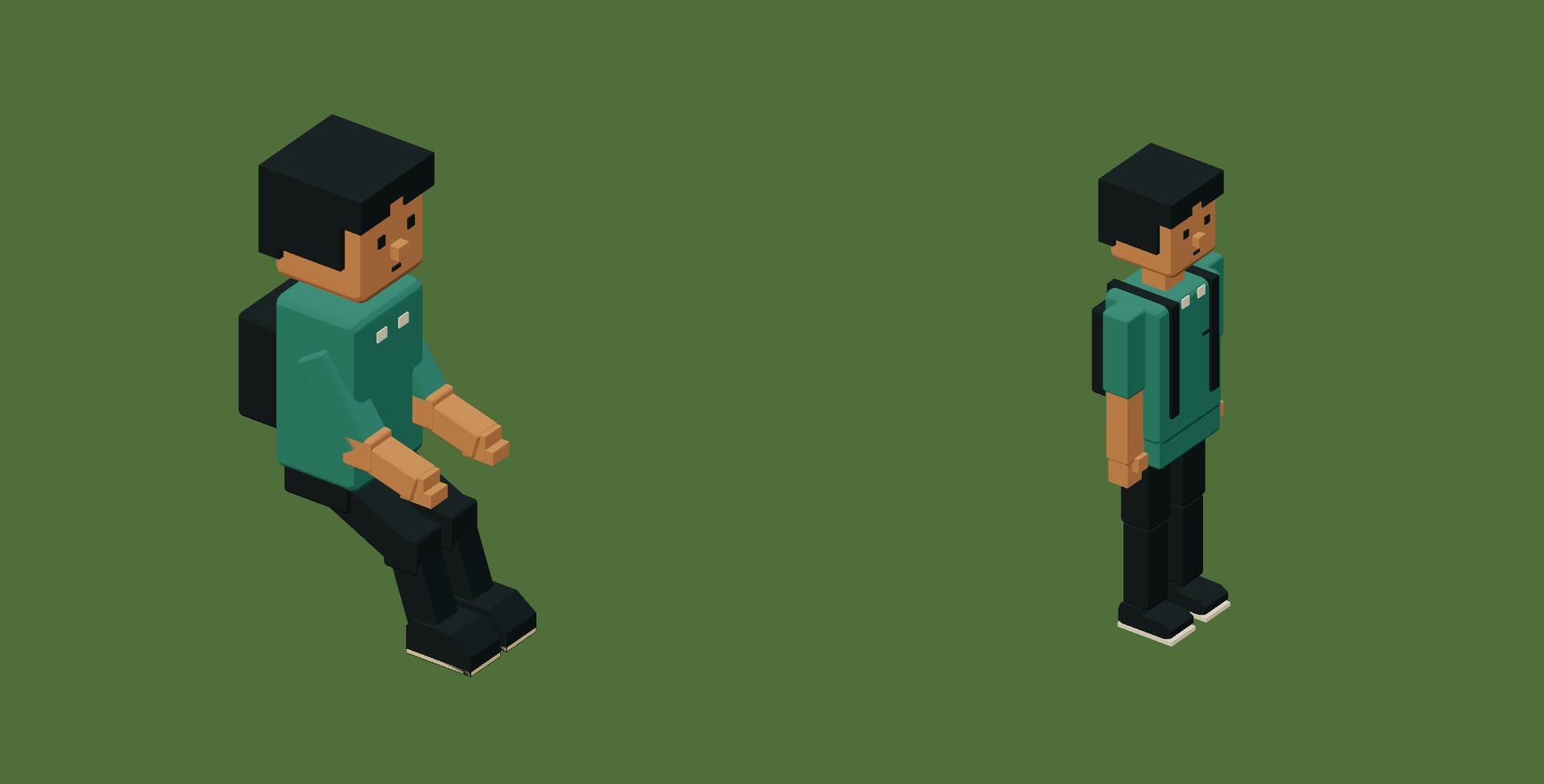
Compose people and clothing · Character motion and bone bindings.
Buildings and transport with recognizable construction
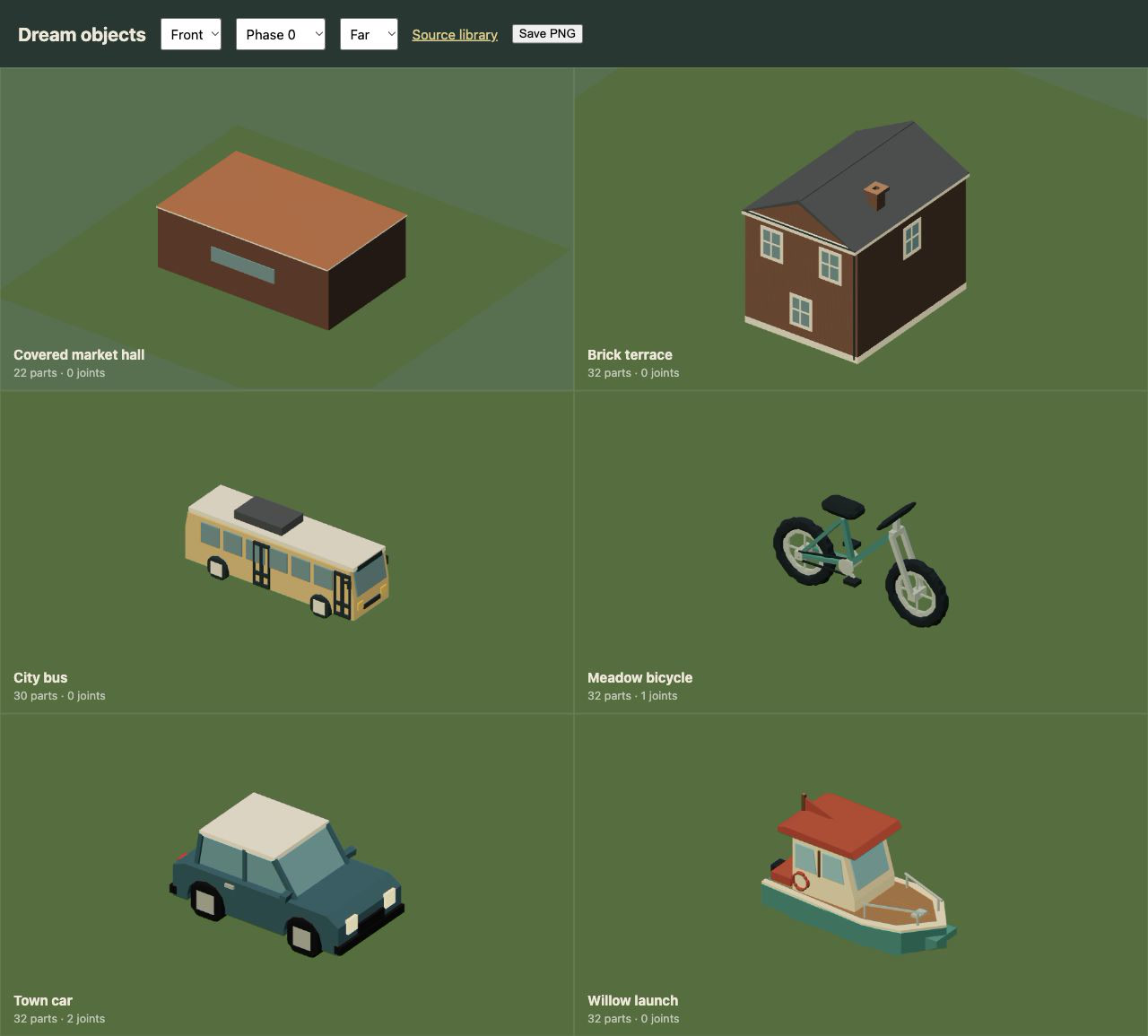
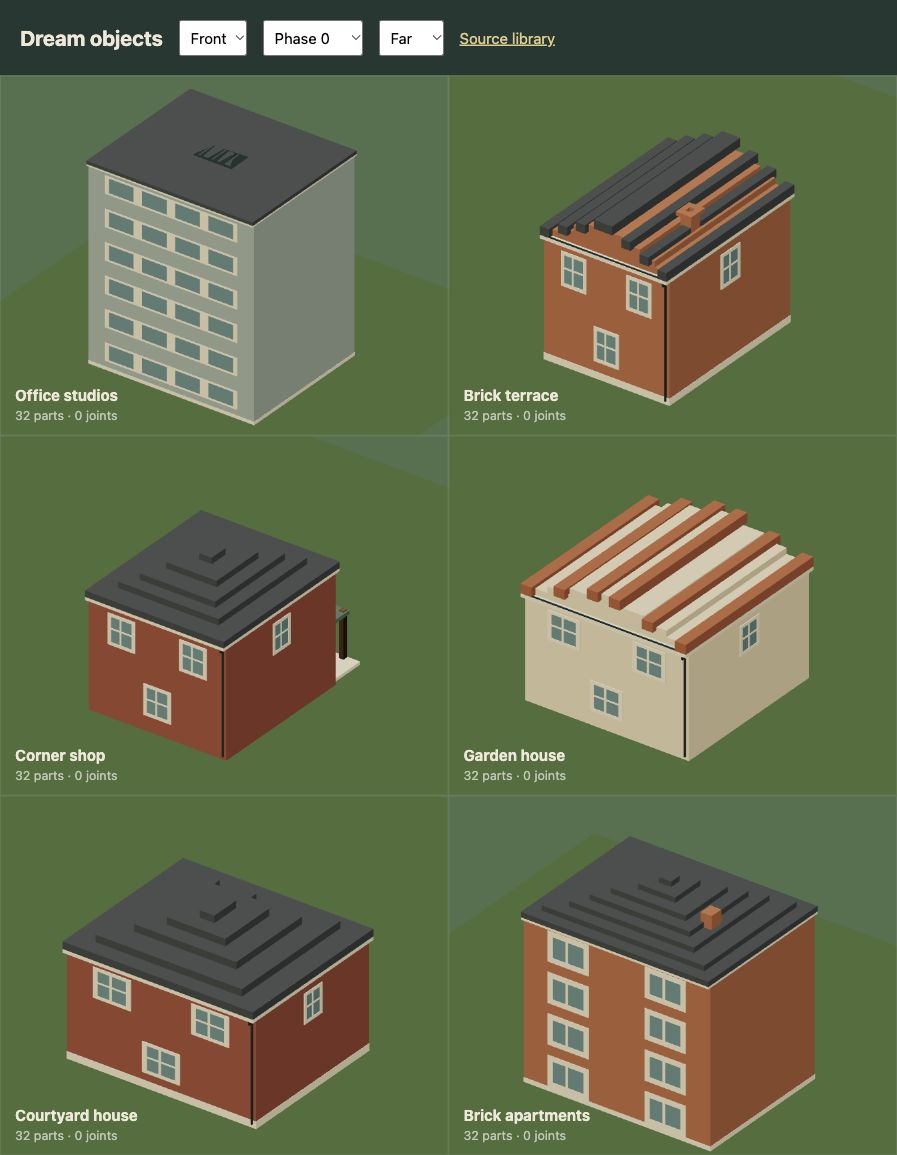
The eleven housing, shop and office templates use shared carved window frames, inset glazing and panel doors. Gabled roofs close over attic walls; gutters lead into bent downpipes. Apartment guards have slender posts, and porch supports meet their slab and canopy. Offices have six floor bands rather than a few oversized windows. Brick uses a masonry-colored surface instead of wood grain.
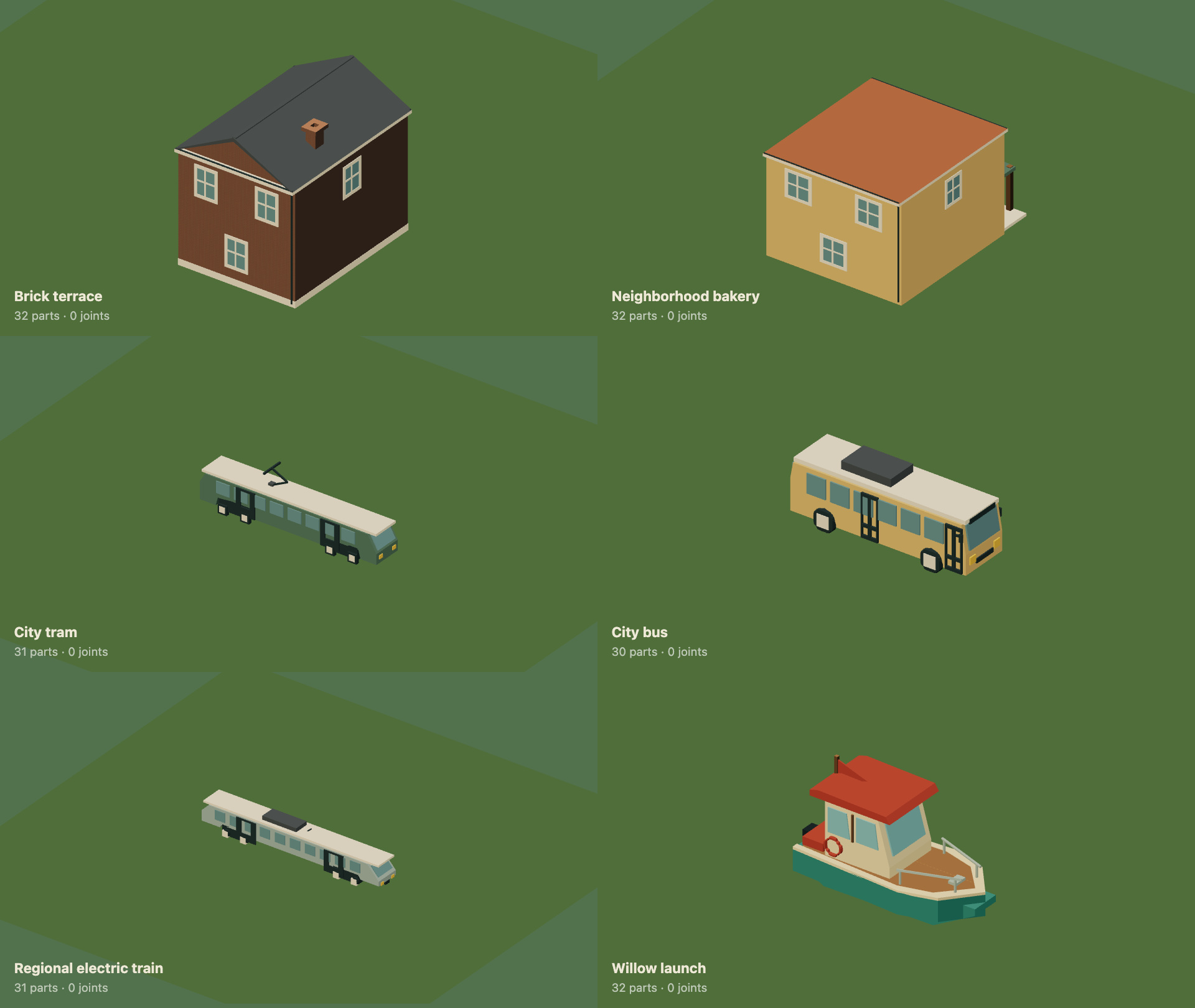
The bus shell has wheel openings, a sloped cab, two passenger doors, repeated window bays and a rooftop cooling unit. The tram and regional railcar have separate cab ends and two four-wheel bogies; the tram's folded collector sits on an insulator. The launch has a keel, pointed upper hull, deck, wheelhouse, guard rail, mounted outboard and fitted helm seat. It remains a six-metre arcade boat.
Fifteen templates cover 197 live placements. Their measured scales and existing physical bodies are preserved, and the bakery's porch remains a separate break zone. Dream 2's visual size minimum is now .1 local units; the v1 minimum remains .5. Finer trim doesn't add physical contacts or raise the 32-part cap.
Construction guide and reference cues · Complete house · Complete bus · Complete launch · Checks and media audit.
Ground vehicles built around their mechanics
The rally coupe, cream-roof town car, compact hatchback and panel van now have different silhouettes. Extruded Dream profiles form sloped cabins and wheel openings. Pillars meet their roofs and shells; lenses sit on their panels. Axles, hubs and tires share rigid bearing frames, with suspension crossmembers connecting them to the body. The racer's visual body travel is limited to five centimetres so its tires stay clear of the openings during a landing.
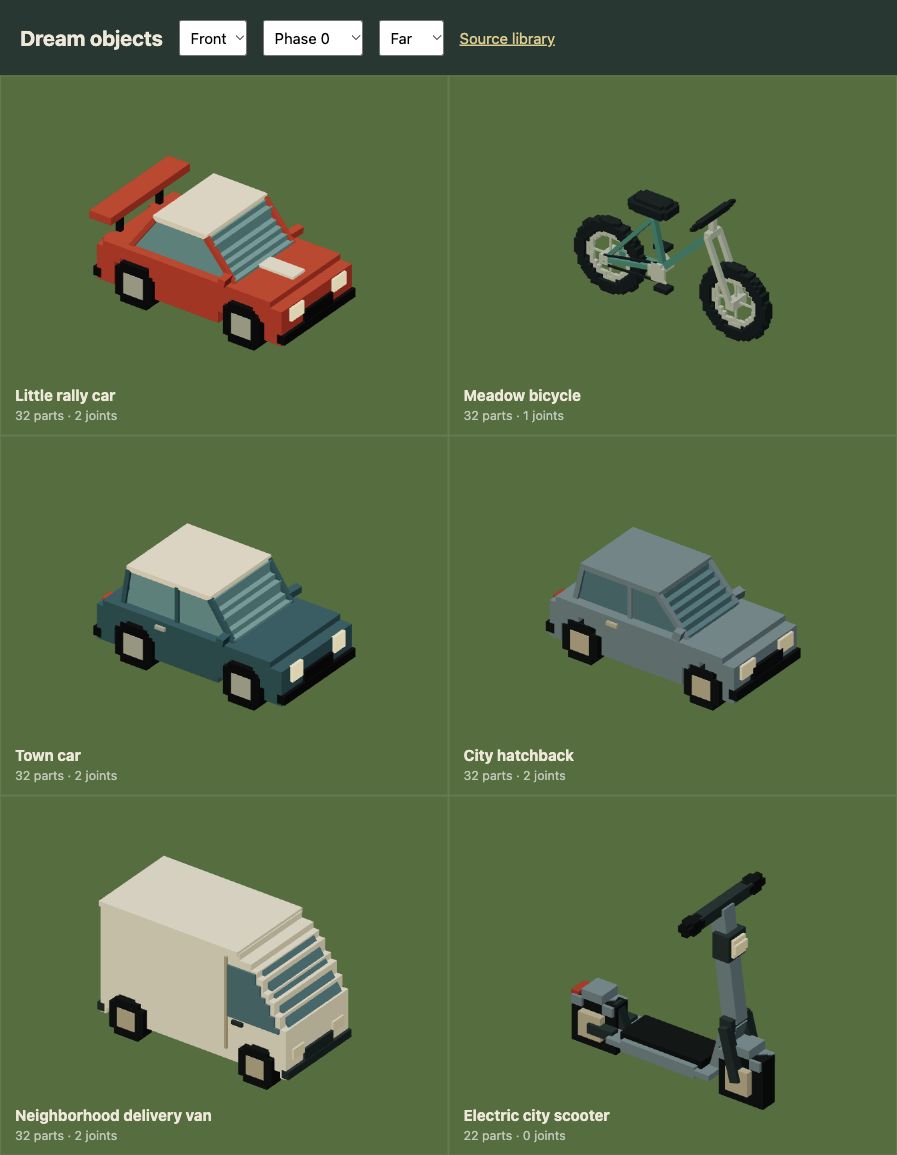
The bicycle is a step-through city frame with paired rear stays, fork blades, mounted axles and a chain line between its rear cog and chainring. Crank arms and pedals turn together around the bottom bracket as it travels. The scooter has a lower deck, paired fork and rear supports, shaped fenders, a brake mount and a headlight housing. The existing collision cylinders and measured vehicle lengths are preserved; neither model adds mesh-shaped physics.
Complete car · Complete bicycle · Prisms and rolling joints · Verification and media audit. Unoccupied bicycle cranks keep their saved phase in instanced poses, then animate by distance when boarded. The cars batch into three or four meshes each, and the bicycle into four. The shared seated rider has the Explorer's face and clothes; its static legs do not yet follow the pedals.
A light aircraft that holds together
Cloudhopper has a continuous tapered fuselage, a glazed cabin, braced high wings, rounded tailplane, rudder, main landing gear and a supported tail wheel. Its 10.8-metre wingspan and collision cylinder retain their existing size. The seat sits inside the cabin. Wheels roll around their axles and the propeller turns around the nose shaft.
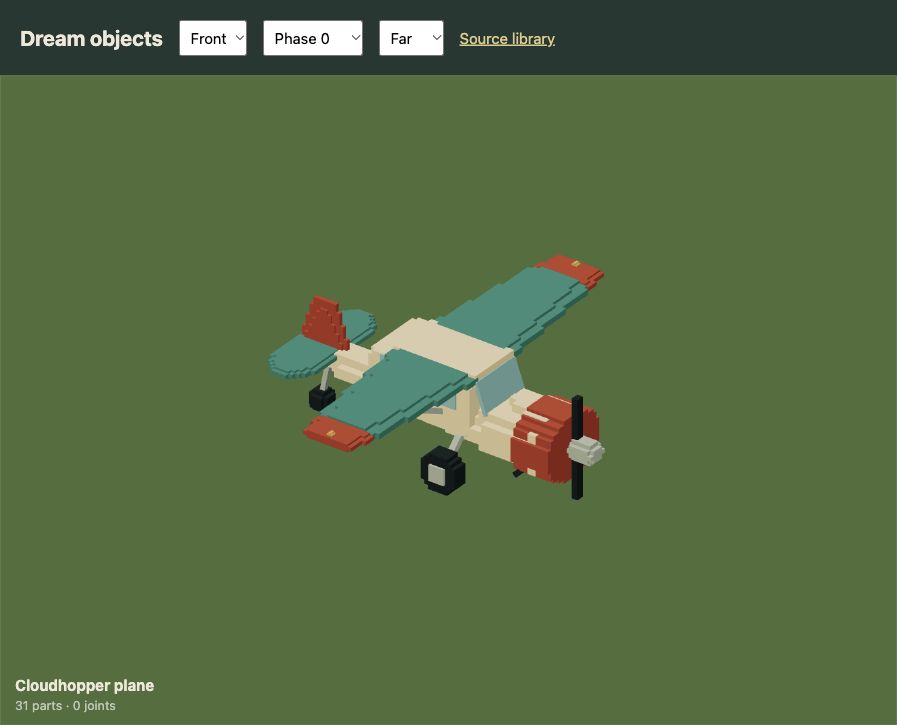
The wings use flattened, tapered cylinders. Each colored tip continues the inner section's end diameter and replaces its outer span. It doesn't cover another wing face. The old red boxes occupied the same top and bottom planes as the teal wing, which made the colors flicker as the view changed. Geometry fixes that overlap; the renderer keeps its existing depth, shadows and antialiasing settings.
Download the complete checked aircraft. Its 31 parts use existing Dream commands and compact into six render meshes with independent wheel and propeller pivots. The verification record includes four viewing angles, surface checks, boarding and a real simulation flight replay.
Adding useful detail
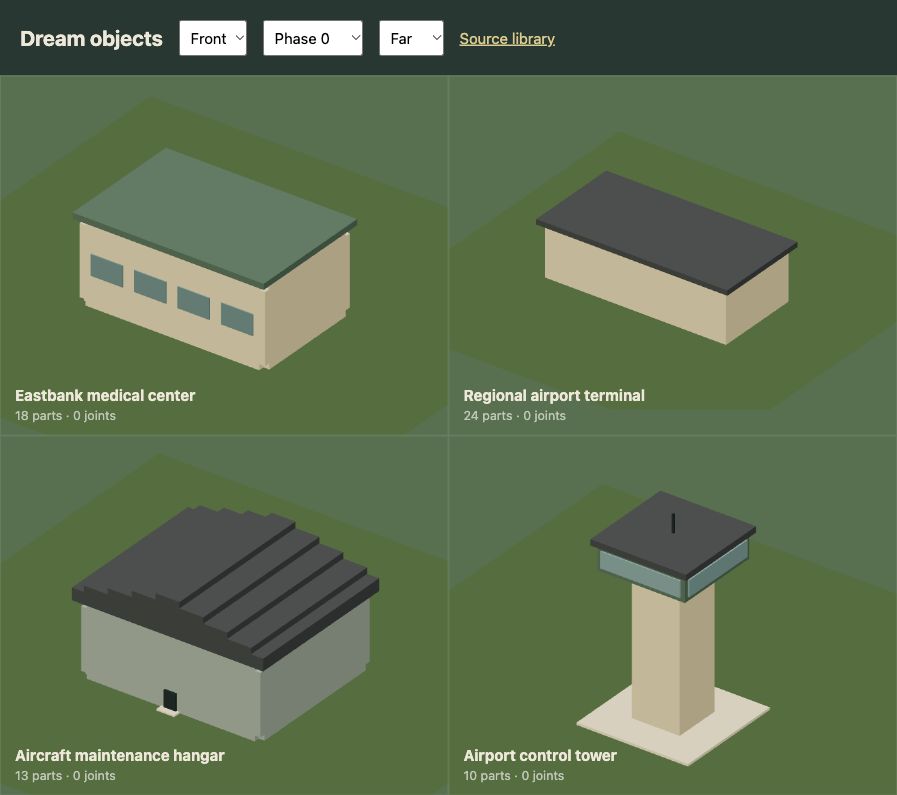
The new airport buildings use different structures: a long glazed terminal with a supported canopy, a gabled hangar with sliding-door panels, and a narrow tower carrying an observation cabin. Eastbank medical center has a separate entrance block and two floors of windows. Each uses static Dream parts with attached roofs, glazing and supports. Compose the exact terminal, or build a connected terminal, medical center and bus stop.
Start with the silhouette and physical size. Use endpoint beams for forks, braces and steering stems so the connections are explicit. Keep glass inside its frame, roof edges over their walls and canopies connected to a supporting building. Seeded deformation gives stone and foliage an irregular surface without adding a new shape or generating geometry every frame.
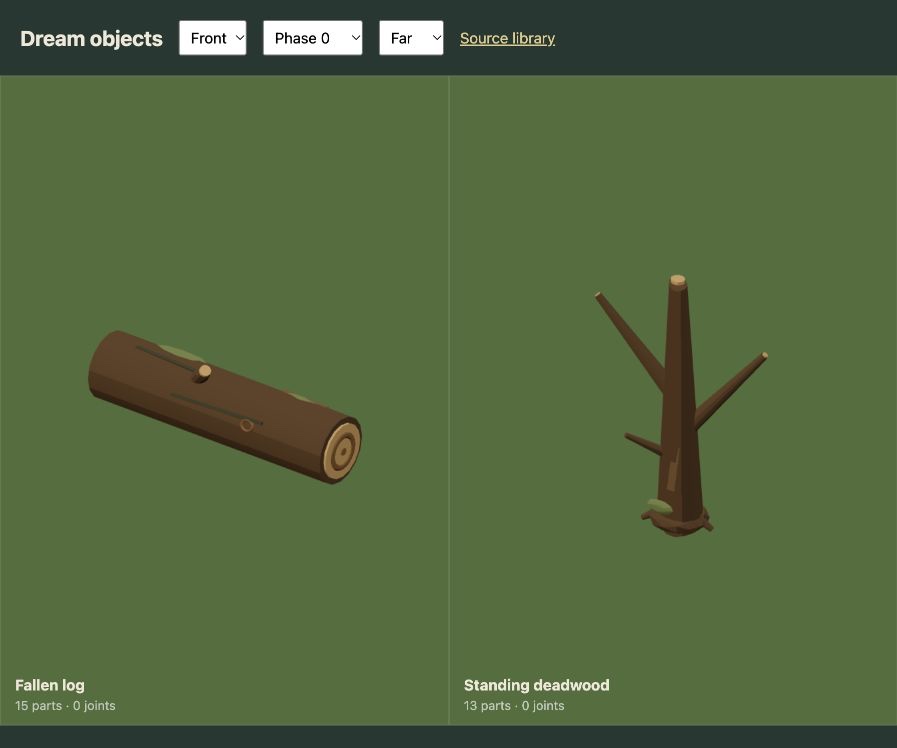
Deadwood uses a continuous tapered trunk, rising forks and smaller cut faces at the snapped ends. Fallen logs have bark scars, end grain and a short embedded branch stub. Their placements use varied headings while keeping the existing terrain support. Birch, oak and amber forks also start inside their trunks. The tapered wood example shows the underlying Dream 2 feature.
Both birches use pale tapered stems, rising forks and fine hanging twigs. Smaller leaf clusters leave the white branch structure visible; thin bark scars appear on the front and back. Each fork joins an existing stem, and each leaf cluster surrounds a branch tip. Their ten-metre height and authored collision bodies are preserved. The ordinary birch's foliage sways; the leaning birch keeps its whole assembly together during a fall.
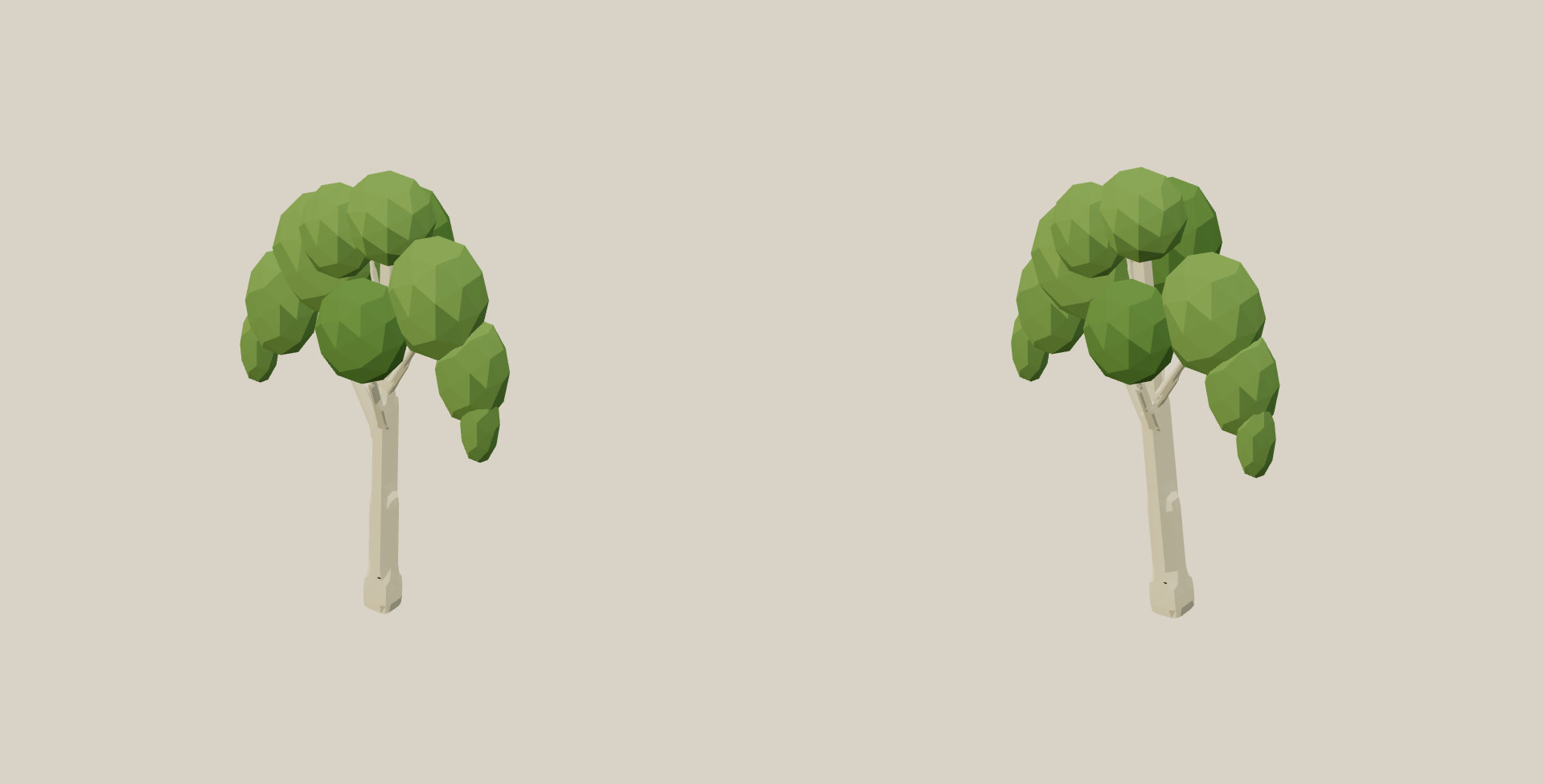
The birch verification record includes four viewing angles, terrain placement, destruction checks and the documentation media audit.
Details belong to their supporting coordinate frame. The baker's apron follows its torso; its cap and moustache follow its head frame. A bench's armrests leave with its frame; the new bakery's canopy and posts leave in its porch zone. Adding a bolt must not create an extra independent fragment. The usual limits still apply: 32 parts per object, eight release groups per breakable assembly, and the existing scene-wide animation and debris budgets.
Rigid parts sharing a material are batched inside each joint frame. Wheels and propellers keep their own pivots. Repeated scenery remains instanced, including its foliage motion and occlusion fade. Added visual detail doesn't add mesh colliders: roads, clearance, driving and impacts still use the engine's existing masks, heightfield and bounded bodies.
The art stays stylized and uses procedural geometry. This pass doesn't add imported meshes, image textures, skeletal skinning or a photorealistic material pipeline. The world and all model interpretation remain mocked.
Different layers of landscape
The flora library has ten distinct forms, including meadow grass and blue hydrangeas, mixed into the live woodland and meadow planting. Ferns and hazel sit around woodland, lavender grows through the drier east, and reeds and willows follow dry banks. Daisies, dock and foxgloves fill selected edges and clearings. Plant roots stay off the circuit, bridge decks and water surfaces. Small scale changes supplement different silhouettes.
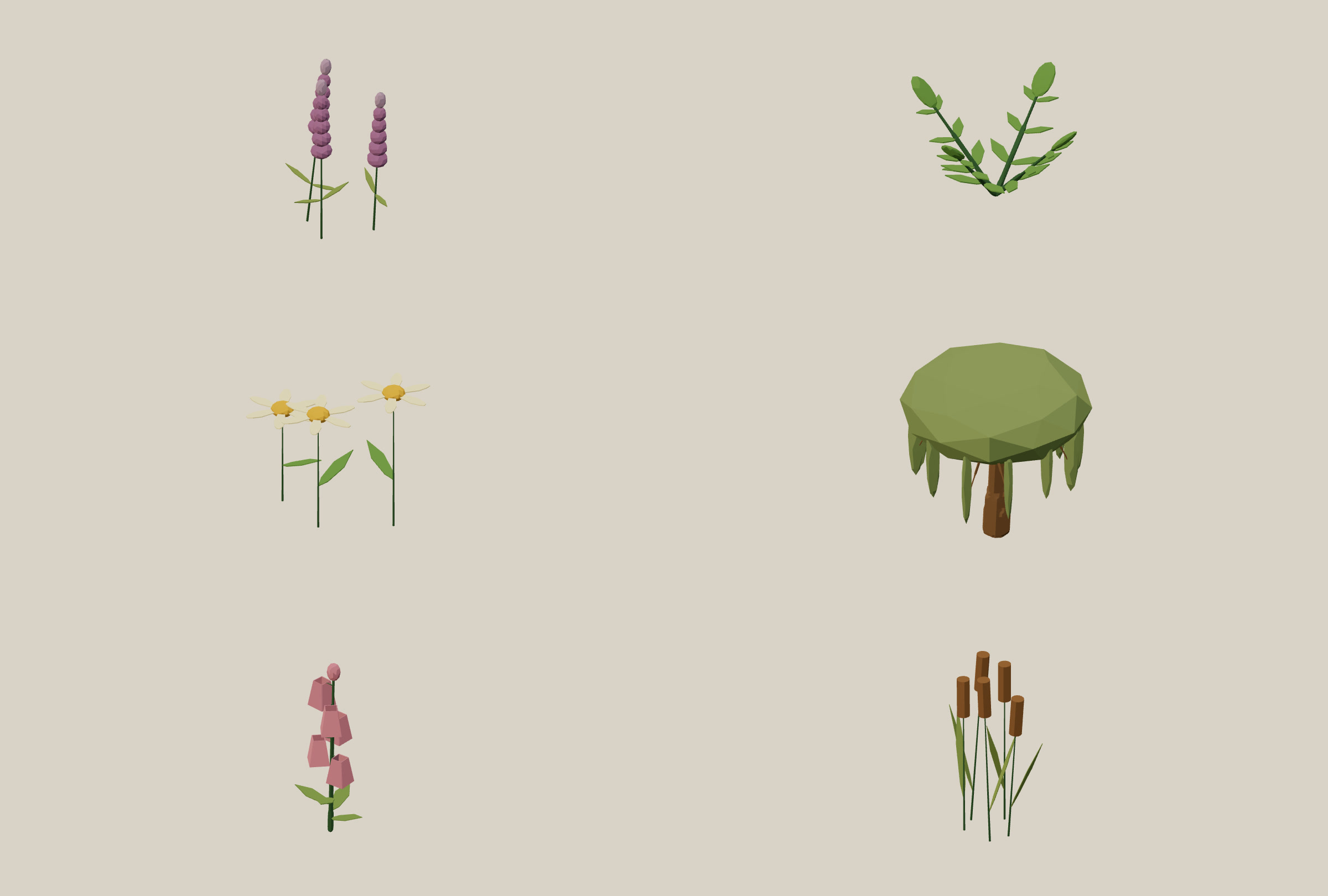
The live city uses a walking deer habitat and gulls above the river; the library also retains fox, hare and kite forms. Birds use continuous airborne ambient routes; walking animals follow clear, dry habitats. Individual route actors stay inside the existing actor and joint budgets. The 111 added pedestrians and 60 ground animals now use bounded ambient movement with shared GPU rigs: walkers stay on connected pavement and ground wildlife flees nearby players. Dogs and cats have four connected walking legs. Plants retain static instancing and shader wind. The behavior guide explains the ambient route contract and its current limits.
A planned town and sports park
The replacement adds terraces, apartments, neighborhood shops and civic buildings with different dimensions and uses. Apartments and offices have several floors; shops and homes stay lower. The blocks have street frontage, courtyards and sidewalks. Suburban driveways run toward their street instead of ending in random grass.
Football goals have connected posts and net threads. Basketball hoops have a supported backboard, a bracket that mounts the rim, and a hanging net. Four animated players practise kicks and dribbles; a commuter visits the market, and the vendor, teacher and health worker react near their buildings. The golf area has an authored fairway and flag. It is an explorable landscape rather than a golf simulation.
Buildings and furniture, sports and people, district layout. The full world stays within the existing 24 live jointed-assembly slots, including the standing character. People use compacted NPC meshes so they can face nearby players. Dream roles and programs choose patrol, activity, rest and proximity reactions; body dimensions and animation budgets stay the same.
Attached architecture
The new houses and civic buildings share dimensions across walls, roofs, doors, glass and supported porch parts. Roof bases meet wall tops. Thin façade details overlap their supporting wall. Porch posts meet a slab and canopy, including the bakery's breakable section. The tests check the actual transformed primitive bounds and roof support; the gallery exposes four views. This is an asset check, not a claim that arbitrary model-generated geometry is structurally sound. Entrance paths receive separate full-scene clearance and reachability checks.
A street kit with context
The eight new assemblies are an avenue streetlight, neighborhood lantern, planted tub, mixed verge flowers, electric city scooter, pigeon, hatchback and delivery van. Each declares a measured size. Lamp contacts stay narrow; the scooter has wheels, a deck, steering stem and handlebar; the two traffic bodies have different windows and cargo proportions.
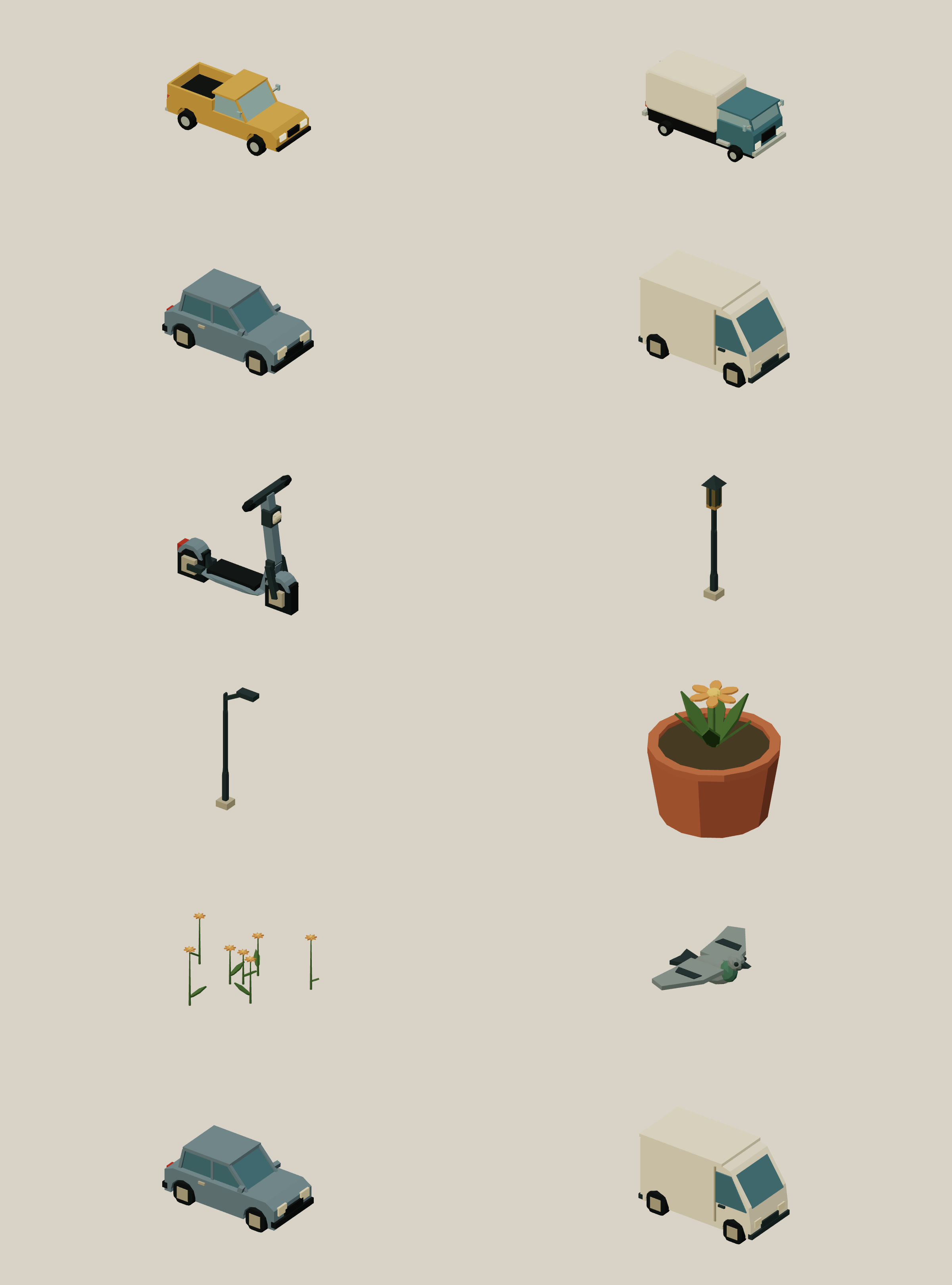
Population rules choose the streets and destinations these assets belong to. Decorative vehicle props bake joint rest poses. Controllable destination parking retains its mechanisms, with instanced unoccupied poses and one occupied fleet rig. Bird flocks use the same authored shape with instanced shader flight rather than allocating a joint controller per bird.
After dark
Architecture and civic window materials declare a warm night color. The two streetlight assemblies declare local lamp sources and measured light-pool radii. Their geometry, contacts and placement rules are unchanged. These are explicit Dream capabilities, independent of asset labels. Day/night authoring.
Voxel geometry
Dream 2 now supports bounded filled/carved voxel parts, greedy surface meshing and optional fracture chunks. The city uses voxel building shells, bench boards and two carved park walls; the bakehouse example adds chunked masonry; measured proportions and explicit contacts remain unchanged. See the voxel guide for syntax, limits, a complete example and current boundaries.
A fuller city and its habitats
The live city contains 133 placed people and 345 trees, alongside roaming ground animals and birds. Shoppers, students and neighbors have varied clothing, hair and complexions; dogs, cats and sparrows join the woodland deer, hares and foxes. Meadow grass and hydrangeas add two more planting forms.
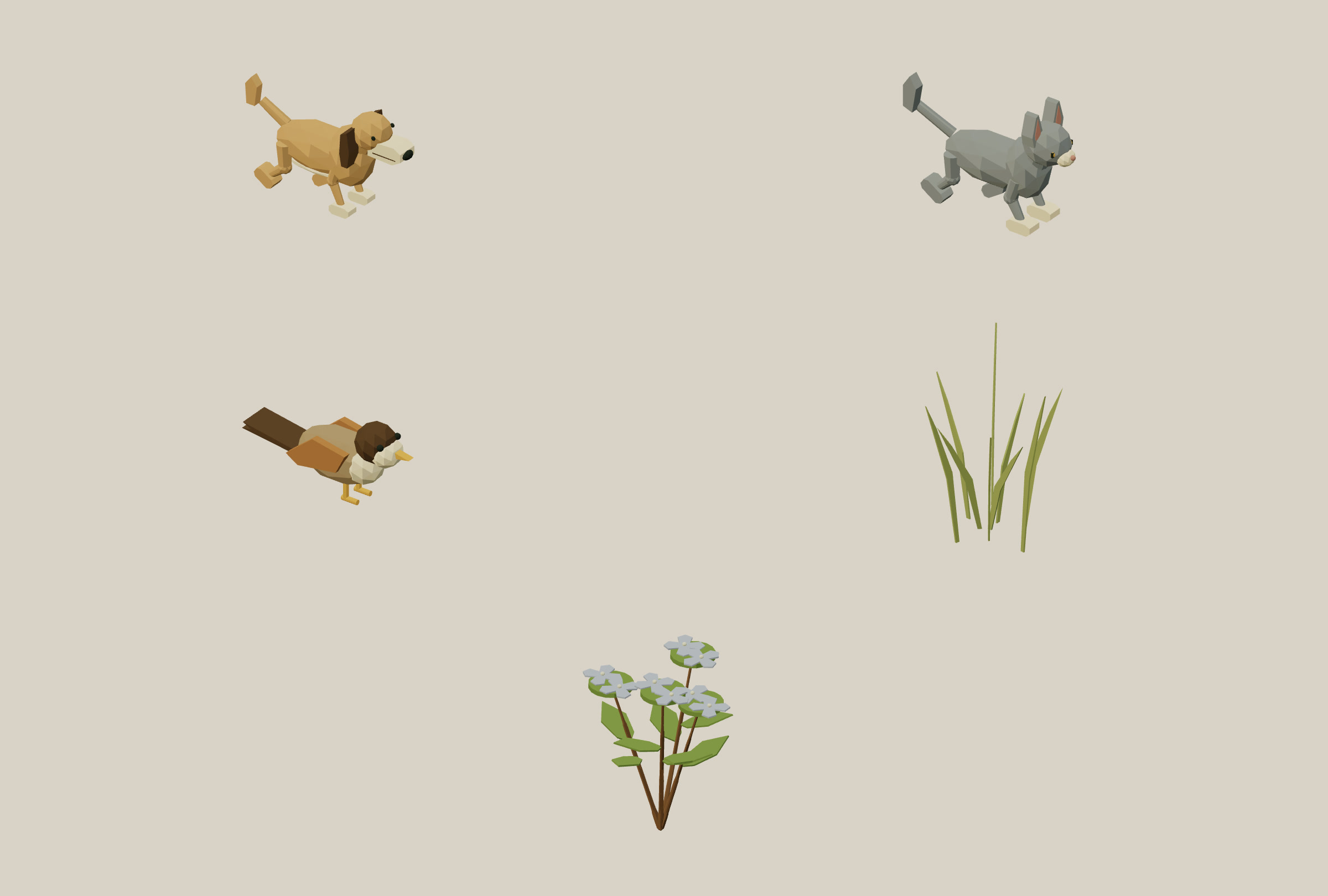
The added residents and wildlife share complete instanced geometry at explicit rest poses. Four new neighbors use live greeting programs. Fourteen usable parked cars/vans have solid bodies on connected parking aprons; the four moving road cars retain their routes. Rest poses, sidewalk placement and population bounds.
Pickups and parcel trucks
The 4.95-metre pickup has an open bed, wheel openings, supported cab, mirrors, lamps and two rolling axles. The 6.6-metre truck has a supported cargo box, rear-door seam, cab steps and its own axle spacing. Each uses 32 parts and two joints. Tires and hubs retain their sixteen-sided contours at the live voxel size, including the small hub faces.
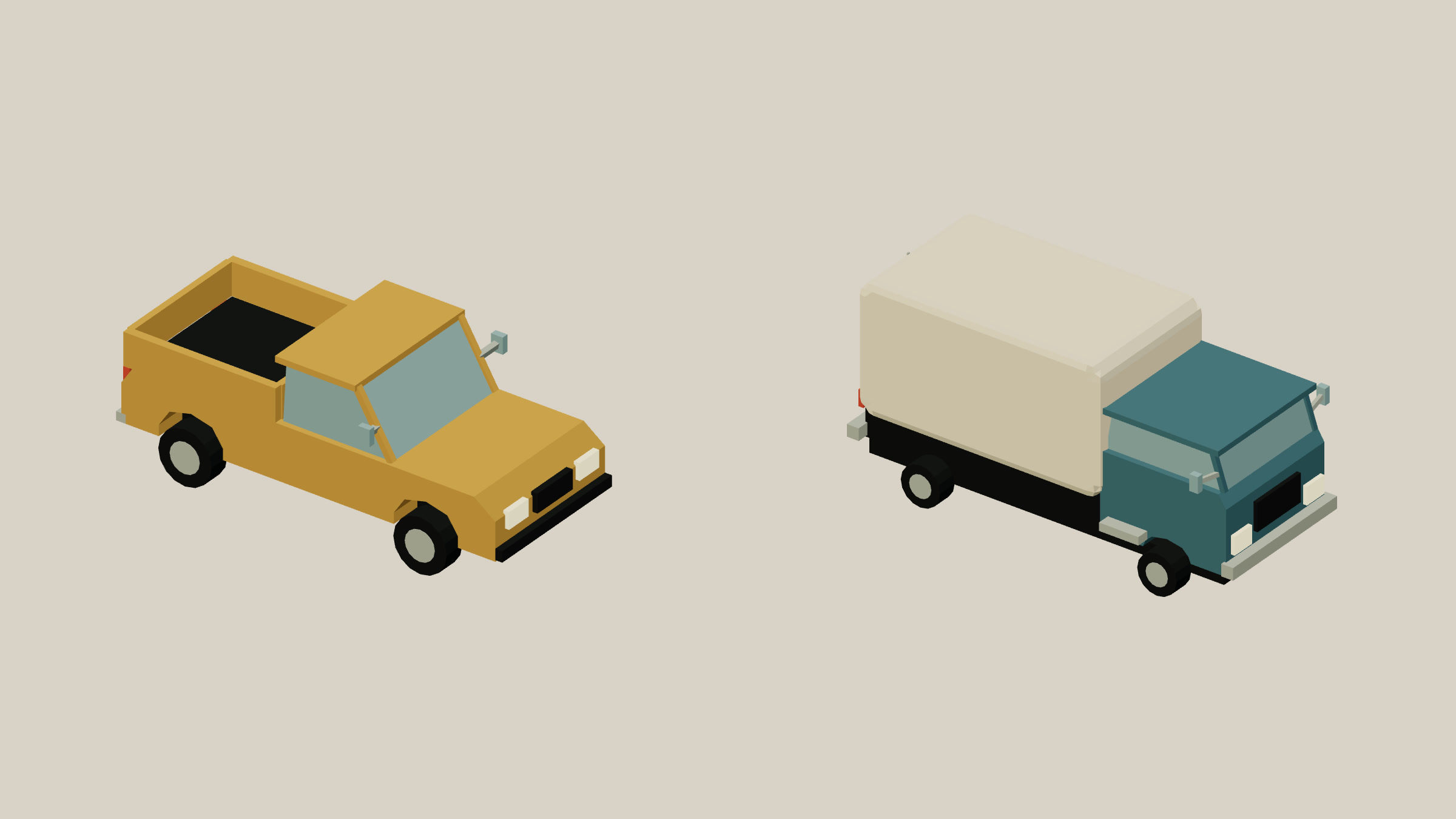
Turntable in HD · GIF · Complete Dream library.
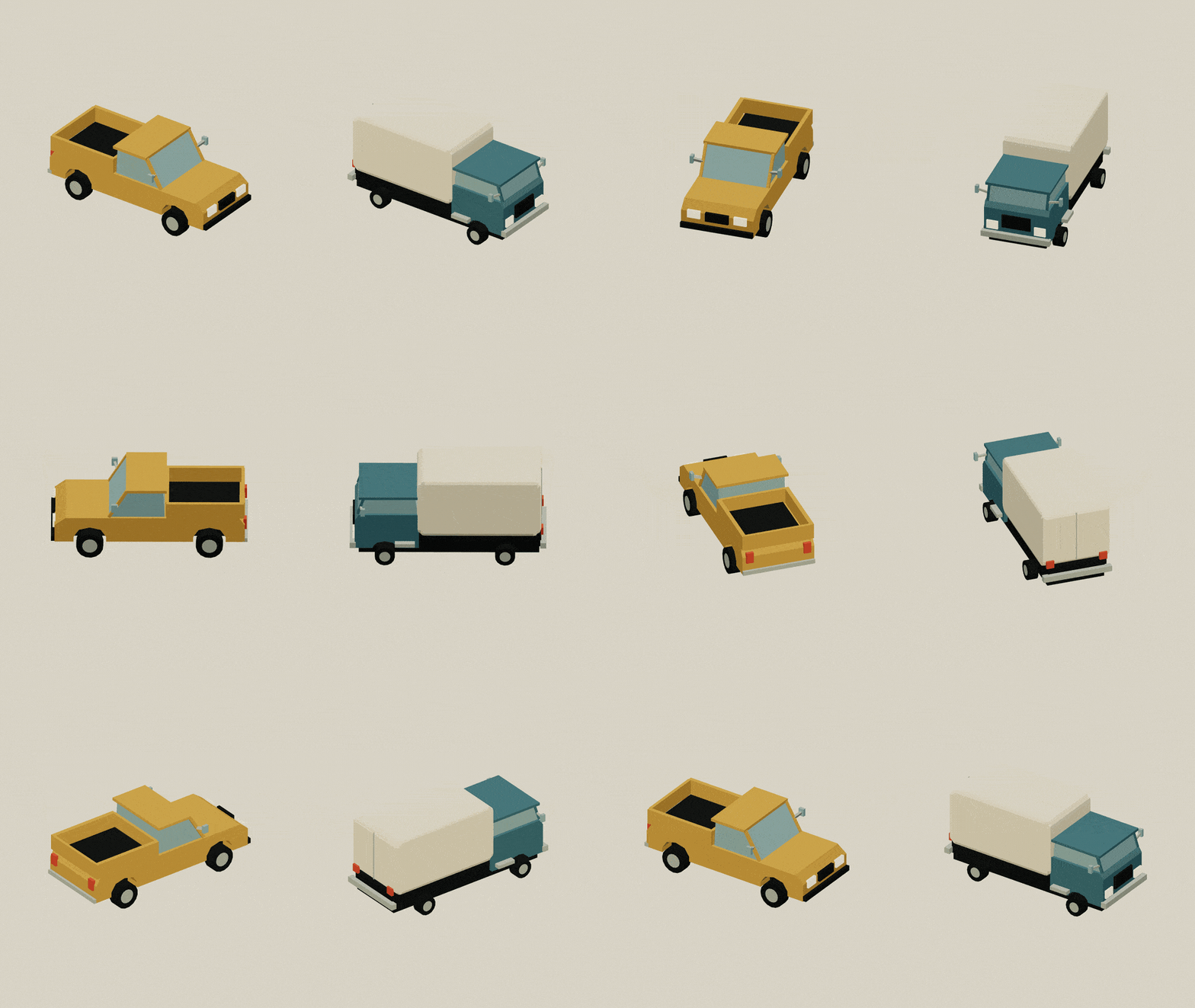
Two pickups and two trucks are parked on connected loading aprons at the station, harbor workshops and airport hangar. Walk up and press F to drive. WASD, Shift boost, parking, reboarding and saved positions use the existing car controller. Sealed delivery cargo stays with the player through these changes; the bed and cargo box do not add a separate inventory or carrying capacity. There is no new autonomous truck route, trailer or vehicle-damage system.
measure(kind=pickup,axis=x,meters=4.95) and
measure(kind=truck,axis=x,meters=6.6) select proportion ranges, while
rideable(...,control=car) declares the controls. The names never infer driving
behavior. The disc component owns one outline; the axle passes numeric arguments
and material bindings to it. This takes 2,522 Dream syntax tokens for the complete
library, compared with 2,697 when the same outline was repeated. These are compiler
syntax counts, not measured model tokens or generation accuracy.
The unused Weathered boulder and Exposed stone slab studies remain in the optional creations catalogue, with their released shapes and materials. This leaves the active project's 128-definition budget unchanged.
A tree family with clearer construction
All 345 live trees now use explicit faceted crowns. Firs and pines have supported boughs and continuous trunks. The willow has one broad crown, six rising boughs and twelve attached hanging branches with leaf curtains. Rowan berries form small clusters; apples have stalks rooted inside the canopy. The amber tree and its sapling keep distinct crown proportions. Birch branches retain their existing construction, with cleaner leaf masses. The unused deadwood model was reviewed and retained.
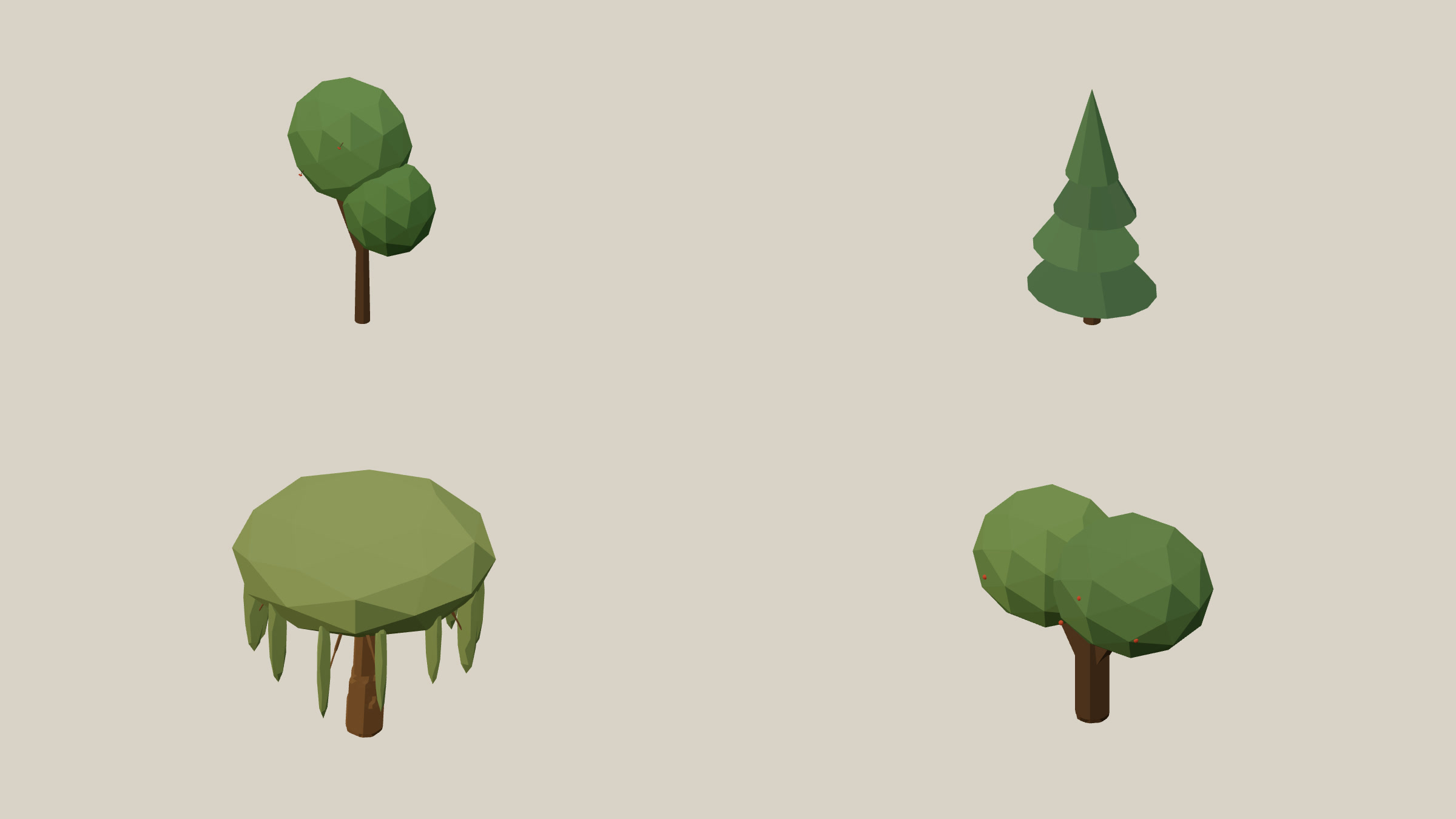
Turntable in HD · GIF · Complete fir source · Four-angle and save checks.
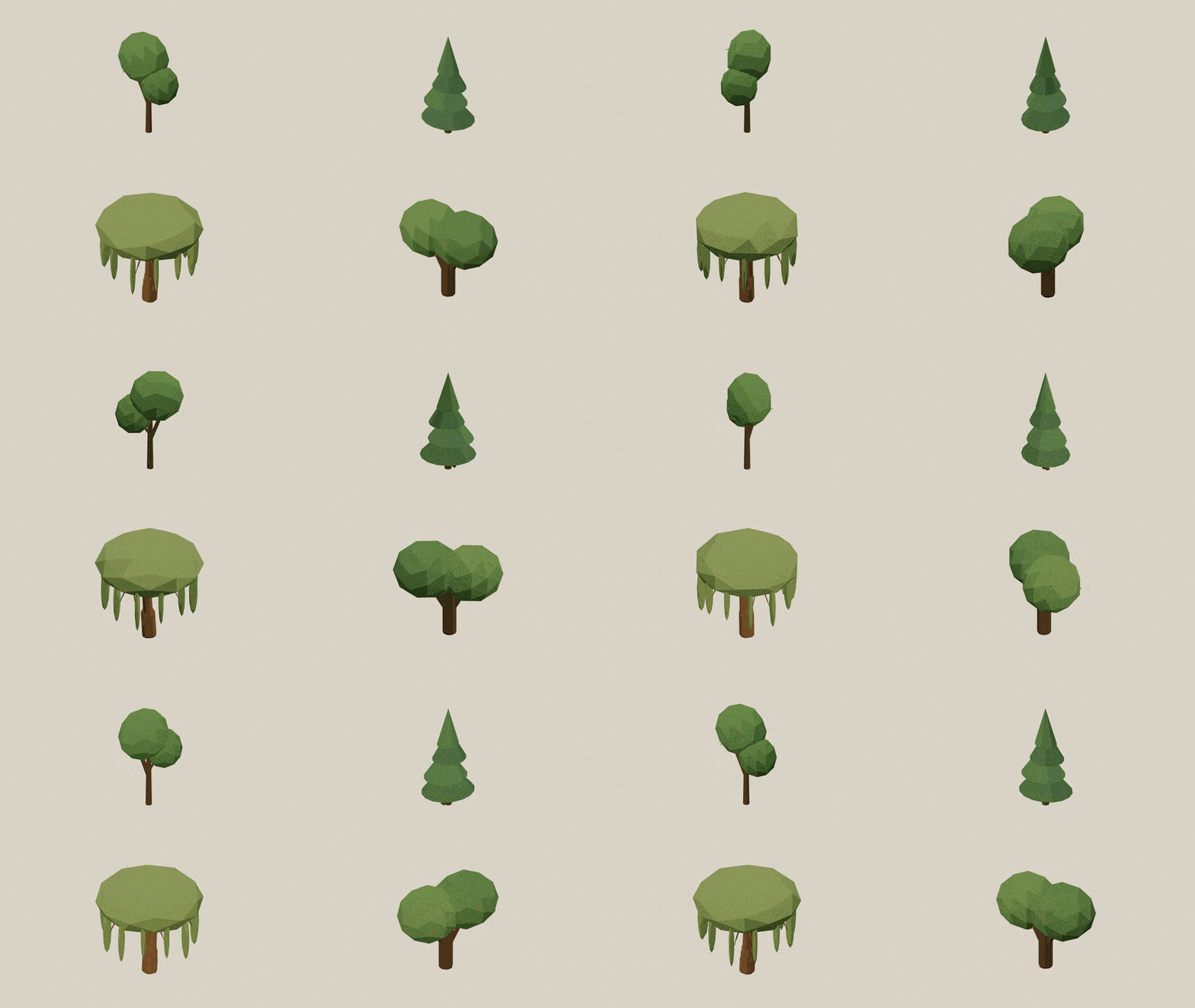
These are stylized crowns, not individually modeled leaves or a botanical simulation. Fruit remains decorative. Existing body dimensions, scales, toppling, finite replanting supplies and growth behavior stay in place. Other asset families remain on the construction review.
Plants built from their stems
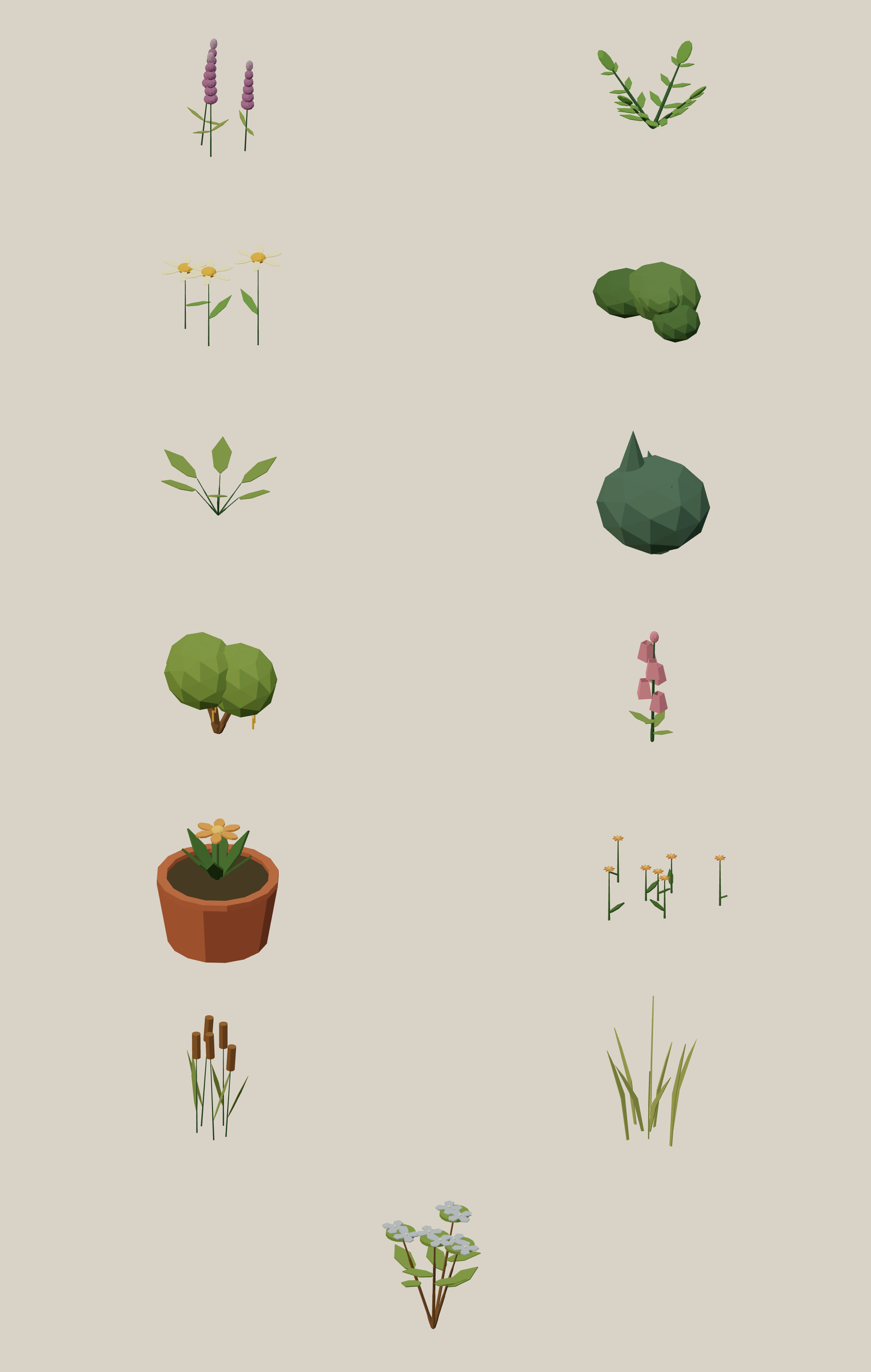
The thirteen landscape and street-plant templates cover all 460 of their current placements. Fern pinnae and dock leaves root on their petioles. Lavender has smaller florets, reeds have pointed blades, and grass tapers to a tip. Hazel catkins hang from small twigs; juniper berries remain small. Hydrangea blossoms sit on supported calyces. Shrubs retain their distinct crown masses with cleaner faces.
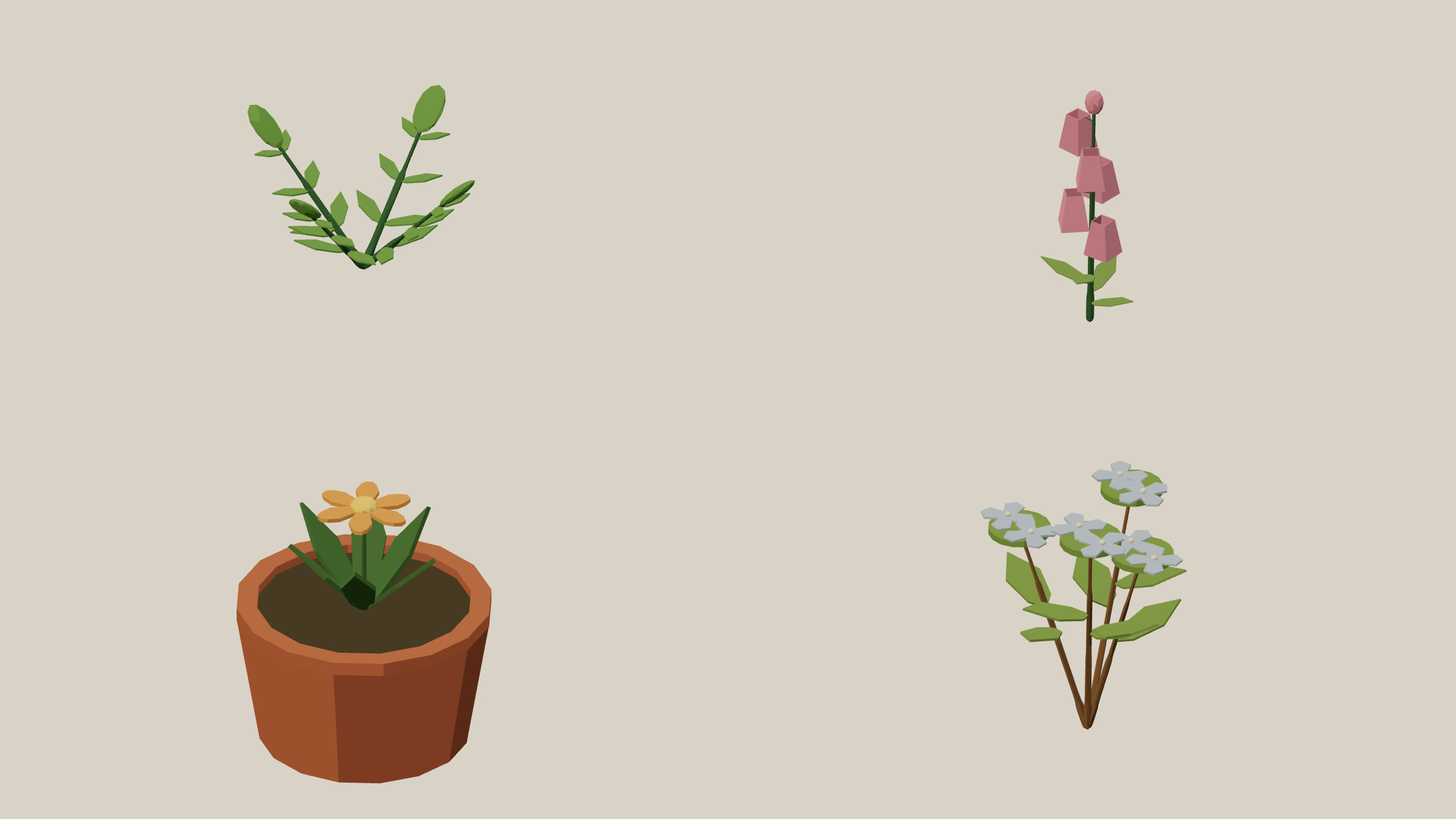
All thirteen templates · Turntable in HD · GIF · Complete Dream source.
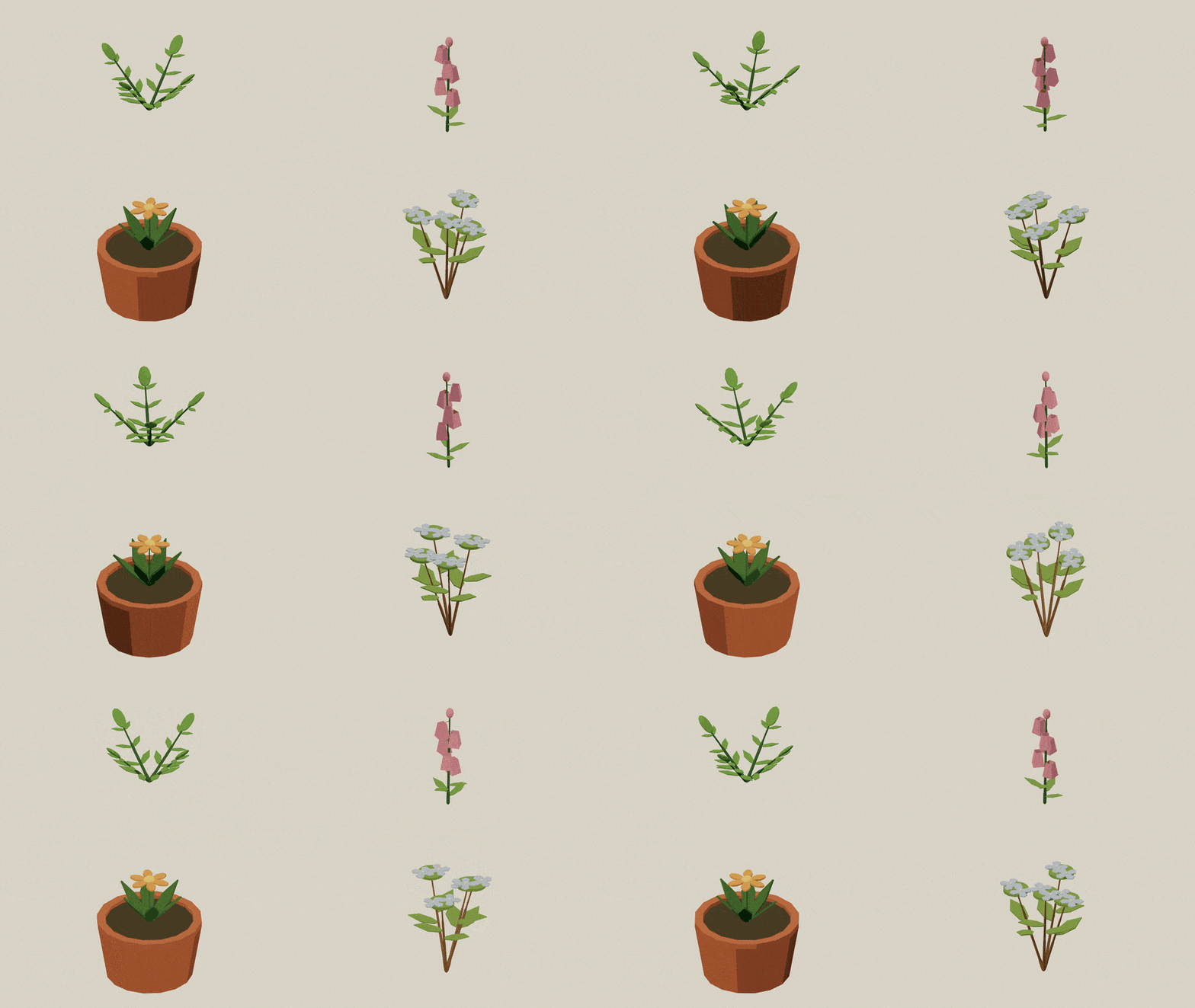
Foxglove bells use four joined panels with an open throat. The planted tub has a flared body and two concave half-rim profiles that meet around its opening. Soil sits above the hidden container cap and below the lip, so the surfaces do not compete at the same depth. These constructions use existing prisms, components, material bindings and bounded repeats, within 32 parts per object.
The measured frame and existing furnishing clearance keep bodies, street placement and navigation stable. The sixteen solid planted tubs now topple on a hard hit and return through the caretaker’s paid repair service. Other plants remain scenery. They add no picking, harvesting, growth or biological simulation. The separate breakable clay planter now has the joined shell and rim documented in the furniture construction pass. Construction, save and native-render checks.
Small ground details
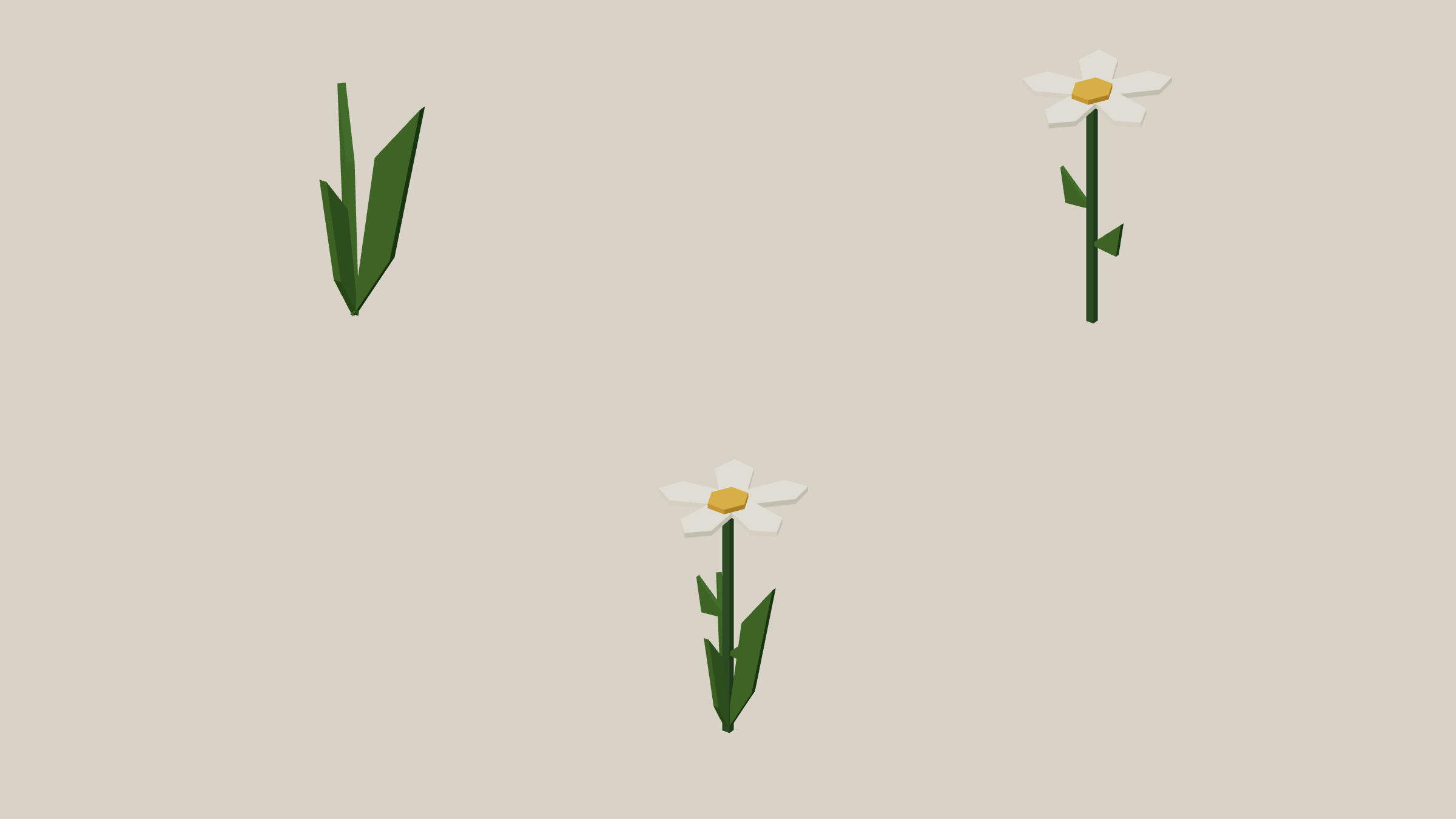
Background grass and flowers are engine-provided Dream assemblies, separate from the 109 exported world templates. Three pointed blades form the grass; flower leaves join their stalk beneath the petals and solid pollen center. The complete example includes their shared components and a combined inspection object. The engine compacts the two types for tiled instancing. They add no physics bodies or interactive plant state. The seeded scatter density and palette remain engine-owned.
Animals built around their movement
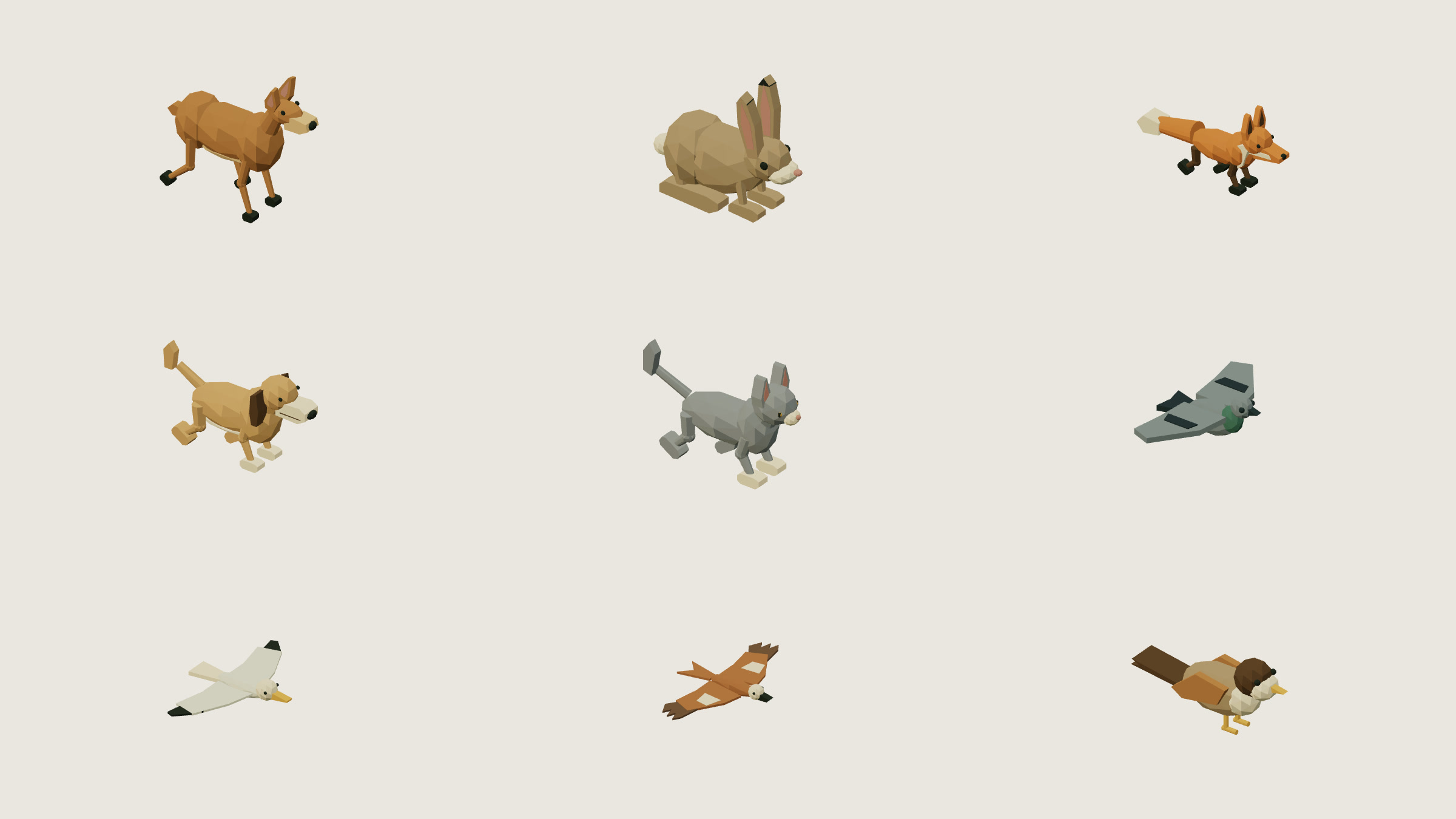
All nine animal exports have been reviewed from four angles. The five ground
species use two-segment legs with distance-driven stride joints. The birds
have tapered wings and tails; eyes and ear panels remain visible above the
surrounding surfaces. Sixty ambient members, the route deer and gull, and all
256 flock birds retain their homes, movement rules, physical sizes and saves.
Red kite remains an unplaced library export.
Construction and limits · Complete source · Motion in HD. These remain stylized rigid strides, without animal foot planting, pet care or new wildlife interactions. The continuing library review has 70 of 109 exports pending, plus the separately tracked engine and optional examples.
Street fixtures that fall and return
The sixteen planted tubs and both produce stalls use local Dream topple
impacts. The tub falls at speed 65; the larger stall needs 90. Each falls as one
rigid assembly, keeping the connected canopy or planting together. Their bodies,
geometry and street positions are unchanged. The existing caretaker service
covers all eighteen, using one kit and paying four credits for each repair.
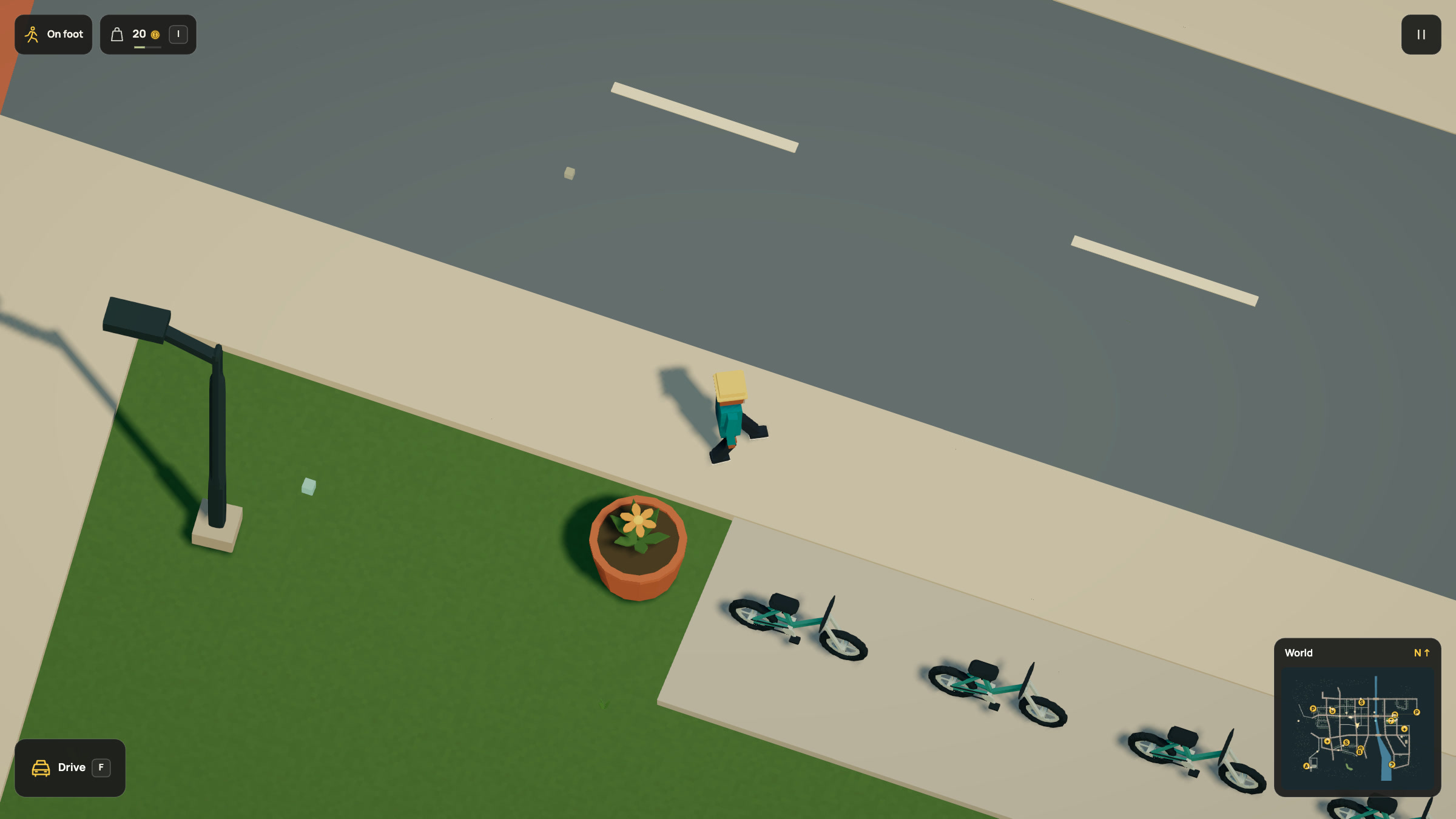
Repair in HD · GIF · Impact recording · Checks and limits.
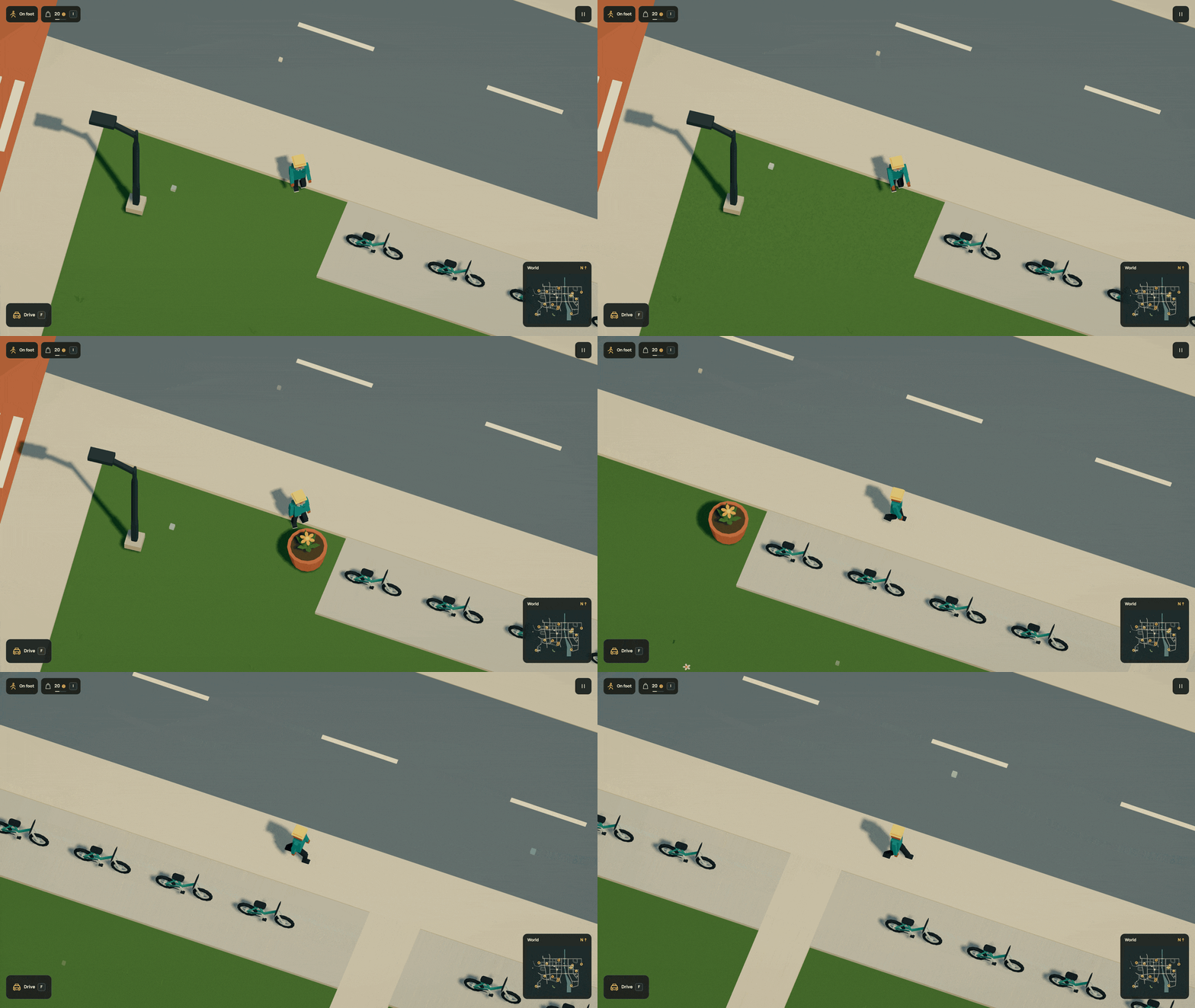
The furniture and plant examples contain the complete objects. Local impact data avoids applying a blanket rule to unrelated custom scenery. Shelters with compound contacts and sports targets retain their existing behavior.