Build with voxels
A wall doesn't need one mesh per brick. Describe the occupied cells, cut openings into them and let the engine build its visible surface. Flat faces merge into larger rectangles. Repeated city buildings still share instanced geometry.
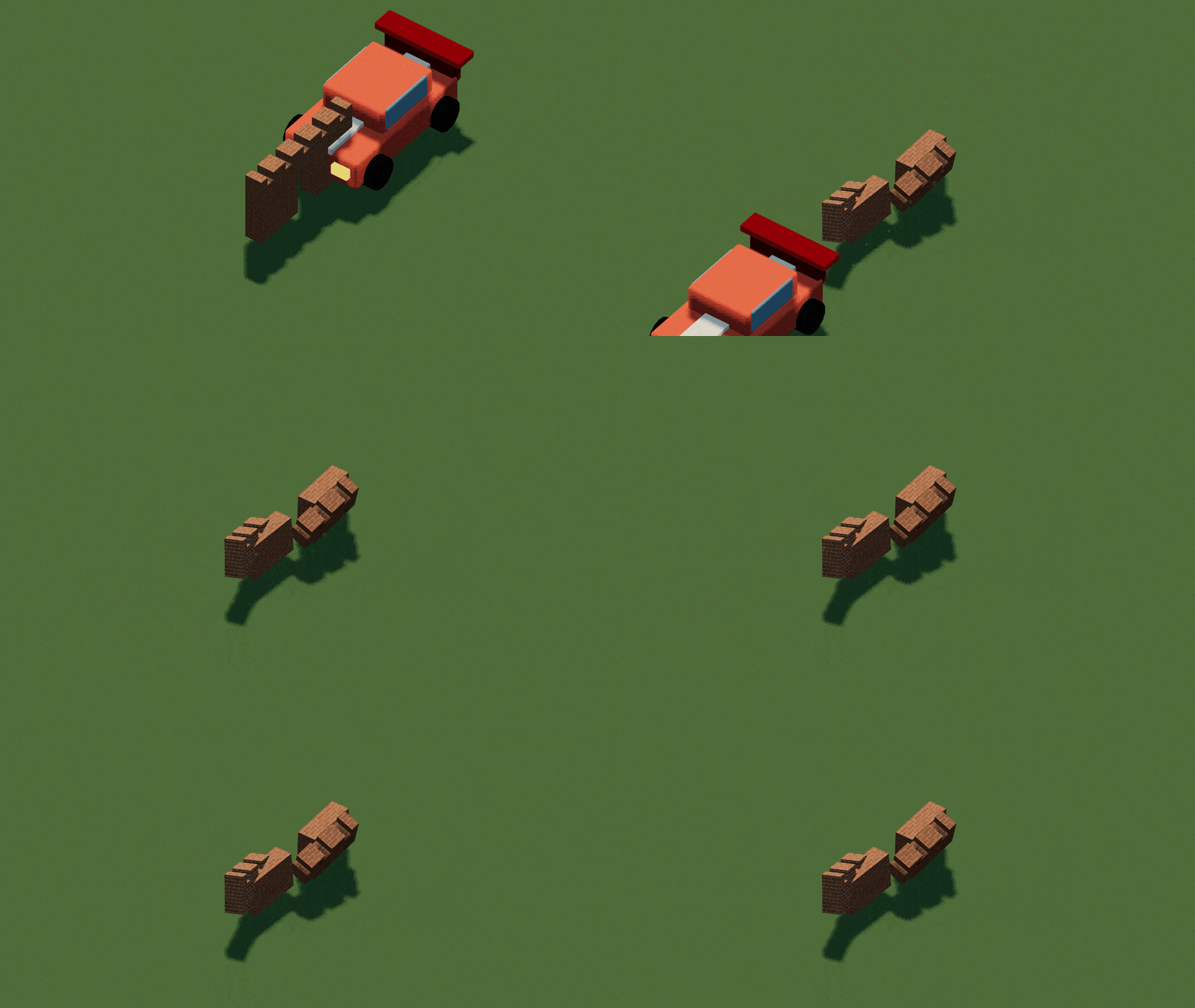
HD recording · Download the complete wall
Voxel construction across the world
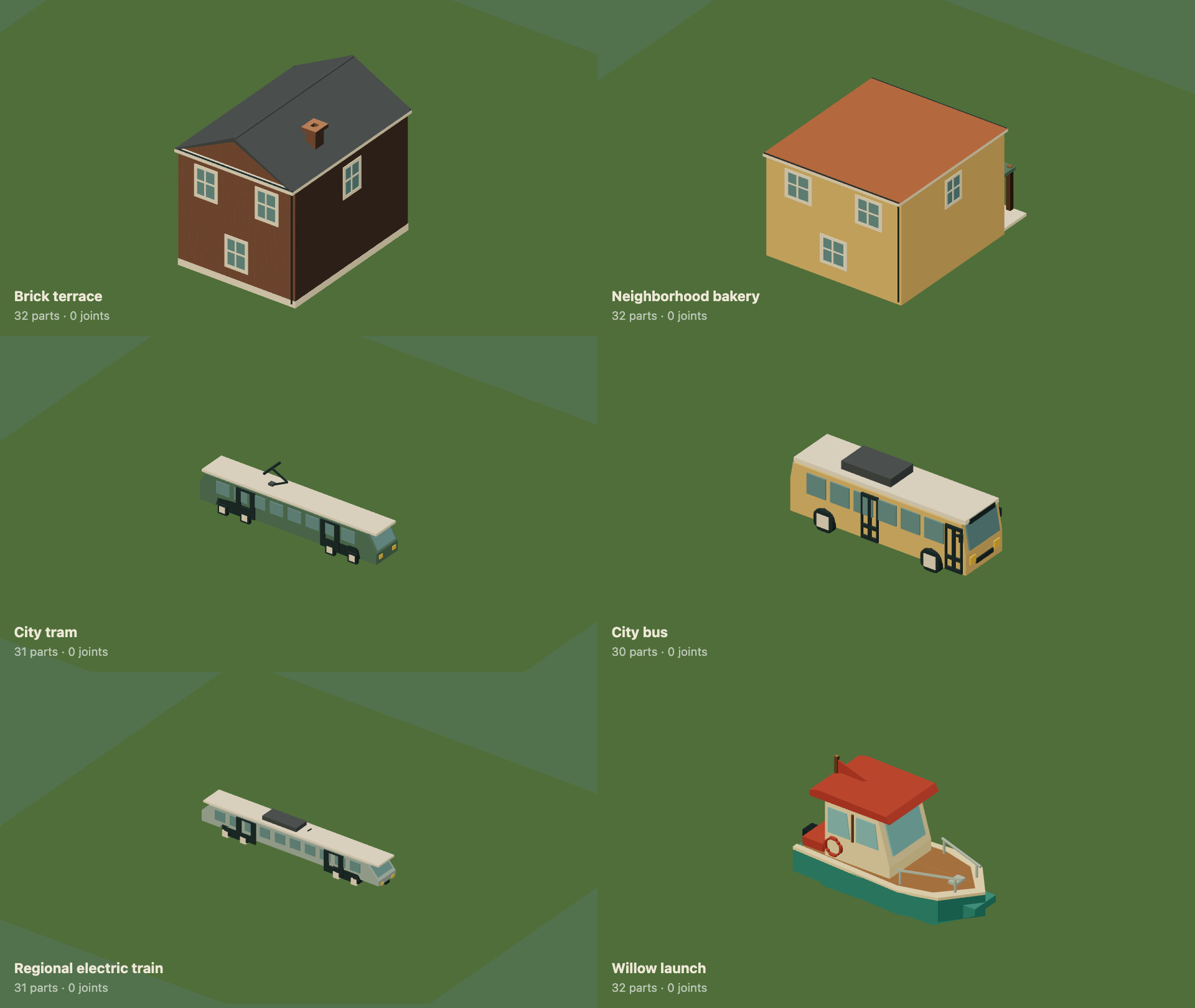
The live city now uses voxel_world(object_cell=1,ground_cell=8,height_step=1);. It converts every linked object template, generated furnishing, player vehicle and flock after the world is assembled. Ground, streets, cycle tracks, painted crossings, bridge decks, water, plants and vehicle parts all produce voxel surfaces. Build a complete voxel world.

part and beam remain compact shape stamps for the model. The engine samples their occupied cells, preserving outlines, openings, material, measured bounds and rigid motion. Explicit voxels gives the model direct control of fill/cut operations and fracture chunks. The world policy changes construction; it does not silently add damage or replace contacts.
Fill, cut, repeat
voxels creates one rigid visual part. grid gives its cell counts, size its full local dimensions and at its center. Cell coordinates start at the minimum corner. Every operation uses integer half-open bounds: from is included, to is excluded. A [30,16,4] grid with size [60,32,8] has two-unit cubic cells.
dream 2;
material masonry(style=brick,colors=[#a96f55,#bcb1a0]);
object garden_wall(label="Voxel garden wall"){
  measure(kind=custom,axis=x,meters=3);
  body(interaction=solid,radius=24,height=32);
  impact(mode=break(speed=90,scatter=50,lift=55,spin=3,lifetime=6,pattern=crumble));
  voxels wall(material=masonry,at=[0,16,0],size=[60,32,8],grid=[30,16,4],chunks=[2,2,1]){
    fill solid(from=[0,0,0],to=[30,16,4]);
    cut opening(from=[12,0,0],to=[18,10,4]);
    repeat top(index=i,count=5){
      cut notch(from=[i*6+2,14,0],to=[i*6+4,16,4]);
    }
  }
}
Operations run in source order. A fill after a cut can restore cells. shape=ellipsoid uses the same bounds and fills or removes cells whose centers lie inside that ellipsoid. Omit shape for a box. Use separate volumes for different materials and component, group, repeat or rigid joints to compose them. Give each volume the same size/grid ratio on all axes for cubic cells; different ratios deliberately create rectangular cells.
The model writes a few operations rather than thousands of cell entries. It cannot upload a mesh, request a shader, fetch a file or supply executable generation code. The compiler contract includes the exact vocabulary and limits.
Destruction uses the same cells
chunks=[2,2,1] divides this volume into four pieces. It requires whole-object break behavior or a zone with break behavior. Each axis must divide the grid exactly, every piece must contain cells, and all parts together must fit the existing eight-fragment assembly limit. Don't wrap an automatically chunked volume in fragment.
The intact mesh hides faces between occupied cells. A fracture meshes each chunk with its newly exposed cut faces. The existing engine supplies impact thresholds, scatter, gravity, settling and fade. No voxel becomes an independent physics body. Existing authored fragment groups still work for voxel furniture, while zone preserves a building's structural core.
A visual opening does not create a traversable opening. Bodies and compound contacts remain explicit cylinders. Terrain has one ground height per XY position. Editable terrain, tunneling, per-cell collisions, local damage masks and structural collapse are further work.
What's in the city
Two carved garden walls flank the river-park bench and break into four chunks each. Eleven residential and commercial building templates now use voxel wall shells. The slatted benches use voxel boards inside their existing seven fragment groups. The asset-library bakehouse storefront uses a carved volume with six masonry chunks, plus its canopy and door. Their measured proportions, entrances, foundations, roads and physical contacts remain shared with the existing world.
The live world's remaining curved shapes become occupied-cell stamps with continuous surface-net boundaries. Undeformed prism and pyramid stamps instead retain exact merged planar contours in their boundary cells, so thin gable shells stay closed and hip slopes stay flat. Exact carved volumes keep their block boundaries and newly exposed fracture faces. The city uses sparse solid ground columns and infrastructure tiles rather than allocating a kilometre-wide 3D array. The world policy leaves older standalone examples readable in their original shaped mode; add it to a complete world to use voxel construction throughout.
Rendering and bounds
The live world streams static geometry around the player. Infrastructure retains exact cut-cell outlines instead of centre-sampled stair steps; bridge ramps use a shared continuous deck field, and water uses continuous shared UV waves without tile skirts. Cell anchors remain available in water geometry. Complete simulation and damage state remains resident. Streaming and contour choice are engine-owned and add no Dream commands. See rendering and memory.
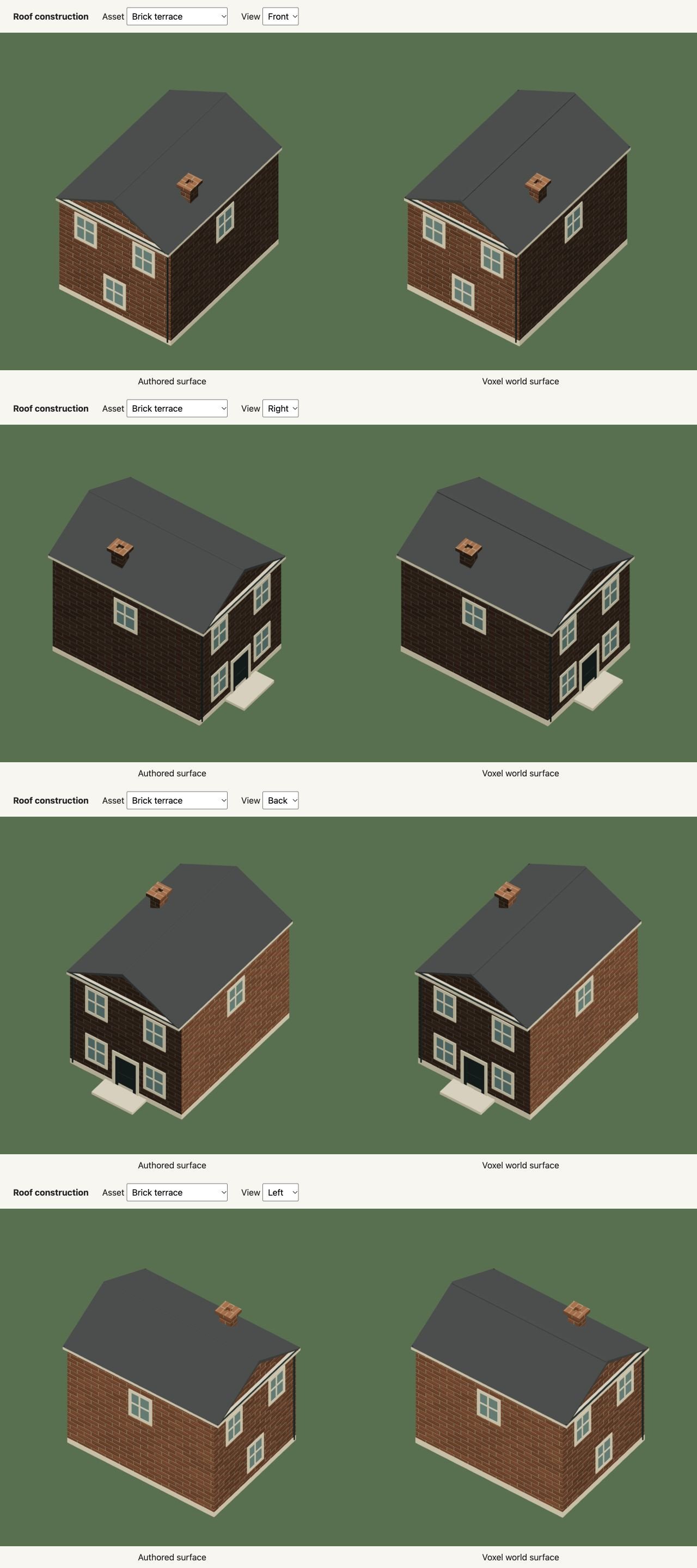
The mesher culls hidden faces and greedily merges coplanar faces within each volume. It caches identical CPU mesh data across validation copies, with an eight MiB / 128-entry bound. Callers own their GPU buffers. Static prototypes continue through the existing material batching, instancing, local bounds and occlusion system. Intact objects don't remesh every frame; debris meshes are built on first fracture and reused after restart.
| Budget | Limit |
|---|---|
| Grid axis | 1–32 integer cells |
| Volume | 32,768 allocated cells, 64 expanded operations, 8,192 merged quads |
| Assembly | 65,536 allocated cells, 1,048,576 fill/cut cell visits, 32 visual parts |
| Linked project | 1,048,576 allocated cells across assembly definitions |
| Scene input | 1,048,576 unique volume cells, including player and flocks |
| Destruction | Eight fragments per assembly; legacy/resident impacts retain 24 objects and 128 potential fragments. Pooled static props share 24 active assemblies and 128 active pieces. |
Empty volumes, empty chunks, out-of-grid bounds, fractional indices, excessive work and unsupported fields fail validation. Voxels don't accept deform, cloth or part-level motion; put rigid motion on a joint. Dream 1 remains unchanged.
A test block with 4,096 occupied cells needs six quads, compared with 24,576 faces if each cell were drawn as a cube. This measures geometry, not browser frame rate. The approach follows Mikola Lysenko's greedy meshing explanation. See the verification record for the live-city geometry comparison and capture audit.
Explicit faceted=true keeps undeformed cylinder, cone and icosphere faces as
exact planar cell contours. This is useful for clean crowns and small fruit:
the source still describes bounded occupied cells, but their boundary need not
become a noisy curved reconstruction. The flag does not raise grid, part, work
or fracture limits. Other shapes and positive deformation reject it; omission
or false preserves the ordinary curved path. Complete fir.