A bakery that keeps itself working
The vendor now packs lunches and bakes bread when stock runs low. A hungry commuter walks over, buys a meal, eats and returns to their routine. When the bakery has room for more flour, the market helper can walk to the station, collect two units and bring them back. You can buy, cook and take the same transport work. Staff do not get their own free supplies or wages.
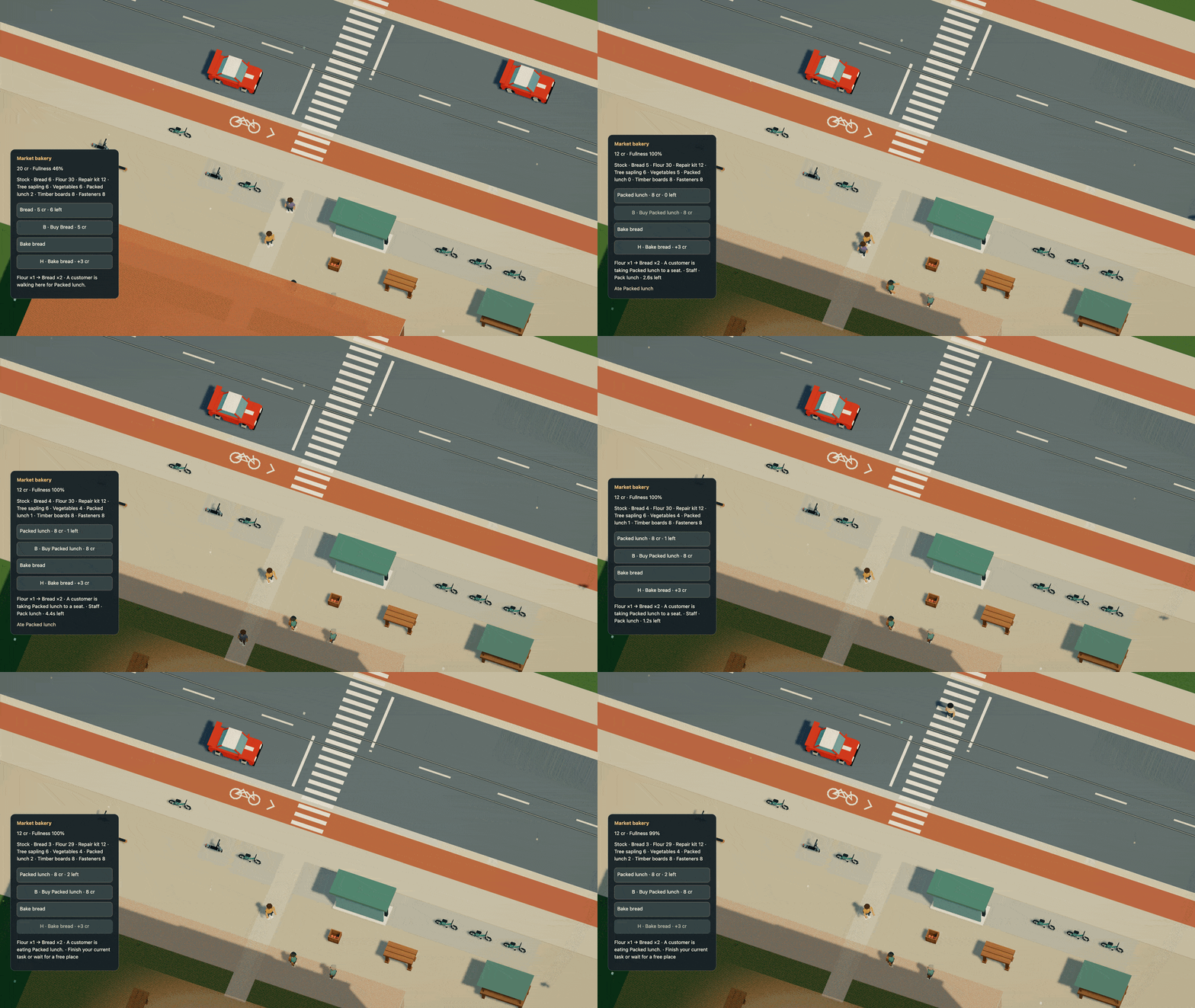
Watch in HD. The recording shows a player purchase and meal, a customer purchase, and the vendor replacing the sold food. Flour transport takes several simulation minutes and is checked separately; this sixteen-second clip does not show that complete journey. These are 30 rendered frames per simulation second, not a live performance measurement.
What moves through the business
| Activity | Input | Result |
|---|---|---|
| Basic bread batch | 1 flour, reserved from the bakery | 2 bread after 6 seconds; worker earns 3 credits |
| Pack lunch | 1 bread and 1 vegetable, reserved together | 1 lunch after 5 seconds; worker earns 3 credits |
| Buy lunch | 8 credits from the customer's wallet | One owned lunch; the bakery receives the credits |
| Flour delivery | 2 flour from the finite station stock | The bakery receives flour and pays the courier 4 credits |
The larger bread batch still requires three personally completed basic batches. The vendor earns that practice independently of you. Both use the same recipe, capacity, effort, treasury and refund checks. A busy lunch job can make you wait; you can still take another available job. The panel names the staff's current work and remaining time.
The business starts with finite bread, flour, vegetables and money. It can stop for missing ingredients, a full shelf, a hungry worker or insufficient wages. The helper can spend earned pay on food after returning. Kit and sapling supply and available repair work retain their existing priorities before flour trips. The counter now follows daily service hours, shared by player and NPC transactions. This is a working counter and supply loop, with shared bench seating, without table service or upstream farming. Ownership is now available at the station depot.
Compose the existing Dream rules
works chooses eligible jobs below their stock targets in order. Lunch comes
first; if it needs bread, baking can supply the missing ingredient. meal
provides a customer's food destination. deliveries connects finite source and
destination shelves. No special restaurant command or generated controller is
needed. Public pedestrian routing works in a standalone business scene, without
adding a repair service or a cosmetic population to make it initialize.
This complete example uses shorter jobs and a small connected neighborhood so the full loop is easy to inspect:
dream 2;
material blue(style=toon,colors=[#537eaa,#3c5f87]);
material skin(style=toon,colors=[#c59774,#a97655]);
object pedestrian(label="Pedestrian"){
  measure(kind=person,axis=y,meters=1.8);
  body(interaction=decor,radius=4,height=18);
  part torso(shape=capsule,material=blue,at=[0,11,0],size=[5,6,4]);
  part head(shape=sphere,material=skin,at=[0,16,0],size=[4,4,4]);
  part nose(shape=sphere,material=skin,at=[2,16,0],size=[1,1,1]);
  repeat legs(index=i,count=2){
    joint leg(at=[0,8,i*3-1.5],motion=swing(axis=z,deg=18,hz=.6,phase_deg=i*180)){
      part shin(shape=capsule,material=blue,at=[0,-4,0],size=[2,8,2]);
    }
  }
}
behavior welcome(start=waiting){
  state waiting(action=idle){on talk(event=interact,to=hello,radius=55,familiar=false);on again(event=interact,to=returning,radius=55,familiar=true);}
  state hello(action=idle,face=player,say="Hello. Welcome to the neighborhood."){
    on ask(event=interact,to=about,radius=55);
    on finish(event=after,to=waiting,seconds=6);
  }
  state returning(action=idle,face=player,say="Good to see you again."){
    on finish(event=after,to=waiting,seconds=6);
  }
  state about(action=idle,face=player,say="I like walking by the river. See you around."){
    on finish(event=after,to=waiting,seconds=6);
  }
}
place neighbor(object=pedestrian,at=[580,710],role=npc,behavior=welcome);
world(size=[4000,2400],spawn=[525,609],heading_deg=0);
road circuit(width=118,points=[[300,590],[660,590],[810,500],[810,220],[660,130],[300,130],[150,220],[150,500]]);

checkpoint start(at=[480,612.5],dir=[1,0],width=100);
checkpoint east(at=[828.75,360],dir=[0,-1],width=100);
checkpoint north(at=[480,107.5],dir=[-1,0],width=100);
checkpoint west(at=[131.25,360],dir=[0,1],width=100);

place customer(object=pedestrian,at=[760,730],role=npc,behavior=welcome);
place depot_keeper(object=pedestrian,at=[1120,970],role=npc,behavior=welcome);
place helper(object=pedestrian,at=[620,730],role=npc,behavior=welcome);
street access(width=60,sidewalk=24,points=[[400,590],[400,850]]);
street main(width=60,sidewalk=24,points=[[400,850],[1400,850]]);
crossing main_cross(street=main,at=[900,850],width=20);
surface depot_yard(color=#b2aa96,points=[[1080,884],[1260,884],[1260,1020],[1080,1020]]);
surface plaza(color=#b2aa96,points=[[530,680],[820,680],[820,816],[530,816]]);
economy(){
 good bread(label="Bread",food=45);
 good flour(label="Flour");
 good vegetables(label="Vegetables",food=20);
 good lunch(label="Packed lunch",food=65);
 account pocket(actor=player,credits=20,capacity=8,satiety=65,drain_s=.05);
 account baker(actor=neighbor,credits=0,capacity=4,satiety=65,drain_s=.05,shop=true,works=[pack_lunch,bake]);
 meal bakery_break(good=lunch,markets=[corner],on=plaza,eat_s=4);
 account regular(actor=customer,credits=20,capacity=4,satiety=25,drain_s=.05,meal=bakery_break);
 account supply_helper(actor=helper,credits=0,capacity=4,satiety=65,drain_s=.05,deliveries=[flour_run]);
 market corner(label="Corner bakery",actor=neighbor,credits=100,radius=70){
  lot bread_shelf(good=bread,quantity=0,limit=16,price=5);
  lot flour_sack(good=flour,quantity=6,limit=6);
  lot vegetables_box(good=vegetables,quantity=4,limit=8,price=2);
  lot lunch_counter(good=lunch,quantity=0,limit=4,price=8);
 }
 market depot(label="Station supplies",actor=depot_keeper,credits=0,radius=70){lot flour_store(good=flour,quantity=12,limit=12);}
 delivery flour_run(label="Bring flour",from=depot,to=corner,good=flour,quantity=2,pay=4,capacity=1,on=plaza,grounds=[depot_yard]);
 work bake(label="Bake bread",market=corner,input=flour,take=1,output=bread,make=2,seconds=2,pay=3,effort=6,capacity=1,target=4);
 work pack_lunch(label="Pack lunch",market=corner,output=lunch,make=1,seconds=2,pay=3,effort=6,capacity=1,target=2){
  ingredient(good=bread,take=1);
  ingredient(good=vegetables,take=1);
 }
}
Run npm run -s dream -- check docs/examples/market-production.dream. The example
includes no repair service or ambient walkers. Its courier and customer still
use validated walking grounds, sidewalks and a crossing. Removing the connection
fails complete-world acceptance. Bodies, actor/rig limits, graph bounds and
shared transaction rules remain unchanged.
Leaving and coming back
Business stock, wages, cooking reservations, food, delivery cargo and both walking journeys live in resident simulation state. Unloading a district does not reset them. Pause freezes the work; R preserves it; Start over resets the world. Reloading performs no offline work and cannot finish or pay an activity twice.
Simulation version 17 registers the staff-policy and standalone-navigation update. Save format 11 is unchanged. The previous city is validated before any state is accepted; all existing records, active jobs, paths, balances, materials and world time are kept. Its geometry and prepared navigation graphs are equal, so there is no population or floor rebasing for this update. The original slot is kept, and corrupt or concurrently changed newer saves still block replacement. Persistence details.
The commuter can now take their purchased lunch to a free slot on the indoor bench. Player and customer claims use the same furniture metadata; standing is the fallback when seats are busy or broken. Shared seating adds no restaurant staff, queue or table service.
The baker now has a physical daily shift: finish committed work, walk into the hall after closing and return before morning service. Counter attendance gates the same transactions for the player, shoppers and couriers.
Own the station depot
Walk to Station supplies in the railway quarter and open the market with M, then choose Business. The depot has finite flour, repair kits and saplings. Buy it for the listed base price of 15 credits plus its available cash. The seller receives that payment in their personal account; it does not become cash you can immediately withdraw from your new company. These are mock prices, not a business valuation model.
Ownership includes the existing stock and delivery commitments. If the caretaker or player carries two repair kits to the bakery, the bakery pays the depot six credits and the courier four after handoff. Two delivered saplings pay the depot four credits. Picking up cargo does not create supplier income. Flour remains a zero-invoice supply contract. No money appears because time passed or a player owns a counter.
At your counter, choose a whole-coin amount with left/right and Deposit or Withdraw. You can transfer available cash while the counter is closed, but buying the business needs open, staffed service. Wage, cargo, invoice and refund commitments remain protected. Existing jobs keep their staff, supplies and pay after a sale. The pause menu lists the businesses you own and their available cash; transfers still require standing at the counter. Car, seated, airborne and swimming controls cannot make these transactions.
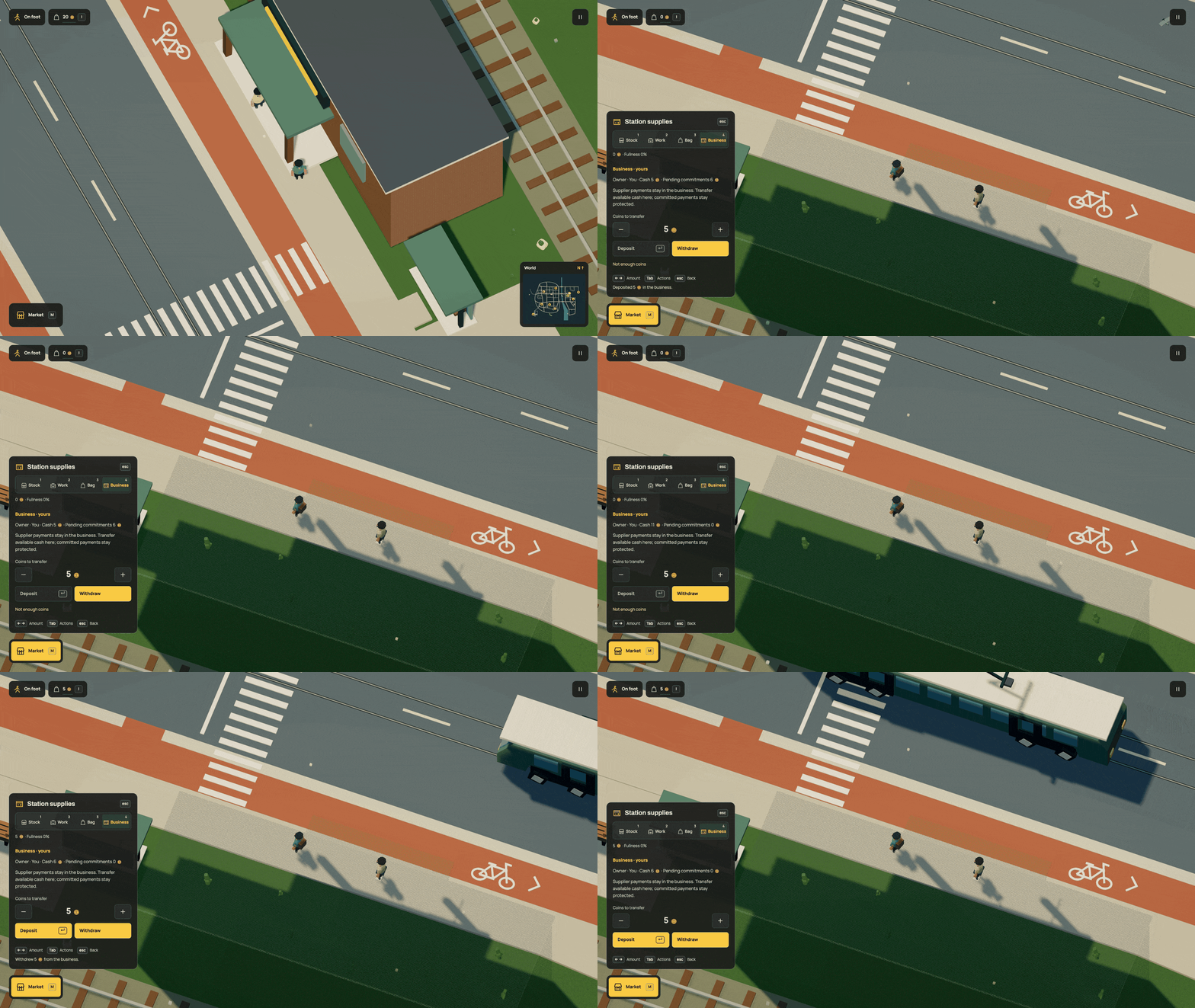
Watch in HD. Purchase, deposit, an actual two-kit handoff and withdrawal use 600 rendered frames at 30 frames per simulation second. The pre-roll drives the damage and supply journey through the ordinary engine; it does not give the player money or create cargo. This is an offline recording, not a performance benchmark.
Describe another ownable business
The complete runnable bakery uses the same capability with paid production and hungry customers. Here is its market block, unchanged from the file:
 market corner(label="Corner bakery",actor=neighbor,credits=10,radius=70,owner=baker,sale=15){
  lot bread_shelf(good=bread,quantity=8,limit=16,price=5);
  lot flour_sack(good=flour,quantity=12,limit=12);
 }
owner references a personal account; actor continues to operate the counter.
The account's initial balance, inventory and policies remain distinct from the
company's treasury and shelves. Omit sale for an owned business that is not for
sale. owner=pocket can give the player an initial business without a purchase.
A sale needs a non-player initial owner and a positive integer base price of at
most 1,000,000. The final quote and all balances must fit that same money bound.
Existing limits remain eight markets and sixteen accounts, with no additional
NPC, body or rig slots.
The current capability supports one acquisition per business. It does not add resale, hiring, price setting, loans, property deeds, idle owner income or a way to start a new business. Station stock can run out; upstream production remains unfinished. The bakery example proves that depositing capital can restart paid production without free ingredients or wages.
Keep what you bought
Ownership, purchase time, stock, available cash and active commitments live in resident simulation state. Chunk unloading, R, pause and save/reload retain them; Start over restores the authored owner and balances. Format 15 / simulation 23 validates the exact r65 world before adding only its zero-funded depot seller and initial owner reference. Every older field and original save slot stays intact. Save rules and migration.