Leave and come back
The world now saves on this device. Meet someone, park a bicycle, move a ball or break a table, then reload the same world. Those changes return with you. A person you have met can recognize you through their Dream program.
Autosave runs every ten simulation seconds, after a conversation press or committed economic event, when pausing and when leaving the page. Save now in the pause menu writes immediately. Reopening the page restores the saved state before the first neighbourhood is loaded.
| Saved state | What returns |
|---|---|
| Player and vehicles | Position, active control, motion, signed wheel travel and parked poses |
| People | Program state, routine clocks, facing and whether you have met |
| Physical changes | Moved props, damaged objects/building zones and remaining debris |
| Sports | Balls, home/away scores, match time/results, team poses, possession and tactic/action clocks |
| Market life | Credits, inventory, fullness, shelf stock, consumed food, completed batches, reserved work, sealed cargo, completed deliveries, repair claims/journeys, courier pickup/carry/return paths, consumed supplies and planted-tree progress |
| World clocks | Simulation time, ambient population state and day/night phase |
Held controls, buffered jumps and shot charges are cancelled on restore. Transient impact flashes are not replayed. The engine checks the active body's clearance; an unsafe pose recovers the player while retaining valid world changes. Public transport restores passenger ownership beside its saved route clocks.
R still recovers your vehicle and keeps the world's changes. Start over resets the world and replaces its current saved slot, including NPC familiarity. The pause menu shows whether saving worked. If storage is unavailable or full, the game remains playable and reports that saving failed. A malformed or externally changed saved slot is preserved. Save current session explicitly replaces it with your current session; Start over replaces it with a fresh world. Automatic writes stop if another tab has changed the slot. Keep one active world tab; this is not multiplayer synchronization. Controls opens the contextual keyboard guide without crowding out save actions. It updates after restoring a different movement or seated state.
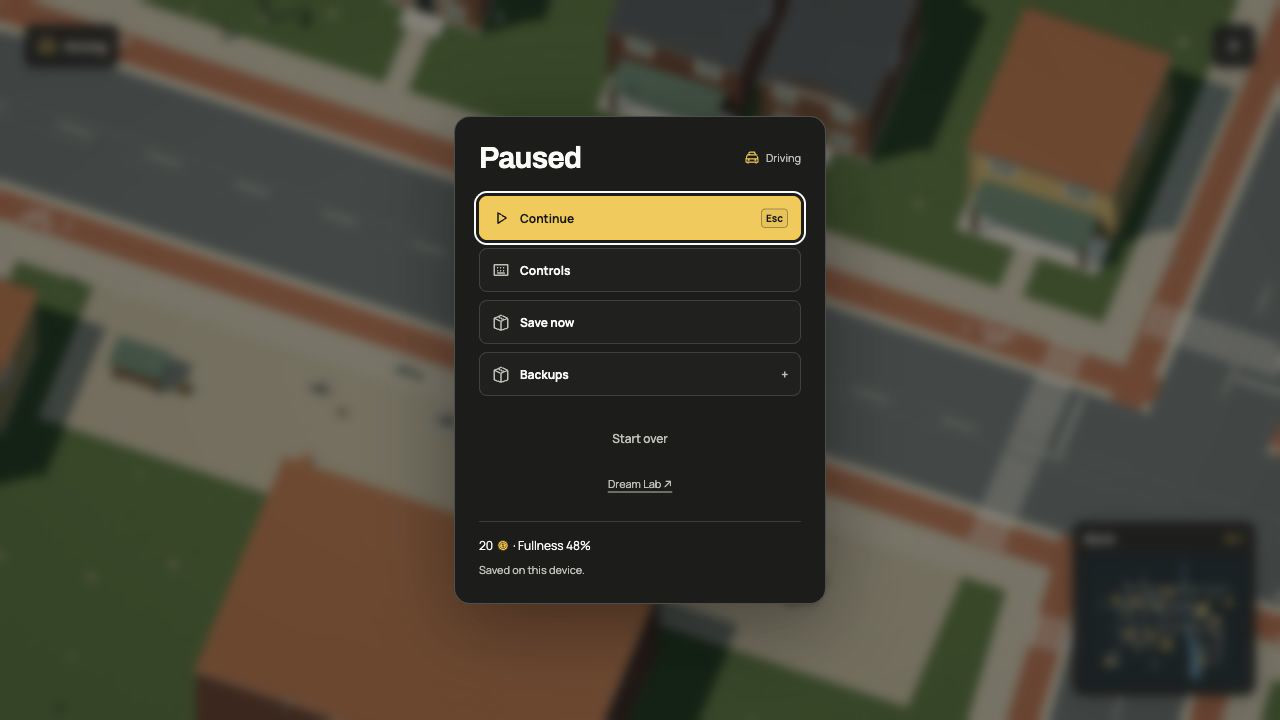
Active deliveries return too. The pause menu shows the sealed cargo beside your balance; reloading keeps its destination and reserved pay.
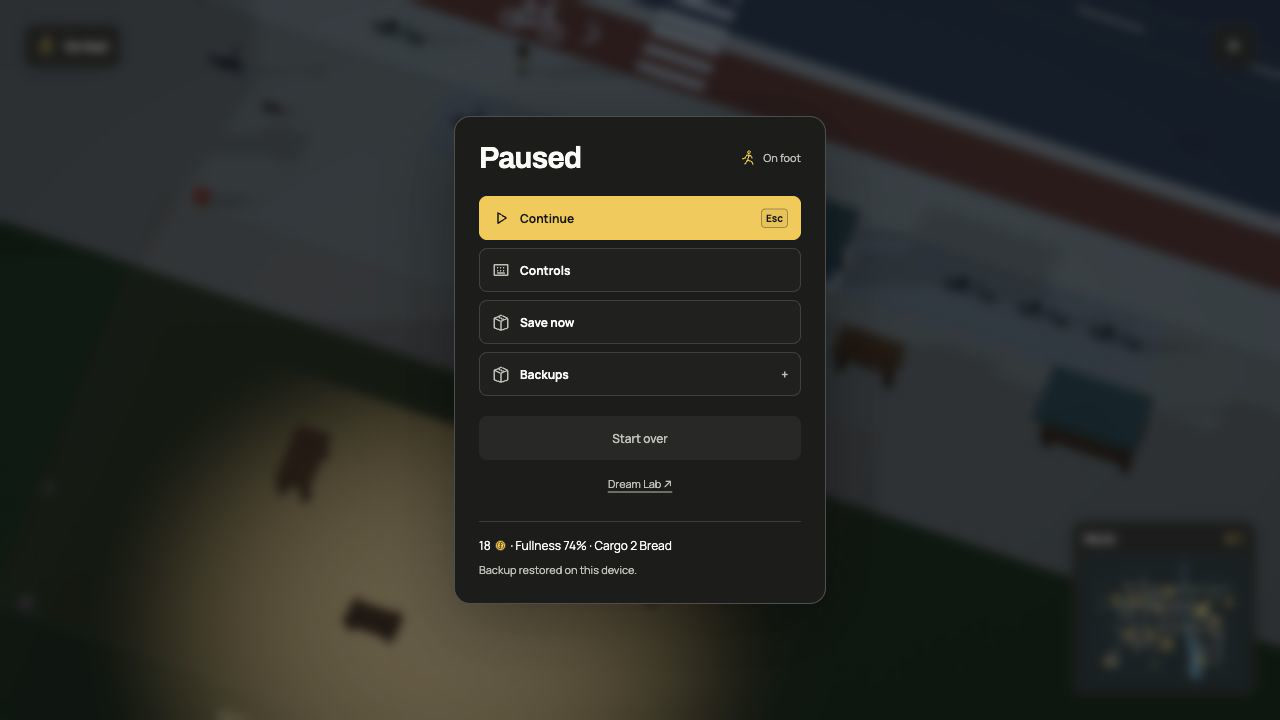
Startup checks now reuse unchanged object encodings within one worker-owned batch with a 32 MiB retained-text budget and an uncached overflow path. The temporary encoder is discarded before chunk building. Canonical bytes, the nineteen current/historical fingerprints at that release, format 11, simulation version 17 and every existing slot stayed unchanged. Seating later adds its explicitly registered format-12 / simulation-18 upgrade below. Ordinary one-off checks never use a global cache. Verification.
Take a backup with you
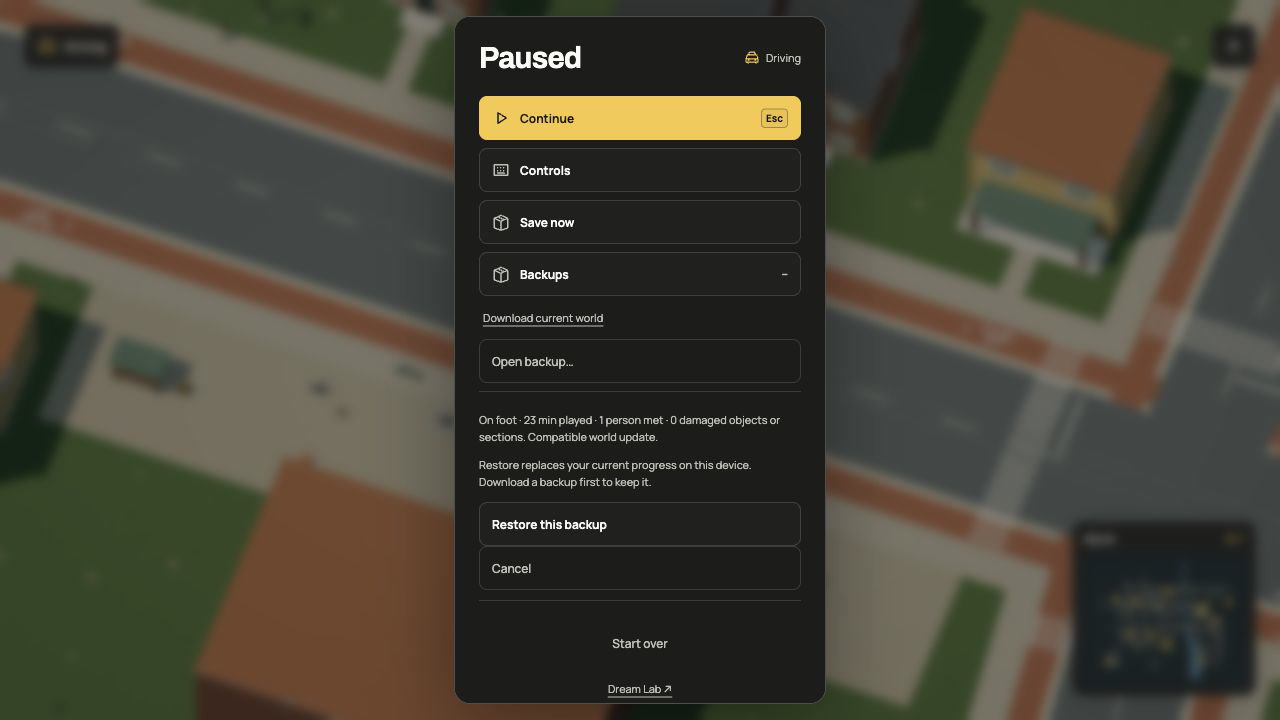
Pause, open Backups, then choose Download current world. The JSON file contains the current simulation state, its source identity and a compatibility fingerprint. It contains no meshes or executable code. Keep it somewhere you can find again, or move it to another browser or device yourself.
Choose Open backup… to inspect a file. The preview shows your control mode, play time, people met and damaged objects or sections. Nothing changes until you choose Restore this backup. Cancel leaves the current session intact. Restore writes the validated state to local storage before applying it to the running world. If validation or storage fails, the current session continues unchanged. Download a backup first if you want to keep the session you are replacing.
Files are checked locally. Opening one does not upload it. A backup from incompatible rules or geometry is rejected, even if its member IDs look familiar. Oversized, malformed or unsupported files are rejected too. Backups are editable single-player data, not signed records or cheat-proof evidence.
Source and compatibility
The host hashes the complete supplied Dream source and module map with SHA-256 before acceptance. A second SHA-256 fingerprint covers the accepted world and a pinned simulation version. Only host revision/source/provenance fields and behavior-state say text are excluded from this second fingerprint. Object-key order is normalized; array order remains significant. Derived numeric values are rounded to 0.00000001 for the fingerprint to remove browser math noise; simulation geometry is unchanged by that normalization. Comments and formatting disappear during compilation. This allows wording changes without treating different movement rules as the same world.
| Authored change | Progress |
|---|---|
| Comments, formatting, host provenance or dialogue wording | Continues automatically when the compiled contract matches |
| Placement, geometry, terrain, routes, NPC transitions, materials or other accepted world data | Separate slot; automatic migration is not supported |
| Shader or UI code only | Source identity is unchanged; simulation-version changes still require an explicit upgrade |
The current format 17 retains the exact source hash and compatibility fingerprint, with simulation version 32. Its economy records include reserved ingredients/wages, work deadlines, fullness, consumed items and completed batches, sealed cargo and completed delivery counts. Restore checks total credits and material conservation, including reservations, before applying anything. Work does not finish while the page is closed or compiling.
The passenger-exit update has a registered upgrade from the released simulation 12 world. Its accepted Dream data is identical. The upgrade keeps every saved field and clock, including passenger ownership, growth and a worker's return journey. It does not rerun older floor, population or inventory migrations. The previous format 9 slot remains stored; corrupt newer progress still blocks fallback. All earlier registered upgrades continue through their checked physical projections. Other world or rule edits do not gain automatic compatibility.
The first market has an explicit registered upgrade from the earlier world. It verifies that every pre-market rule still matches, then initializes only the new accounts/stock/needs at the saved simulation time. Player position, vehicles, damage, sports, NPC memory, population and day/night remain saved. The known r44 format 1 source and format 2 browser fingerprints are supported; original slots are kept. A malformed newer slot blocks writes rather than silently loading an older copy. The registered upgrade chain includes the first-market, first-delivery, usable-parking, local-repair, replacement-supply and connected-repair releases. Later incompatible economy edits cannot silently replay older progress.
Format 1 cannot establish arbitrary cross-source compatibility. Format 2 worlds outside the registered release require their exact earlier fingerprint. Unsupported format 3 economies are rejected. The first-delivery release also upgrades the known format 3 market: it checks the earlier world and economy, preserves existing balances, stock, fullness and reserved work deadlines, and initializes only the depot, canteen, staff account and empty delivery ledger. Sealed cargo and reserved delivery wages round-trip in format 9. Cancelling, recovery and reloading cannot pay a delivery twice. Future engine or economy changes need their own tested migration; no general layout or rule migration exists. A compatibility fingerprint is a safety check, not a signature proving a file's origin.
The parking release upgrades the known r46 format 4 backup only after the host confirms an exact projection of the previous world. It preserves all economic/physical state and validates vehicle ownership against the old prop roles before accepting it. Old slots remain intact. Formats 5 and 6 permit up to 281 saved unoccupied poses (256 dormant parking records, the resident fleet and the original car); old formats keep their 24-record bound. This changes saved metadata capacity, not live animation limits.
Restoration checks the format, world identity, source/compatibility, finite fields, exact members, NPC states/clocks, damage, fragments and vehicle ownership. Population clocks must be current enough to avoid replaying an unbounded backlog. One atomic browser storage write preserves the previous slot if writing fails. Files are bounded to one million characters; file reads are also bounded before allocation.
Incompatible worlds keep separate local slots. An update that adds buildings or changes rules can still start a fresh world; old saves remain stored but cannot be played by incompatible source. The registered first-market, first-delivery, usable-parking, local-repair, replacement-supply and connected-repair additions are migrated; later layout, economy or schema changes remain separate slots. No save is uploaded or synchronized across browsers. Clearing site data removes local saves, so download a backup before clearing them. There is no offline catch-up or cloud service.
Render chunks remain replaceable. Simulation and damage state live outside them, so unloading scenery cannot reset a person, repair a building or move a parked car. Wave texture disturbances and temporary particles are visual effects and are rebuilt after reload; water settings and clocks remain authored/saved.
Development capture, profiling and review starts are isolated from normal saves. A dev-only test-save review uses a separate local namespace for reload verification. Pair it with test-paused to inspect a restored state before any simulation tick. These helpers are absent from the production build.
Talk to people · World systems and next capabilities
The repair release verifies an exact projection of r47 before accepting its format 5 saves. It preserves all existing accounts, inventories, market stock, NPC memory, damage, population and vehicle ownership, then initializes only the repair kits, caretaker account and repair ledger. Original slots remain stored. Earlier registered upgrades continue through this projection. Format 6 records repair notices, claimed target/zone, worker position, bounded path, progress, reserved kit/pay and return home. Restore checks membership, path area, clocks, claims, material consumption and money conservation before applying the state. A currently blocked path remains valid saved intent; movement checks obstacles again every step. Closed pages perform no work. Arbitrary geometry or economy changes still need a separate migration.
The replacement-supply release keeps format 6 and advances simulation rules to
version 6. Its registered r48 projection removes only the new depot-kit lot and
delivery, and restores the former table-only service declaration. A matching
backup keeps every old account, stock unit, completion counter, in-progress
repair, return path, parked pose and memory. Only 32 new depot kits and a zero
kits_run completion counter are initialized. Completed repairs are never reset.
Older registered releases continue through the same chain; arbitrary edits cannot
opt into it. Both r48 and current local slots are retained, and a corrupt newer
slot prevents fallback. Delivery invoices are derived from the pinned contract;
save validation includes their escrow and incoming treasury reservations.
The connected-repair release keeps format 6 and advances simulation rules to 7. The registered r49 projection removes the two new seating surfaces and restores the former market-only policy; every existing object, contact and public-pavement field is preserved. Matching r49 saves keep their complete simulation state, including paid supplier deliveries, completed repairs, supplies, in-progress work, needs, memories, damage and vehicle ownership. Older registered upgrades continue through this projection. Original local slots remain stored.
Repair paths may now span accepted pedestrian infrastructure between declared grounds, with the same 128-point bound. The large derived graph stays out of saves; it is prepared by the world worker. Current obstacles can block saved intent without invalidating it. Presentation interpolation is transient and resets on recovery; it does not change saved contacts or clocks.
Pooled streetlight destruction
Format 7 supports independent damage records for up to 4,096 world objects, while active debris remains capped at 24 object assemblies and 128 pieces. Unknown IDs, duplicates, incompatible impacts and over-budget active debris are rejected. Legacy formats retain their 24-whole-object damage bound. Mesh caches and light-pool visibility are derived after restore and are never saved.
The registered r50 projection removes the pool policy and lamp rule, restores the earlier lamp categories/ungrouped metadata and keeps exact geometry, contacts, placements and economy state. Its fingerprint must match r50 before old progress is accepted. Actual r50 backups retain their complete saved state, including existing repairs, journeys, kits, credits, needs and parked vehicles. Older registered upgrades remain chained. Original slots stay stored.
A lamp stays dark after its falling piece fades, after streaming eviction and after reload. A completed repair restores its full collision and light pool; R preserves damage and Start over restores the authored world. Capacity pressure can retire older cosmetic pieces, never the saved damage record. There is still no offline repair or general migration for arbitrary world/rule edits.
Street-service navigation upgrade
The registered r51 upgrade keeps format 7 and advances simulation rules to 9. It removes only the new service-street fields and High Street/South Avenue crossing to verify the earlier fingerprint. Every object, work surface, contact, balance, kit, job, damage record and clock remains saved. Earlier registered upgrades continue through the same chain; old slots stay intact.
The crossing adds pedestrian navigation nodes. The engine validates saved node references against the earlier graph, then maps them to the same coordinates and compatible neighbor connections in the new graph. People retain their positions, travel history, random state and clocks. Worker paths are already coordinate-based and remain unchanged. Both graphs are prepared in the world worker. This is a tested migration for this release, not a general map-edit migration. Unknown old indices or missing coordinates are rejected.
Orchard recovery upgrade
Format 8 / simulation 10 adds at most 32 growing-tree records: object, planting service, planted-at clock and elapsed unblocked growth. A damaged young tree's debris retains its captured size. Restore checks membership, uniqueness, authorized service, valid clocks/progress, planted-input consumption and reserved planting capacity. Paused or closed pages accumulate no growth.
The registered r52 format 7 projection removes only the orchard grounds, sapling stock/delivery/service and extra worker policy. Existing objects, crossings, public-pavement graph and old market rules must still match. A matching save keeps all balances, stock, damage, jobs, paths, clocks, memories and vehicle ownership; only the new inventory keys, six market saplings, eighteen depot saplings and zero new completion counters are initialized. The earlier upgrade chain remains supported. r52 node indices already belong to the current pedestrian graph and are retained; older releases still use their registered graph conversion. No other layout or economy change can silently opt into this upgrade.
Natural-ground appearance upgrade
The r53-to-r54 upgrade keeps format 8 / simulation 10. It changes only the orchard work area's finish, retaining the same geometry, navigation and physical rules. The host verifies the complete r53 projection before exposing its old slot. Existing growth progress, worker paths, supplies, money, damage, memories, vehicles and clocks remain exact; no new stock or counters are initialized. Derived public node indices already match and are retained. Original slots remain stored, and a malformed newer slot still blocks fallback. Other layout or rule edits require their own migration.
The r54-to-r55 upgrade advances to format 9 / simulation 11. The host registers an exact r54 projection removing only automatic courier assignments and delivery work-ground fields. Every previous state field and world clock is preserved; no trip starts, stock changes or wage is paid during restore. The old format 8 slot remains intact, and a corrupt format 9 slot blocks fallback.
Courier pickup intent is separate from reserved sealed cargo. Saved phase, contract, position, destination, coordinate-only path and retry clock are checked against the accepted world and actor capability. Carrying requires the matching delivery reservation; pickup and return prohibit one. Money/material conservation and shared contract capacity include all commitments. Restoring a currently blocked path keeps its intent and checks live obstacles when movement resumes. The original registered upgrade chain remains supported.
Enterable-market upgrade
R56 keeps format 9 and advances simulation rules to 12. Its registered r55 projection restores the pinned hall assembly and placement, original entrance, 70-unit bakery reach and repair grounds, and removes only the four new interior furniture placements. Earlier upgrades pass through that exact physical projection. The old slot remains intact; an invalid newer slot blocks fallback.
Balances, inventory, reserved work/cargo, damage, plant growth, clocks, sports and parked-vehicle ownership stay saved. Derived pedestrian node IDs are rebound to the new graph; when an old goal disappeared or is blocked, a nearby reachable node replaces that goal without moving the walker or resetting its history.
A grounded player's old pose may now intersect the raised floor or wall. Restore first tries supported footing at the same XY, then clear footing within 32 units, retaining the active body and parked vehicles. An active batch prefers a pose that still reaches its market through the opening. This is an explicit geometry upgrade, not arbitrary layout migration. If no safe local pose exists, the existing player-recovery rule still applies. The building's support and NPC work state are independent of render chunks.
Multi-input work upgrade
The registered simulation-13 release upgrades to simulation 14 after validating
its exact accepted-world projection and conserved saved ledger. It preserves all
existing fields, including work deadlines, balances, stock, consumed food,
deliveries, repair claims and paths, growing trees, NPC memory, vehicles and
visual time. It adds only the four new zeroed inventory/consumption entries,
eight vegetables, eight boards, eight fastener units and an empty lunch shelf
at the market, plus zeroed pack_lunch and assemble_kit batch counters. No money
is added. Reloading the new slot cannot seed those supplies again.
The old format-9 slot stays intact. The current slot wins; corrupt or changed current data blocks fallback rather than silently rewinding to the previous release. The earlier registered upgrades still pass through their own checked physical projections before receiving the new definitions. A change to another world, price or recipe remains incompatible. Ingredient reservations are derived from the accepted recipe and active work ID; saves cannot supply a custom recipe.
Personal completion history
Format 10 / simulation 15 adds per-account counts for completed work, deliveries and repairs, plus unassigned earlier totals. The registered r57 upgrade first validates the old world and complete economy. It preserves every previous saved field, initializes only the larger job's empty batch counter and the new history, and leaves previous shared counts unassigned. Older event buffers were truncated; they cannot safely identify every worker. New personal records start at zero.
An active saved job keeps its deadline and reservations. Its actual completion then adds one personal record and the ordinary wage. NPC work never increments the player's record. Restore checks exact task IDs, integer bounds, totals and any active job's qualification before applying state. A normal format 10 reload does not repeat the migration or erase personal progress. The old slot is kept; a corrupt or concurrently changed newer slot still blocks writes and fallback.
The exact registered projection removes only the larger job, milestones, ordered baker policy and guarded conversation additions. Previous world geometry, contacts, paths, initial inventories and task rules retain their existing fingerprints. All earlier registered upgrades remain tested. Pure r57-to-r58 upgrades do not rebase the population, move vehicles, adjust floors or advance simulation time. A save is locally editable data; these checks do not prove who actually played it.
Meal journeys
Format 11 / simulation 16 adds optional per-account meal travel: plan/market, outgoing/eating/return phase, paused routine home, position, heading, distance, retry clock, bounded waypoints and the eating deadline. Restore verifies the program's frozen home, assigned market/food, dry pedestrian support, path segments, phase ownership and timers, plus ordinary credit/material conservation. A purchased meal is owned inventory; eating consumes it once. No offline catch-up occurs.
The registered r58-to-r59 projection changes only the commuter's food policy. It adds no accounts, balances, stock, geometry or population. Format-10 personal history is retained exactly; it is never put through historical attribution again. Older formats still pass through their original registered checks before this upgrade. No population or floor rebasing happens for the pure format-10 upgrade. The original slot remains, and corrupt/newer or changed-tab saves still block replacement. R and chunk unloading retain the journey; Start over clears it.
Staffed business update
The r59-to-r60 update keeps format 11 and moves the simulation fingerprint to version 17. The existing vendor's ordered jobs add lunch preparation, and the existing market helper adds the existing flour contract on its market ground. Standalone meal/courier scenes now prepare public walking independently of repairs and ambient walkers. No initial stock, money, objects or ledger members are added. Current live-city geometry, contacts and prepared graphs are equal.
Restore validates against the registered r59 world before accepting any state. Every prior field and world time stays exact: no history attribution, population rebasing, floor adjustment or restarted timer. Active work and customer/courier paths continue under ordinary fixed ticks after loading. The older format-11 slot is kept under its original fingerprint, and normal reload never repeats the upgrade. The earlier registered chain and corrupt/newer/concurrent-tab guards remain intact. This is a host-pinned upgrade, never authored Dream migration code.
The r60-to-r61 upgrade uses format 12 / simulation 18. Its registered projection removes only the bench seat metadata and the commuter's indoor seating option. It preserves every old state field, clock, ledger, personal counter, vehicle and active trip; older standing meals finish in place. No geometry, population or stock is rebased. The original format-11 slot remains intact. New saves retain the player seat and NPC reservations and reject duplicate, missing, broken or displaced claims. A corrupt newer slot still blocks fallback.
Counter hours (r62)
Format 12 / simulation 19 registers the exact released r61 world. Its projection
removes only market.hours; every saved state field and visual clock remains
unchanged. Seats, ongoing meals, reserved batches, cargo, repairs, needs, money,
stock and personal history continue. Couriers waiting outside service hours save
the same real journey and escrow; reopening resumes the transaction once. No
extra timer or offline work is inferred. The old slot is kept, and a corrupt or
concurrently changed newer slot still blocks replacement.
Staff travel (r63)
Format 13 / simulation 20 saves each assigned account's out/rest/in phase, physical position, heading, speed, distance, target, path and retry clock. Staff programs pause during travel, remain available at rest and keep meeting memory. No offline catch-up runs. The registered r62 projection removes only shift policy, restores the teacher's old six-unit-offset entrance anchor and merges the same school path footprint back into its prior declaration. Every old state field and both clocks remain exact; original format-12 slots remain. Older migrations still validate their registered worlds first. Unrelated world changes cannot use this upgrade to reset progress. See staff shifts.
Shared social time (r64)
Format 14 / simulation 21 records one optional player-hosted meal: plan, partner, both seat refs, reserved portions, captured home, path, pose, distance, retry and eating timers. Sparse per-partner history records only completed meals and their last completion time. Restore checks capability, unique claims, original home, paths, timers, refund space and conserved material, including both portions. Immediate F/R exits refund on a copy before a save can observe invalid ownership.
The registered r63 projection removes only new social plans/account capability, guarded dialogue/states and the school bench. The previous accepted fingerprint must match before decoding; existing state remains exact, with no invented history, population rebasing, changed clocks, resources or first meetings. Keep the format-13 slot and every earlier migration. Unknown future worlds cannot use this upgrade to rewind progress. Gameplay and bounds.
Connected school repair coverage (r65)
Format 14 / simulation 22 adds the school yard and its two access patches to the existing furniture service. The registered r64 projection removes exactly those three grounds and reproduces the old fingerprint. No saved field changes: retain shared meals/history, remembered acquaintances, stock, balances, cargo, work, repair paths, damage, vehicles, population and clocks. The old format-14 slot remains available under its original fingerprint. Restore validates against the old world first, then the expanded service, without rebasing navigation, bodies, inventories or task attribution. Existing r63 and earlier upgrades remain chained. There is no offline repair or replenishment.
Business ownership (r66)
Format 15 / simulation 23 saves each authored business's current owner and optional purchase time with its existing stock and cash. Acquisition and capital events retain bounded amounts; restore checks account membership, sale eligibility, clocks, ownership and credit/material conservation. Deposits protect company refund/invoice headroom; transfers to a person protect pending wage headroom.
The registered r65 upgrade first validates its exact previous world. It appends only a zero-credit depot owner with empty inventory/history at saved simulation time, and initializes the station market's authored owner. No old field, job, balance, food, memory, physical pose or clock is rebased. All earlier projections still apply before this step, including both format-14 worlds. The original format-14 slot stays intact; corrupt or externally changed newer progress blocks fallback and replacement. No offline income is calculated.
Six-a-side matches (r67)
Format 16 / simulation 24 first verifies the exact r66 world and its previous format-15 state. It adds ready match records while keeping old scores, balls, NPC history, money, company ownership, work, repair and other world state. Held shot controls are cancelled. The old slot remains available. Every earlier registered upgrade still passes through its own checked projection.
A current match restores its per-member poses, ownership, elapsed time, home/away scores, round, result and bounded tactics/action clocks. Shared rosters keep one visible venue and at most one playing match. Restore cancels held input and shot charge; it does not take the ball away from its saved owner. R releases current possession while keeping progress; Start over creates new ready matches.
Street-only city, r68
The r68 save format 16 pins simulation 25. The registered update verifies the exact r67 physical world before loading its state. Existing people, vehicles, businesses, work, damage, sports results and world clocks survive. Pedestrian node references are mapped to the new pavement graph while valid positions, random state and clocks remain saved. Walkers on a removed internal zebra move to nearby clear pavement; obsolete staff, repair, courier, meal and shared paths reroute to their existing destinations. Commitments, supplies and wages remain reserved. The retired circuit checkpoint index becomes zero and its pad cooldowns are removed. A newly occupied static footprint uses the existing safe player recovery. The old format-16 slot stays intact until and after a successful write to the new fingerprint slot. Earlier upgrades still run through r67 first.
Connected park, r69
Format 16 / simulation 26 checks the exact r68 world before adding Garden park. All 1,719 released objects remain identical. The projection removes only the new park objects, surfaces, destination and furniture repair ground. Earlier upgrades still run through their own registered projections and original slots.
Old ambient members are matched by stable object ID, with positions, random state, travel history and clocks retained; derived node indices are rebased. Eight new visitors start at the saved simulation time with zero travel, without offline catch-up. Existing businesses, financial ledgers, work commitments, physical changes, parked vehicles, sports matches and NPC memory remain saved. Unsafe active poses use the existing local clearance recovery before the ordinary reset fallback. The previous format-16 slot stays intact after a successful new write.
Walking spacing update
Format 16 / simulation 27 validates the exact released r69 world before applying the new ambient walking rules. Geometry and saved fields are unchanged. Keep every population pose, node, distance, random state, wait and clock exactly, along with jobs, money, ownership, seats, matches and damage. Existing overlapping people separate through ordinary future movement, without a reset or offline catch-up. The old format-16 slot and the full earlier migration chain remain.
Separate airport approach, r70
Format 16 / simulation 28 checks the exact r69 world before applying the airport junction change. All previous object IDs remain. Six lamps move with the airport road; newly clear space admits seven static furnishings and two walking residents. Existing population members retain their saved state, with derived portals rebased and only a walker on obsolete pavement moved to nearby clear ground. New residents start at the saved tick. Obsolete work paths reroute without restarting commitments.
Money, ownership, stock, work, damage, vehicle poses, matches, NPC memory and clocks remain saved. A passenger aboard the airport bus stays aboard at the same simulation time on its revised route; their pose is fitted to that bus. Other passenger routes are unchanged. The old format-16 slot remains intact after writing the new slot. The registered chain still accepts all 28 pinned historical backups.
Character wardrobe, r71
Format 16 / simulation 29 verifies an exact projection of the released r70 person templates before accepting previous saves. All object IDs, positions, measured heights and physical cylinders stay fixed. Existing people retain their population poses, distance, random state, waits and clocks; only derived walking portal indices are rebased for the new visual envelopes.
Jobs, money, stock, ownership, conversations, shared-meal history, damage, parked vehicles, seats, matches and visual time remain saved. The upgrade does not introduce residents, replay older transactions or relocate people. The old format-16 slot remains stored after a successful new write, and all 28 historical backups continue through the checked chain. Other geometry edits do not receive automatic compatibility. Character and upgrade checks.
NPC-hosted meals, r72
Format 17 / simulation 30 adds an optional pending invitation with its host, reserved adjacent seat and 30-second simulation deadline. An optional per-account last-offer clock prevents repeated invitations. Accepted meals record the NPC food donor; its absence retains the existing player-funded meaning. Pending food stays in the host’s bag. Acceptance escrows two portions; interruption refunds that same owner exactly once. Save/restore cannot repurchase, consume twice, assign the guest a refund or award a meal before eating finishes.
The registered r71 projection removes only the optional social supply lists and restores the bakery lunch refill target from three to two. Its entire accepted world must match before migration. The transition preserves every saved field, clock, wallet, shelf, job, meal, relationship history, population coordinate and physical change. It adds no resources and runs no older initialization again. Format 16 stays strict and cannot contain the new fields. The original slot is kept after the first successful format-17 write; the earlier migration chain remains available. New worlds outside this exact registered projection do not gain automatic compatibility.
City repair coverage (r73)
R73 keeps format 17 and advances simulation rules to 31. Its checked projection restores the r72 fixture service label and three-street selection before decoding an older save. All saved fields and visual time remain unchanged, including invitations, reserved food, repair progress, worker paths and physical damage. The original format-17 slot is retained. A malformed newer slot still blocks automatic fallback.
Historical projections retain the released repair access footprints, selected before their work areas are prepared and inherited through the existing migration chain. The wider live approaches cannot alter an older migration's waypoints. These are host-side cache rules, never Dream fields or saved flags. The native airport work/return checkpoints and 33 prior backups are covered by the coverage verification.
Development inspection links with test-save now read their compatible saved
world before preparing a review. A valid restored review skips its offline
preparation and retains its exact state; a fresh review still runs the full
fixed-step preparation. Production restore, paused clocks and capture isolation
keep their existing behavior.
City trees (r74)
Format 17 / simulation 32 registers the tree rule and expanded planting coverage. The r73 projection restores each tree's original impact and fragment ownership, and the original three-tree planting service, before validating its backup. The prior accepted world is exact apart from host provenance. Every saved field and visual clock survives, including an old sapling already falling, active repair paths, stock, money, meals and relationships. Original slots remain. No new inventory, work or time is granted by the upgrade.
Intact tree geometry and public pedestrian node order stay unchanged. Wider work verges can use supported corner turns in the worker's derived graph; released narrow-service paths retain their previous behavior. These graphs and render prototypes remain host caches, outside Dream source and saved state. Thirty-six checkpoint comparisons and complete verification.
Depot fleet upgrade
The registered r75 update adds four parked utility vehicles and their loading aprons. Its projection preserves the complete r74 world data and all earlier upgrade stages. Saved vehicles, cargo, jobs, ledgers, damage, people, growth and clocks keep their state. If a new seed conflicts with saved vehicles, people or work paths, the new vehicle takes nearby dry parking clear of roads, entrances, old paved grounds and rail/runway corridors. Existing poses stay where they were saved. The search is deterministic and bounded to 256 candidates within 32 metres per seed; if it cannot find space, restoration fails without replacing the old slot. The existing unsafe-active-pose recovery remains as a final safeguard. Original slots remain intact. Save format 17 and simulation version 32 are unchanged.
Tree construction upgrade
The registered r76 update replaces tree visuals while preserving saved lives, vehicles, cargo, accounts, damage, falling trees, worker journeys and growing replacements. Its explicit projection restores the released r75 tree definitions and derived placements before every earlier compatibility stage. Old slots remain intact. The worker supplies the prior contact cache with the projection's source identity before old-state validation. Save format 17 and simulation 32 stay unchanged. Native and historical checks.
Landscape plant construction (r77)
The registered plant update retains format 17 and simulation 32. It replaces thirteen landscape and street-plant templates, while an explicit projection restores their released r76 definitions and 460 placements. That reproduces the exact canopy-world fingerprint before any earlier migration runs. Existing bodies, ordered contacts and the complete pedestrian graph remain equal. The worker supplies the prior contacts with the matching source identity before navigation is primed on that exact scene.
Old progress, occupied and parked vehicles, cargo, damage, falling/growing trees, work journeys, ledgers and visual time survive. Original slots are retained. Migration honors the supplied storage prefix, including isolated review slots; it cannot fall back from a review namespace to a public save. Checks and native backup.
Furniture construction (r78)
The registered upgrade validates the exact r77 world through its five original furniture templates and eighteen original placements. The worker supplies that projection's contacts before navigation is primed. All earlier projections run after removing the furniture revision. Review prefixes retain their own slots.
Format 17 and simulation version 32 remain unchanged. The upgrade retains every saved field, including occupied seats, broken groups, live fragment poses, repairs, jobs, money, food and delivery cargo. Fragment identities stay stable; their new visual geometry also supplies their new physical extents, so later fragment trajectories need not match the old shapes. The table cap is deliberately lower. A walker saved standing on the previous cap falls safely onto its new height during ordinary fixed steps, without resetting progress.
Wildlife construction (r79)
The registered r78 projection restores the nine original templates, all 62 animal placements/ambient rigs and the sixteen original flock specifications. It reproduces the released world fingerprint and matching contact source before navigation. Earlier projections first remove this visual revision. Isolated review prefixes never borrow a public save.
Format 17 / simulation 32 and every state field remain unchanged. New stride
joints read existing travel only; no new clock is saved. Homes, bounds, routes,
reactions, economies, damage and vehicle ownership retain their state. The
reconstructed ear silhouettes and subsequent limb poses differ intentionally.
Historical matrix and native round trip.
Street furniture toppling (r80)
The sixteen planted street tubs and two produce stalls gain pooled whole-object topple impacts. Construction, contacts, placements and scales are unchanged. The registered r79 projection restores the two original template records and reproduces the released fingerprint before every earlier stage. Format 17 / simulation 32 and every saved field remain unchanged; existing damage, repair claims, stock and credits carry over. A tub or stall first knocked down after the upgrade enters the existing broken-object state and the same paid repair service, which now covers 449 targets. Checks and browser evidence.