Rendering
The final image now has a spatial antialiasing pass after output conversion. Canvas antialiasing did not cover the offscreen post-processing targets, leaving stair-stepped cycle stencils and other fine diagonals. SMAA finds edges and blends their coverage at the existing drawing-buffer size. It changes no world geometry, textures, camera resolution, simulation or HUD text. The two normalized targets use six bytes per drawing-buffer pixel in total, excluding driver overhead and the existing composer buffers. Their embedded lookup images and shader programs are ready before the first-frame handoff; failure follows the ordinary loader. The pass releases its targets, textures and materials on final page exit. A matched 1080p town drive on the local M3 Ultra added .180 ms mean GPU time and three full-screen draws, with the same world geometry. Frame intervals stayed near 16.67 ms. This does not establish performance on weaker laptops. Raw timings and verification.
Rendering the whole world
The mock world has 1,773 placed objects across a 14000 × 11000 landscape. Static render geometry now loads around the player and leaves memory behind them. The accepted Dream world and its simulation stay complete.
Usable parked vehicles
The 91 parked bicycles, scooters, cars, pickups and parcel trucks retain their full construction. Untouched models stay in streamed instance batches. Boarding hides the original instance in both color and shadow passes and creates one full CPU rig. Leaving it disposes that rig and adds its saved pose to local instance batches by model and rigid part. Wheel phase is baked only when ownership, parking or residency changes. Local prototypes and instance buffers are released when their destination chunks leave memory. Collision queries keep immutable seeds plus a spatial index of moved poses; they never scan the entire fleet each fixed tick.
The 256-record dormant fleet cap leaves the limits at 24 resident route actors or controllable vehicles, 32 NPCs and 24 live joint assemblies. One active fleet rig is reserved. The matched original drive retained 253 mean draws, 647,115 triangles and 255,358,898 counted buffer bytes, with a 16.667 ms mean frame interval on the local M3 Ultra / 96 GiB. This is one local retention check, not a speed or low-powered-device claim. Checks and browser evidence.
The ambient movement pass caches immutable rest radii and accepts a pavement step early only when its complete swept footprint fits strictly inside one convex piece. Boundary joins, concave pieces, thin gaps, water and physical contacts keep their existing checks. Candidate steps stop accumulating nonnegative spacing costs once they cannot beat the current choice. The complete repair replay compares exact saved results and local CPU time; it is not a browser FPS claim.
Segment samples now share their enclosing contact query, and distant vehicle forecasts yield before the exact two-second closest-approach calculation. Numeric cell rows avoid repeated string keys while keeping query order and moving-record buckets unchanged. The matched replay records the exact state trace and local CPU timings; population and visual quality are unchanged.
Walking feet retain world position, height and facing during stance, then return at bounded rates. CPU rigs and sidewalk shaders share this policy and the longer strides. Two support probes fit shoes to the visible terrain, pavement, decks and reachable object caps; the pelvis adjusts before the rigid leg solver runs. Crowd probes run at most 20 Hz per returning foot, including offscreen members. Four existing attributes now pack fourteen contact floats plus phase and amount. This adds 2,420 instance-buffer bytes across the live city’s material batches, with the same eleven ambient draws and unchanged geometry. The host worker reuses the cached street render plan, sends bounded support polygons, and the client indexes them once. Fine bicycle stencils stay cosmetic. There are no additional meshes, navigation decisions, physics bodies or saved fields. Sports squads retain their existing match cadence and action poses. Numerical contacts, cache sizes and local CPU measurements.
Loading and memory
Cycle surfaces are resolved once per accepted Scene before chunk clipping. Declared junctions connect existing cycle facilities within the shared riding footprints and crossing-arm bounds. Their convex pieces are unioned once, so matching orange ribbons do not stack. Separators, centerlines and stop bars yield to this surface, while glyph placement still checks the dedicated lanes. Maps reuse the same helper. Collision masks and pedestrian envelopes are unchanged. Geometry and native checks.
The loading screen arrives in the first HTML response. One worker compiles and validates Dream, then builds terrain, streets, water and static object chunks on demand. Finished mesh buffers are transferred to the renderer, along with engine-owned material recipes and per-instance occlusion data. Object stamping and batching stay off the main thread. The first complete view starts the game; the rest of the map is built as it becomes relevant.
The worker also supplies the pedestrian portal graph, surveyed static collision cylinders and whole-world culling bounds. The game restores their local query helpers instead of repeating graph construction and terrain-support surveys. Graph node order stays exact so saved pedestrians retain their destinations. These are host-owned caches, outside Dream source and saved state. Source identity, bounds, links, starting nodes and cylinder structure are checked before use. Route surfaces/paint/rails and live interactive assemblies use cooperative build steps: the loader can update between pieces without changing their geometry or creating a lower-detail version. Individual mesh builds and the first GPU upload can still block; this does not make startup instantaneous. Once the first required chunks arrive, Three.js prepares shader programs asynchronously before the first draw. Browsers with parallel shader compilation can complete that work while the loading screen remains active; other drivers may still block. Simulation waits for both the required chunks and shader readiness. A failure exposes Reload, stops rendering and releases the streaming worker.
On the local M3 Ultra / 96 GiB, the recorded maximum startup heartbeat gap fell from 1,949 ms to 289–293 ms across two final samples at full settings. Loading still took 11.5–12.2 seconds; this mainly improves page responsiveness. Matched drives retained the same draws, triangles and roughly 16.7 ms frame intervals. Measurement conditions, raw reports and limits.
The terrain-query pass skips hills outside their compact support, rejects distant water/pavement outlines before exact polygon tests and reuses immutable bridge frames. It changes no terrain samples, contours or render detail. An exact comparison against the preceding release checks the complete accepted world, navigation, masks, contacts, placement transforms and eleven save fingerprints. The query evidence separates construction timings from native browser measurements. On the same local M3 Ultra, two quiet development reloads took 15.6–15.7 seconds, against a 17.9-second baseline of that market revision. All use full settings; cold-network loads and lower-powered laptops remain unmeasured. Startup still takes time, and first-neighborhood mesh construction remains about five seconds.
Save compatibility now shares canonical world-list entries within one immutable worker bootstrap. The current and historical checks keep their exact byte format, including numeric key order, escaping, array order and the separate old unrounded contract. The encoder is dropped before navigation packets and render chunks are prepared. Retained canonical text has a shared 32 MiB UTF-16 budget; when it fills, remaining checks continue uncached. This budget excludes map/key overhead and is not a browser-memory estimate. The encoder is not a global cache, scene field or saved data. Individual source checks still read their current input normally.
Three local Node comparisons reduced the median nineteen-fingerprint phase from 1.712 seconds to 0.378 seconds. The full ranges are 1.700–1.735 and 0.376–0.870 seconds; the third candidate also had slower construction and support steps. Explicit-GC checkpoints show a 10.5–13.2 MiB JavaScript heap increase with the cache held, then a released checkpoint below the initial level. These are Node diagnostic measurements, not peak memory or browser heap. The matched browser and world checks cover loading, full-quality drawing and the exact accepted scene. This does not change frame-by-frame rendering cost, world contents or save semantics.
Two clean, warmed development reloads at a fixed 1600 × 900 CSS canvas and 1.5 pixel ratio recorded world checking at 7.31–8.32 seconds before and 6.43–6.49 seconds after. Whole-loader times were 14.02–15.33 and 13.23–13.45 seconds. Host activity was not isolated, and the slower baseline is retained. These are local measurements, not cold-network or lower-powered-device predictions. Render counts and resident buffers match under the same graphics settings; the browser reports retain all timing variation.
The development dependency cache lives in each checkout's .npm-cache/vite, so
worktrees sharing installed dependencies do not share optimized module identities.
For adjacent revisions that retain the same Dream world, reproduce that comparison:
node --expose-gc scripts/profile-world-acceptance.mjs a2a21fe087cdaf4c523d3da15bc58de99cc549b5 /tmp/dream-acceptance.jsonIt uses an isolated source archive from Git and fails if any compared data changes. Its Node SSR timings are diagnostic construction measurements, not browser FPS, total memory or a cold-network loading benchmark.

Chunks cover 800 × 800 world units. Selection includes the orthographic view at the world's height extremes, rotated and zoomed views, object extents and upstream shadow casters. A 400-unit prefetch margin and three seconds of movement lookahead prepare the next area. A wider retention band keeps up to sixteen previously visited chunks warm outside that requested area, avoiding repeated rebuilding near boundaries.
Eviction removes Three.js geometry, instance buffers and owned materials, then drops their CPU references. Shared water textures and the toon gradient survive. Returning rebuilds the same source-derived geometry. There is one mesh request in flight; outdated results are discarded. Required chunks take priority over prefetch. When a teleport, zoom or rapid travel outruns construction, the last complete frame holds briefly with a loading status. Simulation and frame exports wait, so the car cannot drive into invisible geometry.
This streams terrain, streets, road paint, ground finishes, small plants, water surfaces and static scenery. Complete scene data, masks, physics, NPC clocks, damage, wave fields, live vehicles/people, ambient populations, flocks, bridges, route infrastructure and light pools remain resident. Streaming does not reset a broken table or stop a bus in another district. There is no distance-based geometry downgrade. Pixel ratio, antialiasing, post-processing, particles and the 2048-pixel shadow map retain their settings. Shadow bounds come from accepted world data, independently of loaded chunks.
The matched local survey measures these major render groups:
| Same current geometry | Retained geometry buffers |
|---|---|
| Entire map built at once | 440.8 MiB |
| Town and warmed nearby chunks | 128.2 MiB |
| Airport after leaving town | 106.4 MiB |
| Waterfront after leaving the airport | 114.2 MiB |
| Return to town with nearby chunks kept warm | 163.4 MiB |
The town case retains 71% fewer geometry-buffer bytes than constructing the same current world at once. The return case keeps four additional nearby chunks; it has released the distant airport geometry. These are deterministic buffer counts, not total browser heap, VRAM or a lower-powered laptop frame-rate claim. The survey includes environment, water/bridges, routes, flocks, static scenery and ambient populations. It excludes live actors, the player, effects, textures, render targets, temporary construction and compiler/worker caches.
node --expose-gc scripts/profile-world-memory.mjs voxel /tmp/dream-resident.json
node --expose-gc scripts/profile-world-streaming.mjs /tmp/dream-streamed.json
The development game's #game[data-streaming] reports required/resident chunks, loaded/unloaded/discarded counts, retained chunk bytes and assembly timing. #game[data-memory] counts geometry across the constructed render scene, including live actors. Neither represents total browser memory. The worker's support-height cache is bounded to 64,000 entries; stamp mesh caches remain bounded per thread.
Streaming evidence and limitations contains the source identity, locality survey, native browser checks and recordings. The earlier all-resident comparison remains historical evidence: indexed columns reduced the previous representation from 535.1 to 400.2 MiB. That geometry differs from the new contoured surfaces, so it is not the matched streaming baseline above.
Diagonals without stair steps
Roads, cycle glyphs, crossings, decks and shorelines use cut-cell contours. The renderer clips their actual outline at supporting ground-cell boundaries, preserves UVs and layer lifts, and merges complete flat interiors. Narrow paint keeps its authored width even when it is smaller than a terrain cell. Adjacent chunks use the same canonical lattice and source-wide UV coordinates. Bridge decks and their pavement share a continuous height field, keeping ramps free of crosswise steps. Water samples the same wave field at shared UVs, without translucent tile skirts, so independently loaded tiles meet. Its persistent material and wave textures keep their original ownership and colour.
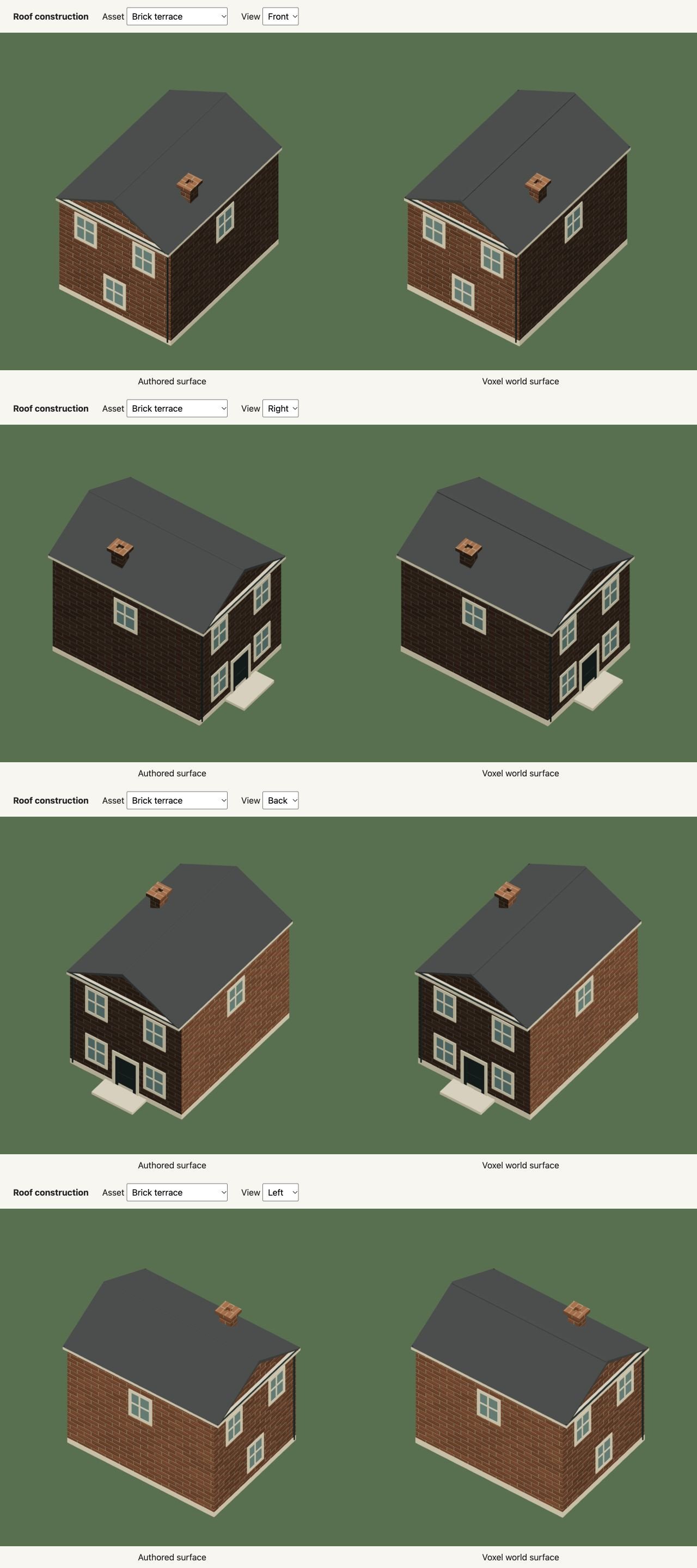
Undeformed prism and pyramid stamps keep exact planar boundary contours. Conservative triangle/voxel overlap retains thin shells between cell-centre rays; coplanar fragments from a source triangle merge to that triangle, without emitting cell-by-cell geometry. This avoids open roof stripes and false contour bands on flat slopes. Curved or deformed shaped stamps use a bounded surface net over occupied cells. Flat coplanar faces are merged, and the resulting surface is fitted to the original authored envelope. Tires retain their open centres; pivots, materials and physical contacts keep their existing ownership. Explicit voxels/fill/cut volumes retain exact cell faces and fracture cuts. Ground hills retain their stepped column appearance. No finer world-size grid, per-cell meshes or per-cell physics bodies were added.
Surface nets follow the boundary reconstruction approach described by Mikola Lysenko. Resource ownership follows Three.js cleanup guidance. The implementation preserves the existing grid and surface limits; these are engine choices, so Dream's command vocabulary stays the same.
Less work for the same image
Tram tracks are thin projected surface details rather than elevated boxes. Their footprints reuse the route's authored miter frames and gauge. The renderer clips them onto actual road/deck top triangles, preserving the same height between vertices instead of independently sampling another strip. Grooves and heads sit two and three millimetres above that surface for rendering. A small raster depth bias survives worker transfer; the geometry still fits the supporting road. Crossing and other street paint yields to the same groove footprint. The static track loads and releases with its street chunks, while the tram and its clock remain resident. Native views, geometry and resource checks.
Toon and paper-grain parts now carry their original linear colors on their vertices. Parts with the same shading and rigid motion can share a draw even when their paint differs. Geometry, normals and UVs are preserved. Glow, cloth and stripes retain their separate material behavior; joints, wheel pivots and detachable building sections keep their boundaries.
Brick, wood and stone use separate engine-owned surface shaders and palettes. A surfacePosition vertex attribute survives geometry merging and instance prototypes; newly cut voxel fragments regenerate it in the original part frame. Screen-space derivatives recover the physical scale after those transforms, keeping brick courses consistent between differently sized buildings. Mortar and grain provide shallow normal relief, with filtered detail at small projected sizes. The finish adds no per-brick geometry or texture downloads, but separate material groups can require more draws than the old shared flat paint. Authoring · Verification.
The engine computes fixed terrain, road, bridge and instanced-scenery transforms once. Wind, water waves and local occlusion fades still animate on the GPU. Moving vehicles, people and debris keep their live transforms. The scene's matrices are updated once before occlusion and rendering, actor poses are reused within a frame, and a character is reparented only when changing vehicles.
Pixel ratio, antialiasing, the 2048 × 2048 sun shadow map, shadow coverage, bloom, color grading, particle counts, asset detail and the fixed simulation timestep stay the same. Frustum culling avoids drawing geometry outside a camera or light's view; it never removes that geometry from memory.
Day and night
The optional Dream daylight clock changes sky/fog colors, hemisphere light and one sun/moon direction. The existing 2,048-pixel directional shadow map remains world-aligned at each phase. Direct light fades out during the sun/moon handoff; camera movement does not drive that phase. Nighttime sky and ground fill retain visible paths, people and dark assets outside lamp pools. Daytime colours and intensities remain exact. This uses the existing three lights and one shadow map. Night visibility check.
Night emission is stored beside vertex paint, preserving rigid merging and instancing across walls and windows. Static lamp pools are tessellated against terrain and decks once, then use the existing resident geometry tiles and shared night uniform. Daytime hides those tiles. There is no point light or shadow map per lamp, and no new actor or joint slot. Pool lighting is unshadowed and affects the ground only. Day/night verification records captures, checks and local full-quality measurements.
Measure a change
Run npm run dev, then open http://127.0.0.1:5173/?profile on your machine. It is development-only and absent from the production build. Its world starts frozen so the initial view can be compared exactly.
- Measure still resets to the starting view with its animation clock frozen.
- Measure drive resets the car and applies the same six-second input sequence at a simulation step of 1/60 per rendered frame. The existing simulation still advances in its 1/120 steps. The renderer runs on the browser's real animation loop.
- Each run warms up for 60 frames, then measures 300. Reload between comparisons to start the particle clock and renderer caches from the same state. Keep the tab visible and avoid running builds or tests during measurement.
cpuMs measures frame preparation and render submission. gpuMs uses nonblocking WebGL timer queries when available; it is null otherwise. rafMs measures presentation intervals, which are usually capped by the display. CPU and GPU work overlap, so their times should not be added. The fixed input clock makes frame costs comparable; this replay does not establish real-time driving speed or a frame-rate guarantee on another device.
The report includes mean and 95th-percentile times, draw calls including the shadow and post-processing passes, submitted triangles, drawing-buffer size and the number of uploaded geometry buffers. Uploaded geometry counts are not measurements of total GPU memory.
Verification
The recorded comparison keeps the source revision, measurement conditions, raw reports and screenshots together. The stationary image comparison checks the visible game area outside the profiler panel. Regression tests also compare painted vertices, normals and UVs through rotation and suspension, retain fixed world placement alongside moving objects, and exercise racing, off-road contacts, destruction and vehicle controls.
These measurements come from the development machine. Lower-powered laptop performance still needs testing on those machines, especially integrated GPUs, high-resolution displays and sustained thermal load. Complete simulation data and bounded live render groups still need memory, even when static districts are unloaded.
The connected city
The rebuilt city covers 1.4 × 1.1 kilometres, with 1,327 placements and 78 assemblies. Street carriageways are unioned before triangulation; sidewalks subtract the entire network, leaving open junctions. Carriageways, sidewalks, surfaces and paint retain local culling tiles. Static buildings use compacted, instanced assets; programmable visitors use compacted actor meshes so they can turn toward the player. Grass samples scale with area to retain density; surfaces reserve their footprint so grass stays off courts, driveways and pitches.
For a fixed comparison render size, the development profiler accepts profile-dpr=1 through 1.5. Production keeps its normal device-pixel-ratio policy. Match the drawing buffer, browser viewport and camera between runs. Add test-driving=town to profile a clear street in the dense new district; suburbs and sports are also development review starts. These helpers change the inspection pose, not the production spawn.
The expansion evidence records raw original-start and town measurements, screenshots, geometry checks and the media audit. More world area does not imply that all its geometry is submitted each frame: the renderer now streams static chunks and also culls draws outside the visible and shadow views. These results do not replace testing on lower-powered hardware.
Bounded NPC updates
The r23 world adds explicit actor roles and per-instance behavior clocks while keeping the existing route and joint budgets. The NPC check repeats the 1280 × 720, DPR 1 town drive with 60 warm-up and 300 measured frames. Mean CPU preparation/submission was 2.05 ms and GPU time 1.02 ms; the earlier town run recorded 1.94 ms and 1.01 ms. Draw calls remained about 172. These are single local runs with normal timing variance, not a performance guarantee. No quality, particle, shadow or resident-world settings were reduced.
Connected transport expansion
The 1.2 × 1 km world keeps terrain, wave, shadow and asset detail unchanged. Water triangles now use the same resident spatial tiling as roads; UVs, depth attributes and wave displacement bounds survive the split. The solver iterates precomputed wet cells instead of dry cells inside a long waterway’s bounding rectangle. Street driving uses cached riding footprints, including bicycle lanes. That earlier pass added no streaming; the current chunk system is described above.
Transport verification records the local measurements and limits for this revision.
The city uses segment-aligned street polygons for angled roads. Shared junction surfaces are unioned once; the road mask uses scanline fills of the same riding polygons. Paint is clipped independently against pedestrian crossing areas, avoiding an expensive global union of thousands of small bicycle-symbol strokes. The map is generated from the accepted scene. The city verification records the current checks, captures and profiling conditions.
Street populations
The r27 world has 1,327 placements plus 256 decorative birds. Static lighting, planting and parked vehicles use the existing compacted instanced scenery. Flocks upload fixed instance buffers once; their color and shadow shaders share elliptical flight and bounded wing flex. Conservative movement bounds keep camera and shadow culling valid, and reduced motion freezes the pose. There is no per-bird NPC, collision body or CPU matrix update.
The existing actor, joint, fragment, route and quality caps remain unchanged. Street-life verification records coverage, current full-quality measurements and the media audit.
Instanced destruction
world(...,damage_pool=true) keeps intact static break/topple assemblies in
streamed scenery. Damage records live in simulation; the instance matrices hide
both color and shadow geometry, including when a chunk loads after damage.
Bounce props and partial building zones retain their resident path.
The renderer creates only needed fragment meshes, shares each template across active instances, releases expired transforms and evicts unused geometry after ten simulation seconds or to make room. Cache bounds are 24 templates and 128 fragment meshes; active debris has the same 24-object/128-piece bounds. Oldest cosmetic debris yields under pressure, while all damaged IDs persist. Cached roots are included in resident buffer accounting even when no piece is visible. Lamp light-pool attributes change only when damage changes. No per-cell bodies, per-lamp lights, resolution reduction or camera LOD is added.
Dream contract and working example.
Street-service approaches are navigation data only. They add no render meshes, lights, actors or per-cell bodies. The world worker prepares the expanded repair network and the earlier ambient graph used by the registered r51 save upgrade. The new crossing uses the existing clipped paint path; buildings, surfaces and quality settings are unchanged. Repair coverage.
Growing assemblies
Plant growth lives in resident simulation state, capped at 32 growing plants plus reserved planting jobs. Static streamed trees reuse their instance matrices; resident trees reuse their root transform. Both share the contact scale, planted root and accepted mature dimensions. Changed instance bounds include the lower young crown, so shadows/culling do not retain only the mature canopy. Unloading and rebuilding a chunk reapplies the saved growth scale before visibility. No new geometry buffer, light or per-cell body is created per growth step. Authoring and limits.
Natural surface areas retain the shared terrain mesh and instanced cosmetic
plants, without another painted layer. Only painted surfaces appear as filled
polygons on the in-game and published maps. The source footprint still owns work
coverage and reserves furniture; geometry and movement bounds are unchanged.
Existing declaration indices retain their original paint lifts when a natural
surface is skipped, so later overlays do not move down onto earlier paint.
NPC resupply reuses resident maintenance walking and the existing character rigs. The live kit and sapling jobs share one additional prepared graph (3,248 nodes, 10,000 directed links) for the same receiving ground, rather than building one per shipment. Original repair graphs, all 1,695 placements and the 2,813-node public population graph remain unchanged. Cargo is ledger state, not a new physical or render assembly. Pickup/carry/return work advances on the existing resident commerce clock; streaming owns none of it. Browser and replay evidence are recorded separately in courier verification.
Ground-floor cutaways
The market shell keeps explicit roof/front/back/left/right groups through compaction, instancing and worker transfer. Inside the room, per-instance visibility hides the roof and camera-facing sides while the floor, contents and far walls remain opaque. Changing Q/E changes only the view. Streamed chunks apply that view on installation; the accepted scene and physical contacts stay resident. Roof shadows remain stable.
Interior floor pools add a bounded always-on surface effect to the existing lighting batch, clipped to the declared floor. They add no point light or shadow map and do not provide wall illumination or object occlusion. Cosmetic terrain tufts now yield to interior floors. See the measured r56 checks; offline walkthroughs are not FPS measurements.
School recovery coverage
The existing caretaker now reaches the school bench through declared grounds. Only prepared repair navigation and source compatibility change: 4,305 nodes and 14,368 directed links, under the unchanged 8,192 / 32,768 caps. The 1,700 placements, meshes, contacts, public pedestrian graph, streamed chunks and quality settings stay identical. Seat restoration uses the existing damage path. No new actor, live rig, light, per-frame scan or physics body is added. See the connected repair.
Six-a-side athletes
The shared eleven-NPC squad uses complete measured humanoids with GPU bone transforms in both color and shadow passes. Templates batch by material; no CPU joint hierarchy is added per athlete. Instanced cycles and kick/throw/contest poses retain rigid segments, finish coordinates and reduced-motion rest. Running uses a longer distance-driven stride. Tactics update at 20 Hz; rendering samples those poses between ticks. Only one venue shows a shared roster. The existing 32-NPC, 24-route/live-vehicle, 24-CPU-rig and 192-ambient caps stay in place.
A local active football sample used 60 warm-up and 300 measured frames at
1920 × 1080, DPR 1.5, in the in-app Chromium browser on an M3 Ultra / 96 GB.
Mean CPU preparation/submission was 3.847 ms, GPU queries 1.647 ms and frame
interval 16.667 ms, with 185.463 draws and 632,080 triangles on average. This is
an absolute sample of that scene, not a before/after optimization or weaker-laptop
claim. Other desktop applications were running. The development profiler accepts
profile-match&test-movement=football to exercise the complete match through its
ordinary join input. Raw results and verification.
Ground-fitting allocations
The underside support builder now reuses scratch vectors while keeping the same triangle visits, 8-unit interior sampling, four-decimal X/Z grouping, lowest Y per group and insertion order. Stored samples still own their vectors. No mesh, contact, foundation, slope or destruction detail is removed.
A five-trial Node fixture benchmark over the r69 world rebuilt 104 cold support
profiles with warm geometry. Vector3.clone calls fell from 1,107,316 to 344,895;
all 2,156,022 returned sample entries across 1,760 placements retain the same
ordered hash. The rebuild-and-hash harness median changed from 886.67 to 855.77 ms.
This includes counting/hashing overhead, not browser startup, frame time, total
memory or VRAM. Inputs, results and regression checks.
Existing screenshots and recordings remain accurate because support coordinates
and the resulting placement rules are unchanged.
Local pedestrian spacing
Ambient walkers now use bounded local passing/slowing/backing choices with their complete rest footprints. One 20 Hz spatial grid serves the same resident crowd; geometry, instance buffers, actor limits and rendering quality stay unchanged. The two-minute Node fixture adds about 0.79 ms per crowd update. One matched native browser replay pair adds about 0.29 ms of CPU work per rendered frame on this desktop, with the same submitted triangles, draw calls and geometry counts. This is added behavior, not a rendering speedup or a guarantee on a weaker laptop. Conditions, raw reports, limits and regressions.
City repair preparation, r73
The worker bootstrap now transfers ordered repair targets, exact contact data and bounded verge polygons beside the existing work graphs. The client checks the complete packet before priming either cache. Targets remain in scene/zone order; malformed source identity, contacts, ordering, bounds or polygon data leave existing caches intact. These are host-derived caches, outside Dream and saved state. The accepted scene, geometry, simulation detail and actor budgets are unchanged by the handoff.
A paired Node diagnostic compares the released navigation consumer against the new one, with the same accepted 431-target scene, contacts, population graph and work nodes. It checks identical initial simulation outcomes. Seven measured pairs follow one warm-up pair, with alternating order. This isolates the repair coverage handoff; it is not a full old-release benchmark, browser FPS, complete loading time or total browser memory. See the samples and script.
Development review reloads also check for a valid saved review before preparing its offline journey. The observed airport review had spent 50.76 seconds replaying a trip it then discarded. Its saved reload now skips that stage and retains the exact economy state. The two observed total loads were 68.23 and 17.77 seconds on an Apple M3 Ultra with 96 GiB memory. They are individual review observations, not production startup or weak-laptop measurements. Worker compilation and other startup work remain; the first draw is still recorded separately and waits for required chunks and shader preparation.
Work-path contact bounds
The static grid deliberately returns conservative candidates. Work-path sweeps now reject a candidate whose complete footprint is outside the swept body's axis-aligned bounds. A rotated rectangle uses the sum of its half-extents as a conservative envelope, with a small outward rounding margin. Remaining candidates keep the same exact distance, broken-state and vertical-headroom checks.
This changes no paths, contacts, actor budgets, geometry or render settings. It adds no persistent cache and keeps moving contacts live. The release comparison and startup samples separate Node acceptance timings, profiling and native browser observations. Existing world and motion captures remain accurate because the accepted scene and ordered routes are unchanged.
Wind-safe tree destruction, r74
Whole pooled topplers reuse the already prepared, assembly-local scenery meshes from a resident chunk. The fragment cache owns cloned geometry buffers; unloading the source chunk cannot dispose a falling tree. Copies replay the same engine material recipes, including vertex paint, night emission and surface finishes. Each falling placement retains its original wind seed. Color and depth passes share the same sway and clock, without a CPU loop over crown parts.
A restored fall outside resident chunks requests its prototype from the existing world worker. Chunks and prototypes share one serialized producer. Queued cancellation removes the request; cancelling active work drains its reply before starting another build. Reset, reduced motion and disposal discard obsolete results. Required prototypes hold the last complete frame and simulation tick until ready; failures use the existing terminal reload screen. There is no second worker, per-cell body or increase to active debris and template-cache limits.
All 345 trees now use a shared fall rule. Their intact meshes, materials, scale, contacts and public crowd graph are unchanged. New supported work turns belong only to services whose declared verge exceeds the previous 32-unit bound; earlier service paths and saved states retain their released semantics. The tree service uses 5,380 nodes and 20,422 directed links within the same 8,192/32,768 caps. Acceptance, replay, migration and native checks.
Explicit faceted stamps
Dream parts may opt into faceted=true for undeformed cylinders, cones and
icospheres. Their existing polygonal exterior retains exact cut-cell contours,
including sub-cell fruit. The bounded occupancy grid, owned buffer copies,
material coordinates, wind and shadow paths remain shared. Other primitives and
ordinary curved/deformed stamps retain their existing paths. This is an authored
surface choice, with no camera detail reduction or extra cell bodies.
The complete 345-tree scenery comparison submits 4,880,054 triangles before the construction pass and 902,330 afterward. Resident geometry/instance buffers in that fixture fall from 34,324,672 to 5,450,060 bytes. Mesh batches rise from 548 to 582 because the models include more branch supports and stalks. These are whole-family geometry counts, not per-frame draw calls, FPS, total browser memory or VRAM. Exact fixture counts.
Landscape plant construction
The r77 plant pass keeps the same construction resolution and streaming rules. Rooted prism leaves, rounded petals, joined flower panels and pot-rim profiles compile to static parts with shared instances. Grass uses the existing bounded wind shader. Visual fitting groups compile away; they add no CPU rigs, scene controllers or per-frame geometry work.
The complete 460-plant fixture submits 685,016 triangles across 321 batches, compared with 2,435,552 triangles and 361 batches for the released models. Unique geometry and instance-buffer bytes fall from 15,384,968 to 4,011,480. These are whole-family counts from the ordinary full-detail scenery builder, not per-frame draw calls, browser memory, VRAM or an FPS speedup. Raw counts and verification.
Constructed background ground cover
The small grass and flower prototypes now compile from a shared Dream library. Each compacts into one vertex-painted mesh before tiling. The same 106,824 grass instances and 13,357 flowers retain their seeded positions and scales. Upright roots sit just below the visible column top or smooth surface. They do not add colliders, rig slots or saved state. Density and palette remain engine-owned.
At the live voxel cell size of 1, grass falls from 138 to 36 triangles per prototype, and flowers from 140 to 124. Across the whole world, submitted triangles fall from 16,611,692 to 5,501,932, with the same 1,984 local instance batches. These are complete-world geometry counts, not per-frame draws or an FPS measurement. Unique geometry/instance buffers change from 7,878,556 to 7,863,196 bytes; instance data dominates this count. The smooth regression fixture uses more prototype triangles than its former simple cones and dots. Raw counts and checks.
Distance-driven animal joints
R79 animals retain full geometry in the existing ambient instance batches.
stride joints use interpolated travel divided by resolved object scale. Timed
swings use the existing animal clock independently. The same bounded joint
uniforms deform color and depth passes. A common stride period is wrapped before
float32 upload, retaining precision during long sessions without changing saved
distance; that period also aligns the existing hare hop. Mixed-period rigs keep
their unwrapped local travel. No extra vertex attribute, CPU rig or per-member
mesh is added. Species remain within 32 parts and twelve joints. There is no
animal foot-contact IK. Construction checks.
The complete resident wildlife fixture contains 60 ambient members, two route actors and 256 flock birds. Its geometry/instance typed arrays change from 15,703,656 to 3,474,272 bytes; submitted full-family triangles change from 839,182 to 205,000. Family meshes rise from 57 to 64 because of distinct limb/face materials. These are full-detail fixture counts, not per-frame draws, total browser memory, VRAM or an FPS improvement. Raw counts.